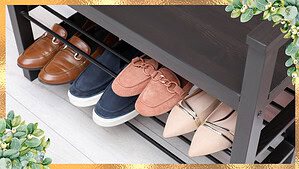
If you've ever stubbed your toe on a pile of shoes by the front door, you already know the problem. Shoes are one of those things that seem harmless on their own but take over a space faster than almost anything else in the house.
One pair by the door turns into three, then five, then a pile that somehow spreads across the entryway and halfway down the hall.
And the thing is, a messy shoe situation makes the whole house feel messier. Even if every other room is clean, a heap of shoes at the entrance sets the tone for the rest of the space.
In this post, I'm sharing 17 practical shoe storage ideas for entryways, closets, and bedrooms. Some of these are quick fixes you can set up today. Others are worth a small investment if you're ready to build something more permanent. Either way, there's something here for every space and every budget.
One thing to think about before you get started: not all shoes need the same kind of storage.
- The shoes you wear every day need to be easy to grab and put back.
- The shoes you only wear a few times a year can be stored away completely.
Once you separate those two groups in your mind, the right storage solution becomes a lot easier to choose.
17 Shoe Storage Ideas That Actually Work
Shoe storage works best when it uses vertical space, creates a clear home for each pair, and separates the shoes you wear every day from the ones you only pull out once in a while.
Here are 17 ways to make that happen.
1. Over-the-Door Shoe Organizer

The back of a door is some of the most overlooked storage space in a home.
An over-the-door shoe organizer hangs right over the door and holds anywhere from 12 to 24 pairs depending on the style. It keeps shoes visible, easy to grab, and completely off the floor.
This works especially well on the inside of a closet door or a bedroom door where floor space is tight.
2. Slim Shoe Rack for Tight Spaces
A slim shoe rack is one of the simplest solutions for a narrow entryway or a small closet. Look for a stackable or adjustable style so you can add tiers as your collection grows. The key is to measure your space before you buy.
A rack that's even a few inches too wide can block a door or make a hallway feel cramped.
3. Under-Bed Shoe Storage Bins

Flat, lidded bins that slide under the bed are perfect for shoes you don't reach for every day.
Off-season sandals, dressy heels, or shoes you only wear for special occasions can all live here.
The lids keep dust off, and since the bins are out of sight, they don't add any visual clutter to the room.
4. Under-Bed Rolling Shoe Organizer
This works the same way as regular under-bed bins, but the wheels make a real difference if your bed sits close to the floor or if you have trouble bending down.
You can roll the whole organizer out, find what you need, and slide it back without emptying everything out. If you have a small bedroom, this is worth the small upgrade in price.
5. Bench With Shoe Storage
A storage bench near the front door or in the bedroom pulls double duty in the best way.
You get a place to sit while putting your shoes on, and cubbies or a hidden compartment underneath to store the shoes themselves. It keeps everything in one spot and stops shoes from migrating to random corners of the room.
This is one of those pieces of furniture that genuinely earns its footprint.
6. Storage Ottoman With Partitions
A storage ottoman works like a bench but blends more naturally into a living room or bedroom.
The hidden compartment inside is great for shoes, and if you add small dividers or use individual bags to separate pairs, it stays tidy instead of turning into a jumbled pile.
Guests see a nice ottoman. You know it's holding six pairs of shoes.
7. Basket or Bin Per Family Member
If you live with other people, a labeled basket for each person near the door is one of the easiest systems to actually maintain.
Everyone drops their shoes in their own basket when they come in, and there's no sorting to do later. It's not the most space-efficient option, but it works because it's simple.
Simple systems get used. Complicated ones don't.
8. Rotating Shoe Carousel

A rotating shoe carousel spins vertically and fits neatly into a corner of a closet. It holds a surprising number of pairs in a small footprint and makes it easy to see everything at once without digging.
If you have a reach-in closet with a corner that's awkward to use, a carousel can turn that dead space into real storage.
9. Wall-Mounted Shoe Shelves or Floating Ledges
Floating shelves mounted low on the wall turn your shoes into something that almost looks like a display.
Each pair sits on its own ledge, the floor stays completely clear, and you can see everything at a glance. I've seen this done in entryways and bedrooms, and it looks intentional and tidy when the shoes are neatly placed.
It also makes getting dressed in the morning faster because nothing is buried or stacked.
10. Wall-Mounted Pegboard or Metal Rack System
A pegboard or a wall-mounted metal rack gives you a flexible system you can adjust as your shoe collection changes. You can add hooks, small shelves, or individual ledges wherever you need them.
This works especially well in a mudroom or a dedicated closet wall where you want to customize the layout over time without having to buy a whole new piece of furniture.
11. Use the Space Under the Stairs

If you have stairs in your home, the space underneath them is often completely wasted.
With a little planning, it can become one of the highest-capacity shoe storage zones in the house. Built-in pull-out drawers work beautifully here, but even a few freestanding shelves or rolling bins tucked into that space make a big difference.
It holds a lot of shoes without taking up any room that you'd actually use for something else.
12. Pull-Out Shoe Shelves or Drawers in the Closet
Deep closets are frustrating because shoes at the back get lost and forgotten. Pull-out shelves or shallow drawers solve this by bringing everything forward when you open them.
You can see the whole collection at once, grab what you need, and push it back in. If you're planning a closet upgrade, this is one of the most practical things you can add.
13. Adjustable Shelving
Fixed shelves are one of the most common reasons closets feel inefficient. Boots need tall clearance. Flats barely need any.
When your shelves can't adjust, you end up wasting a lot of vertical space.
Adjustable shelving lets you move things around as your shoe collection changes with the seasons. It's a small detail that makes a surprisingly big difference in how much you can actually fit.
14. Slanted Shoe Racks

Slanted shoe racks angle each pair slightly so the toe points down. This does two things: it gives you a better view of every pair so you can find what you're looking for faster, and it saves space because the shoes nest more closely together than they do on a flat shelf.
It also keeps shoes in better shape because they're not stacked on top of each other or crammed in sideways.
15. Acrylic Risers or Dish Risers to Double Shelf Space
This is a cheap trick that works surprisingly well.
A simple acrylic riser or even a basic dish riser from the kitchen section of a home goods store creates a second level on an existing shelf.
You can store one pair of flats on the riser and another pair underneath it on the shelf itself. It doubles the capacity of any shelf you already have without adding any new furniture.
16. Clear Shoe Boxes With Drop-Front Openings
Clear shoe boxes protect your shoes from dust and keep them easy to identify. The drop-front style is the most convenient because you can pull out a single pair without unstacking the whole tower.
These work especially well for shoes you want to keep in good condition but don't wear every week. Stack them in the closet, and you'll be able to see and access every pair without any digging.
17. Seasonal Shoe Cycling

This last one isn't a product. It's a habit, and it might be the most useful idea on this list.
The idea is simple: at the start of each season, you swap out what's stored and what's accessible. Winter boots and heavy shoes go into the main area in fall. Sandals and lighter shoes get stored away in bins or boxes.
When spring comes, you swap again.
When you only keep the shoes you're actually wearing right now within easy reach, your storage system stays calm and manageable. You're not trying to fit every pair you own into one spot. You're just making room for what you actually need this month.
I started doing this a few years ago and it made a bigger difference than any organizer I've ever bought.
Pick One Corner and Start Today
You don't need to overhaul your entire shoe situation at once.
The formula is straightforward: use vertical space on doors and walls, hide what you can in benches and ottomans, take advantage of the space under your bed and under your stairs, and rotate your shoes with the seasons so you're never trying to manage more than you actually need.
Pick one zone today. Your entryway or your closet floor is usually the best place to start because that's where the daily pile-up happens.
Choose two ideas from this list that fit your space and your budget, and get those in place before you tackle anything else.
A little order in one corner can shift how the whole house feels.
Stop Starting Your Morning by Looking for the Right Pair

Mornings feel different when your shoes are where they're supposed to be. No digging, no mismatched pairs, no tripping over a pile on the way out the door.
My Free Declutter for Self Care Checklist is a simple, step-by-step guide to help you clear the clutter room by room, including the spots where shoes, bags, and daily items tend to pile up. If you've been meaning to get things organized but aren't sure where to start, this is for you.
Frequently Asked Questions
What are the best shoe storage ideas for small spaces?
For small spaces, focus on storage that goes up instead of out. Over-the-door organizers, wall-mounted floating shelves, and slim stackable shoe racks all keep shoes off the floor without taking up much room. Under-bed bins are another strong option for shoes you don't need every day. The goal is to get shoes off the floor and out of the walkway without cramming everything into one overloaded spot.
How do I organize shoes in a small closet?
Start by pulling out everything and separating your everyday shoes from the ones you wear rarely. Store the rarely worn pairs in clear boxes or under-bed bins, and keep only current-season shoes in the closet. From there, add a slanted rack or adjustable shelving to make better use of the vertical space you already have. Pull-out shelves are worth considering if your closet is deep and things tend to get lost at the back.
What is the best shoe storage for an entryway?
A storage bench with cubbies underneath is one of the best options for an entryway because it handles two jobs at once. If space is very tight, a slim shoe rack or a basket system with one bin per family member works well too. The most important thing in an entryway is that the system is easy to use quickly. If it takes more than two seconds to put shoes away, people won't do it consistently.
How do I store off-season shoes?
Off-season shoes store best in clear drop-front boxes, lidded bins, or vacuum-sealed bags if they're bulky. The clear boxes are especially useful because you can see what's inside without opening anything. Store them under the bed, on a high closet shelf, or in a low-traffic area. Before you put them away, wipe them down and make sure they're dry so they stay in good condition until you need them again.
What is the best way to store expensive shoes?
Expensive shoes do best in individual clear boxes where they're protected from dust and won't get scuffed by other pairs. If the shoes came with their original box, that works too. Stuff them lightly with tissue paper to help them hold their shape, and keep them somewhere with stable temperature and low humidity. Avoid stacking heavy items on top of them, and check on them once or twice a year to make sure nothing has shifted or deteriorated.
Follow me elsewhere!