I've lived in small spaces most of my adult life. And for a long time, I thought the problem was square footage.
That if I just had one more room, one more closet, one more corner to tuck things into, everything would finally feel organized.
But that wasn't it.
Over time, I realized that the real problem was that I had storage space I wasn't using. Space above my doors, under my bed, on the backs of cabinet doors, in the awkward gap beside my refrigerator.
It was all just sitting there while I kept buying more bins and wondering why nothing felt organized.
But, once I started paying attention to the space I already had, things changed pretty quickly.
In this post, I'm sharing 7 storage ideas that work especially well in small homes and apartments.
These aren't about buying a lot of new stuff.
They're about using what you already have more wisely, freeing up your floors, and making your space feel calmer and easier to live in.
7 Storage Ideas That Make a Small Space Feel Bigger
Storage in a small home works best when it's vertical, hidden, and easy to maintain. Not when it adds more stuff to an already crowded room.
These ideas focus on using space you already have, without turning your home into a storage unit.
1. Go Vertical With Slim Shelves, Floating Cabinets, and Wall Storage
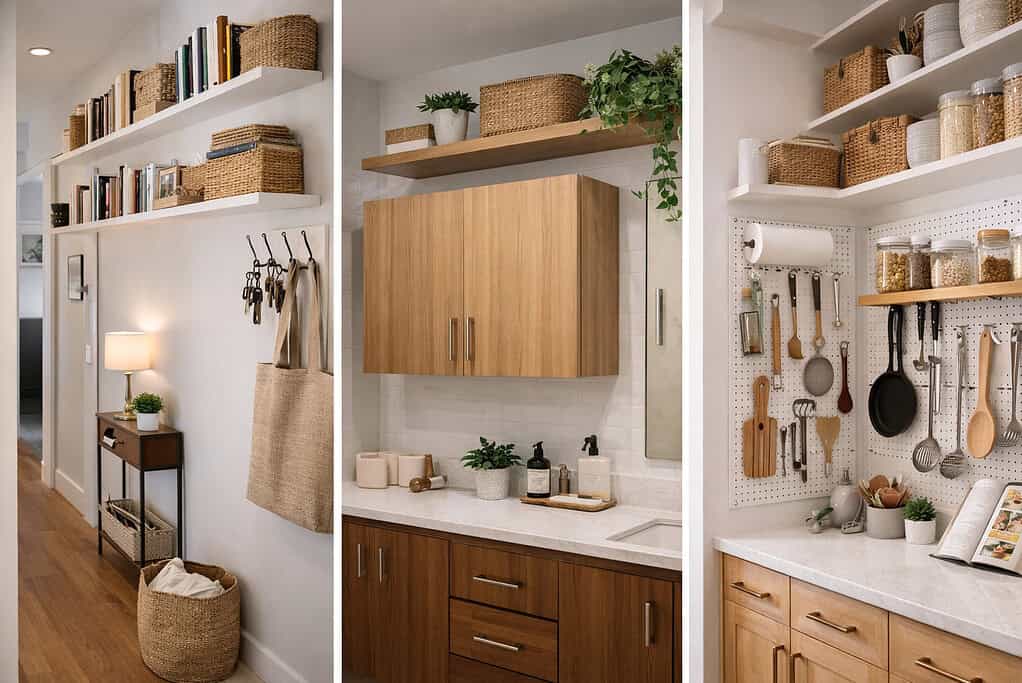
Most of us store things at eye level and below. But the space above eye level, all the way up to the ceiling, is usually completely empty.
That's some of the most valuable storage space in a small home, and it costs nothing to start using it.
Slim wall shelves are one of the easiest and most affordable ways to do this. They don't stick out far into the room, so they don't make the space feel crowded, but they give you a real place to put things.
I put a row of slim shelves along one wall in my hallway and used them for books, small plants, and a few baskets. It cleared a surprising amount of clutter off my counters without making the hallway feel smaller.
Floating cabinets work well in bathrooms and kitchens where counter space is tight. They keep things off the counter but close enough to grab easily.
Wall hooks and pegboards are another option worth trying, especially for things you use every day. Coats, bags, keys, dog leashes, kitchen tools. When those things have a spot on the wall, they stop piling up on chairs and counters.
One tip that made a big difference for me is to use baskets on open shelves instead of storing items individually.
When your eye lands on a shelf and sees one basket instead of twelve random objects, the whole room feels calmer. It's a small thing, but it works.
2. Choose Double-Duty Furniture That Earns Its Footprint
In a small space, every piece of furniture takes up room. So when a piece only does one job, it's not really earning its place.
Double-duty furniture changed how I think about what I bring into my home. A storage bench at the foot of the bed holds extra blankets, seasonal throws, and things I don't need every day. It also gives me a place to sit while putting on shoes.
A coffee table with a lift-top or drawers underneath keeps remotes, chargers, and magazines out of sight without adding another piece of furniture to the room.
Storage ottomans are another great option. They work as extra seating, a footrest, and a place to tuck away toys, linens, or whatever tends to pile up in your living room.
The key is to think before you buy. When you're shopping for a new piece of furniture, ask yourself whether a version with built-in storage exists. Most of the time, it does, and it doesn't cost much more than the version without it.
3. Treat Under-Bed Space Like a Bonus Closet
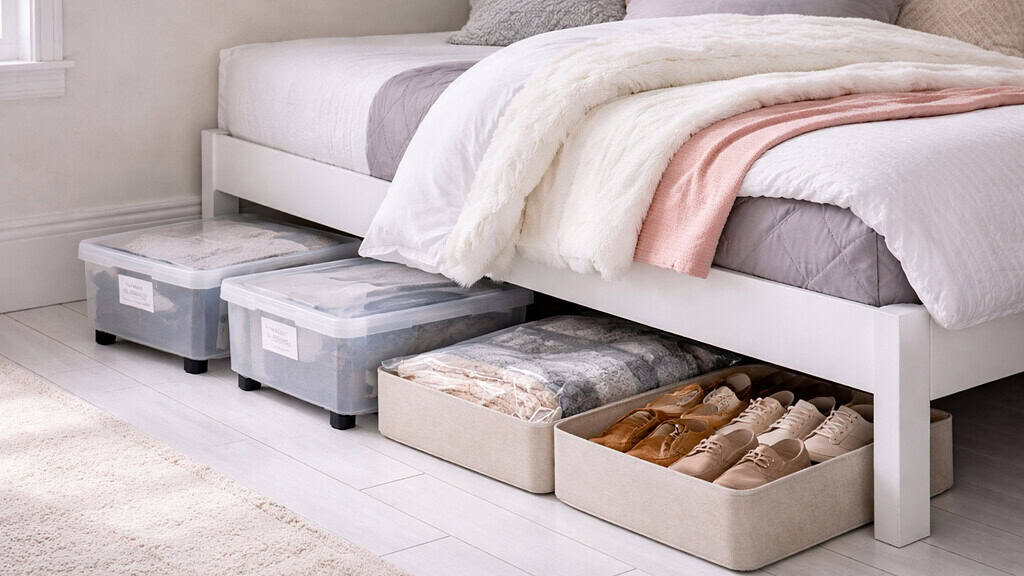
The space under your bed is one of the most underused spots in a small home. It's out of sight, it doesn't change how your room looks, and depending on your bed frame, you may have a surprisingly large amount of space down there.
I use the space under my bed for things I need but don't reach for every day. Off-season clothes, an extra set of sheets, a pair of shoes I only wear to church.
Rolling bins with lids work really well because you can slide them in and out without getting on the floor. Flat storage drawers are another option if your bed sits low. And if you're storing fabric or clothing, vacuum-sealed bags are a great way to compress bulky items so you can fit more in the same amount of space.
If your current bed frame doesn't leave much room underneath, bed risers are an inexpensive fix. A few inches of extra height can make a real difference in how much you can store.
One thing to keep in mind: treat this space like any other storage area. Don't just shove things under there and forget about them. Use bins with labels so you know what's where, and go through it a couple of times a year to make sure you're not storing things you no longer need.
4. Use the Dead Space You're Already Paying For
Dead space is the space in your home that exists but isn't being used for anything. The narrow strip of wall beside the bathroom door. The gap between the refrigerator and the wall. The toe-kick space under your kitchen cabinets. The wall above every doorframe in your house.
These spots feel too awkward to do anything with, so most people ignore them. But they add up to more usable space than you might think.
Toe-kick drawers are one of my favorite solutions.
The space between the bottom of your kitchen cabinets and the floor is usually just empty. Shallow pull-out drawers built into that space are perfect for flat items like baking sheets, cutting boards, or placemats.
The gap beside your refrigerator can fit a slim pull-out pantry cart. These roll out when you need them and slide back in when you don't. I found one at a home goods store for under thirty dollars and it holds canned goods, cooking oils, and spice jars that used to crowd my counter.
The space above doorframes is great for things you need occasionally but not often.
A small shelf above a door can hold extra paper towels, gift wrap, seasonal decor, or anything else that needs a home but doesn't need to be within easy reach.
5. Turn Awkward Nooks Into Micro-Zones So Clutter Stops Migrating
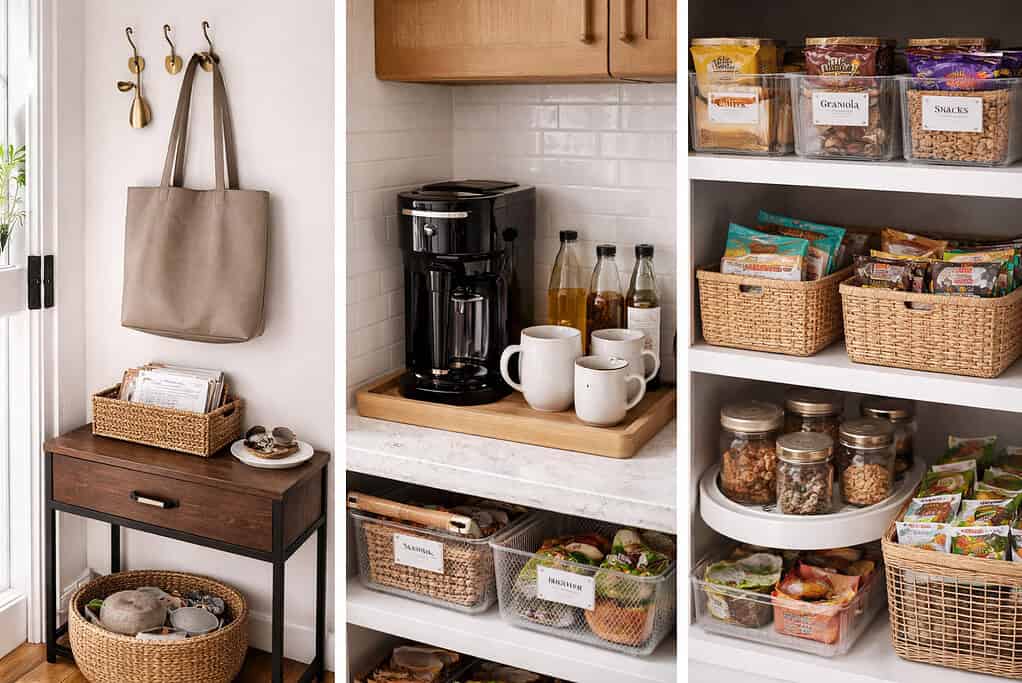
Clutter tends to pile up in the same spots over and over again. The corner of the kitchen counter. The little table by the front door. The space beside the couch.
And most of the time, clutter builds up in those spots because there's no clear system for what belongs there.
Micro-zones fix that.
A micro-zone is just a small, dedicated setup for one specific category of things. A coffee station on one corner of the counter. A mail zone near the front door. A snack zone in the pantry. A cleaning zone under the sink.
The setup doesn't have to be elaborate. All you need is one shelf or surface, two or three bins or baskets, and a label so everyone in the house knows where things go. When something has a clear home, it stops migrating to the nearest flat surface.
I set up a small mail zone on a narrow shelf near my front door. It has one basket for incoming mail, one small tray for keys and sunglasses, and a hook for my everyday bag.
It took about fifteen minutes to put together, and my kitchen counter has stayed clear ever since.
The pantry is another good place to try this. Instead of organizing by food type, try organizing by how you use things. A coffee and tea zone. A baking zone. A snack zone for things you grab in a hurry.
When everything you need for one task is grouped together, you spend less time searching and less time putting things back in the wrong place.
6. Make Doors Work Harder With Over-the-Door Storage
The backs of your doors are almost always empty. And in a small space, that's a lot of wasted room.
Over-the-door organizers are one of the easiest storage wins because they require no drilling, no installation, and they don't take up a single inch of floor space.
They work well on pantry doors for extra food or cleaning supplies, on bedroom doors for scarves, belts, and accessories, and on bathroom doors for toiletries and hair tools.
The most important thing to remember with over-the-door storage is to keep it organized by category.
One pocket for cleaning supplies. One section for hair accessories. One row for snacks. If you just start filling pockets randomly, it turns into a jumbled mess that's harder to use than no organizer at all.
Also, not all over-the-door organizers fit every door.
Before you buy one, check the thickness of your door and the clearance needed to close it properly. Most organizers are designed to work with standard doors, but it's worth double-checking before you bring one home.
7. Use Hidden but Pretty Storage to Reduce Visual Clutter
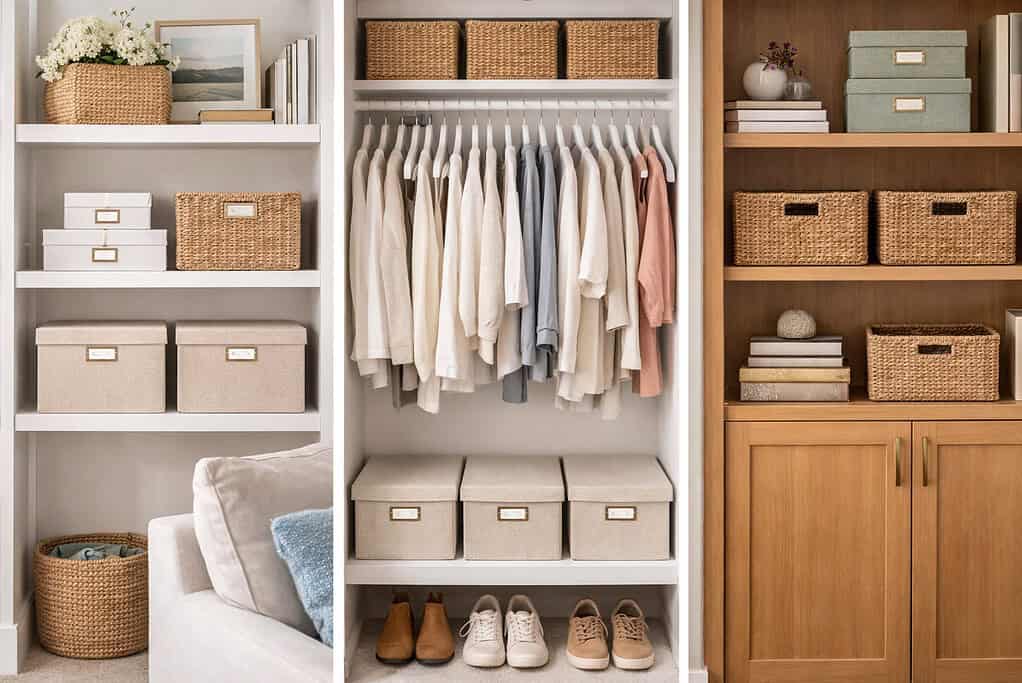
In a small space, what your eye sees matters just as much as how much you can fit.
A room full of visible clutter feels smaller and more stressful, even if everything technically has a place. That's where hidden storage comes in.
The idea is simple. Instead of storing things on open shelves where everything is visible, you use containers, baskets, and closed cabinets to hide the everyday mess while keeping things easy to access.
Matching baskets on upper shelves is one of my favorite tricks. Instead of storing miscellaneous items directly on the shelf where they create visual noise, you put them in baskets that all look the same.
From across the room, your eye sees a row of neat baskets, not a pile of random objects. It looks intentional, and it makes the whole room feel more pulled together.
The same idea works with decorative boxes on bookshelves, lidded bins in closets, and closed cabinet doors in the living room or bedroom. Anything that keeps small, cluttered items out of sight without requiring you to reorganize your whole home.
One rule I follow for open storage: if it's going to be visible, it should be grouped and contained. A collection of small things sitting loose on a shelf always looks messy. Those same things inside one basket look fine.
Small Space Storage Doesn't Have to Be Complicated
The homes that feel organized and calm aren't always the biggest ones. They're the ones where everything has a place and the floor is clear.
If you take nothing else from this post, remember this: go up before you go out. Use your walls, your doors, and the space above your head. Look for the dead zones you've been ignoring. And when you bring in storage solutions, make sure they're hidden, double-duty, or both.
You don't have to tackle all seven of these ideas at once. Pick one spot today. Maybe it's the space under your bed, or the back of your pantry door, or one wall that's been empty for years. Start there, get it working, and then move to the next one.
Small changes in a small space go a long way.
Ready to Stop Tripping Over Clutter in Your Small Space?

When storage feels overwhelming, the hardest part is usually knowing where to begin. My Free Declutter for Self Care Checklist helps you cut through the pile-up one small step at a time, so you can actually start using the storage solutions in this post without feeling like you have to do everything at once.
Inside, you'll find a simple room-by-room guide to help you decide what stays, what goes, and where things should live so they stop migrating back to your counters and floors.
Frequently Asked Questions
What are the best storage ideas for small spaces?
The most effective storage ideas for small spaces focus on three things: going vertical, using double-duty furniture, and making use of space you're already ignoring. Slim wall shelves and floating cabinets move storage off the floor and up the wall. Furniture with built-in storage, like ottomans and coffee tables with drawers, gives you more without taking up more room. And the space under your bed is one of the most underused storage zones in most homes.
How do I maximize storage in a small bedroom?
Start with the space under your bed. Rolling bins, flat storage drawers, and vacuum-sealed bags can hold off-season clothes, extra bedding, and shoes without changing how the room looks. Wall shelves above the dresser or beside the door give you more surface space without eating up floor space. And if your dresser or nightstand doesn't have much storage, consider replacing it with a piece that does.
What storage works best for renters?
Over-the-door organizers, wall hooks, and freestanding shelving units are all great options for renters because they don't require drilling or permanent installation. Command hooks can hold a surprising amount of weight and come off cleanly without damaging walls. Freestanding bookcases and shelving carts give you vertical storage you can take with you when you move.
How do I reduce visual clutter in a small space?
The quickest way to reduce visual clutter is to group small items into containers instead of storing them loose on shelves. Matching baskets on open shelves, lidded bins in closets, and decorative boxes on bookshelves all hide everyday mess while keeping things accessible. Closed storage, like cabinets and drawers, does the same thing. The less your eye has to process when you walk into a room, the calmer the space will feel.
What should I store under the bed?
Under-bed storage works best for things you need occasionally but not every day. Off-season clothing, extra blankets and pillows, shoes you don't wear often, and spare bedding are all good options. Use bins with lids to keep things dust-free, and add labels so you're not pulling everything out to find what you need.
Follow me elsewhere!

