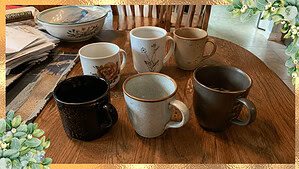
I opened my kitchen cabinet one morning and a mug nearly fell out on me.
I caught it just in time. And when I really looked at that shelf, I had to laugh. Mugs stacked two deep, tipped sideways, crowded onto every inch. I counted them later. Twenty-eight coffee mugs, for a house with two people in it.
There was the one from our trip to the Grand Canyon. A “World’s Best Grandma” one my granddaughter picked out. A couple from a bank that stopped handing them out years ago. A snowman mug that only makes sense in December. And three or four in the back I’d completely forgotten I owned.
Here’s what got me, though.
Out of all those mugs, I drink from the same two every single day. (yup, only two)
That’s the trouble with mugs. They’re so easy to collect and so hard to let go of. Every one seems to carry a little memory, or came from someone I care about, so getting rid of even one felt like tossing out the person or the moment along with it.
But a cabinet with twenty-eight mugs and two favorites isn’t really holding my memories. It’s holding clutter. And every morning, it was making the simple act of reaching for a cup harder than it needed to be.
So I finally dealt with it. And it turned out I could keep the few that truly mattered to me and clear out the rest without any guilt at all.
Learning how to declutter coffee mugs really came down to telling the difference between a mug I loved and a mug I’d just been storing.
Let me walk you through what I did.
Why We End Up with So Many Mugs in the First Place
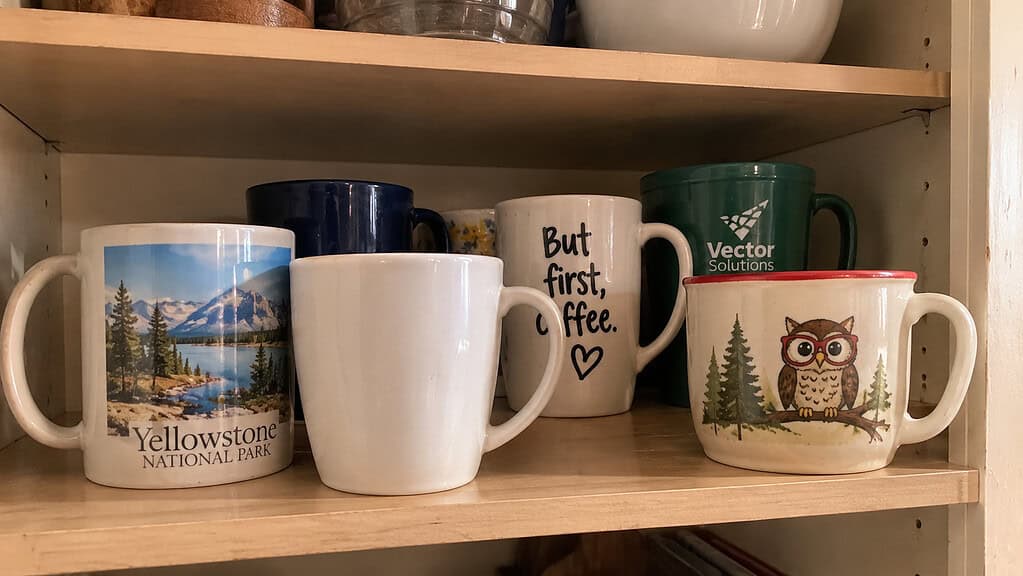
I didn’t set out to collect mugs. Nobody does. They just arrive.
Some come as gifts. A grandchild picks one out with a sweet saying on it, and now you have it forever. Some are souvenirs, brought back from a trip because a mug is a cheap, easy thing to buy on the way out of a gift shop. Some were free, from a bank, a car dealer, a charity walk. And some I bought myself, on a whim, because it was pretty or on sale or had a saying I liked that day.
Mugs pile up faster than any other dish in the house. And I think there’s a real reason for that.
You can only own so many dinner plates before it feels silly. But a mug feels different. A mug feels personal. It holds your morning coffee, your afternoon tea, the cocoa you drink when you can’t sleep. So each one starts to feel less like a dish and more like a little friend.
That’s the emotional side, and it’s real. But there’s a plain, practical side too. Mugs are small, so they don’t seem like much on their own. One more mug never feels like a problem. You just tuck it onto the shelf.
Until one day you open the cabinet, and there’s no room left, and you can’t remember where half of them even came from.
None of this means you did anything wrong. Mugs are sneaky that way, and they’re a little sentimental on top of it, which makes them one of those things we hold onto without meaning to. If you’ve ever wondered why certain objects feel so hard to release, it helps to understand the real reasons we can’t let go of clutter. Once I saw what was going on, sorting through my own mugs got a lot easier.
How to Sort Through Your Coffee Mugs Without the Guilt
Here’s exactly what I did with my cabinet of twenty-eight. It took me less than an hour, and I didn’t feel bad about a single mug by the end.
Pull Every Mug Out and See What You Actually Have
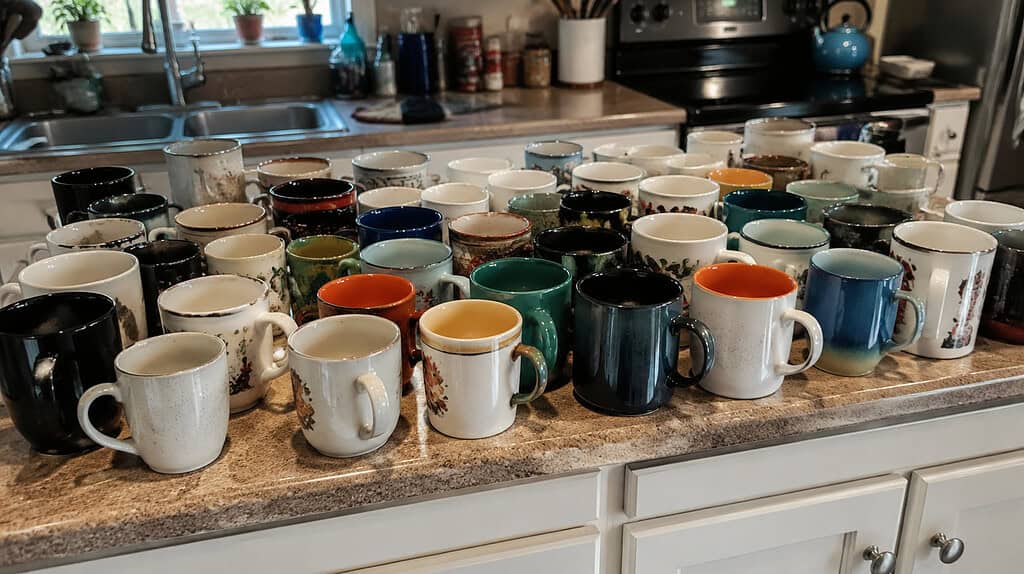
The first thing I did was take every last mug out of the cabinet and line them all up on the counter.
This step matters more than it sounds. When they’re crammed in the cabinet, you never really see them. You just grab from the front and forget the rest. But lined up on the counter, all together, you finally see the truth of it.
I was a little shocked. Twenty-eight mugs, out in the open, looked like a lot. Some I hadn’t touched in years. A few I didn’t even recognize.
Seeing them all at once made the whole thing real. It’s the same idea behind a good kitchen declutter, which works best when you can see everything you own instead of guessing. You can’t make a good decision about a mug you forgot you had.
Notice Which Ones You Reach for Every Day
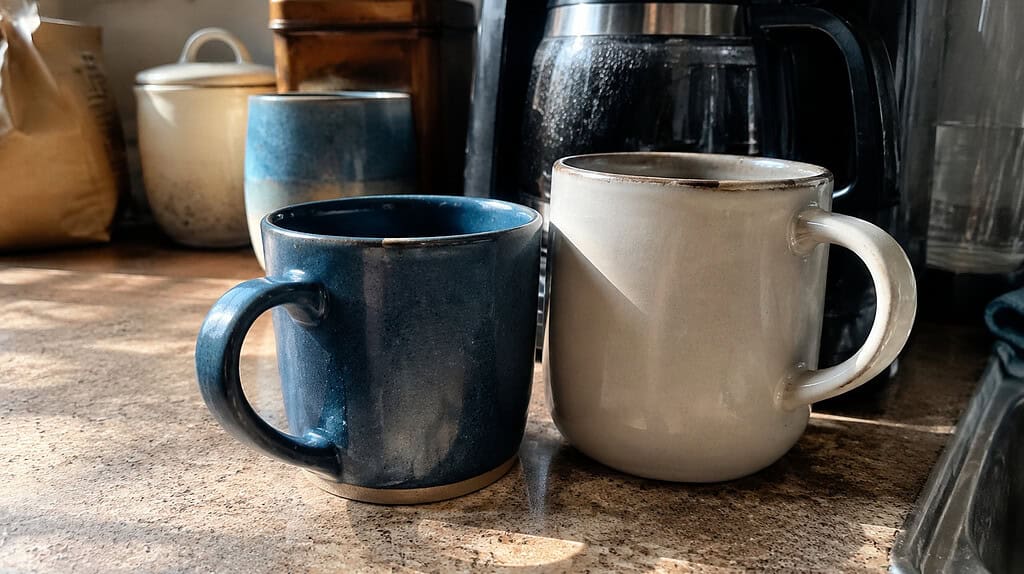
Standing there looking at all of them, I asked myself a simple question. Which of these do I actually use?
The answer was easy, and a little embarrassing. Two. My favorite blue one, and a bigger one for when I want more coffee. That’s it. Those two do all the work, day in and day out.
Maybe you have four, or six. That’s fine. The point is to notice the ones your hand goes to on its own, without thinking.
Those are your real mugs. Everything else is just keeping them company on the shelf.
Be Honest About the Chipped and Stained Ones
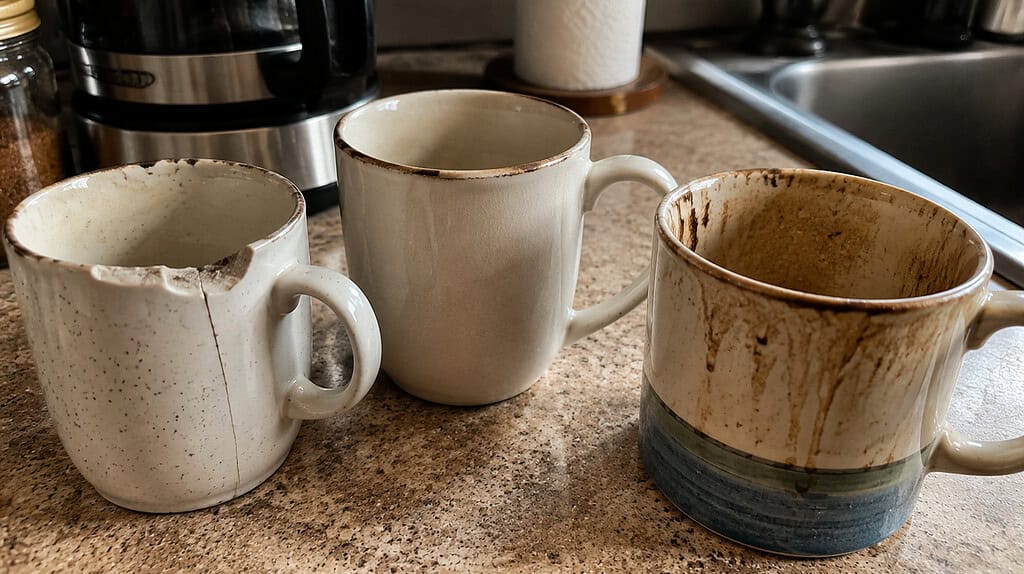
This next part is where a little honesty goes a long way.
As I looked at my lineup, I noticed a good number of them were past their best.
A chip on the rim. A crack running down the side. Coffee stains cooked in so deep no amount of scrubbing was ever going to lift them. One had a handle that had been glued back on years ago and I never quite trusted again.
I’ll be honest, I don’t know why I was keeping those.
A chipped or cracked mug isn’t holding a memory. It’s just worn out. Letting those go isn’t sad at all, it’s practical, and it clears space for the ones you actually love. So the broken and stained ones went straight into the “let go” pile without a second thought.
Keep the Few That Truly Hold a Memory
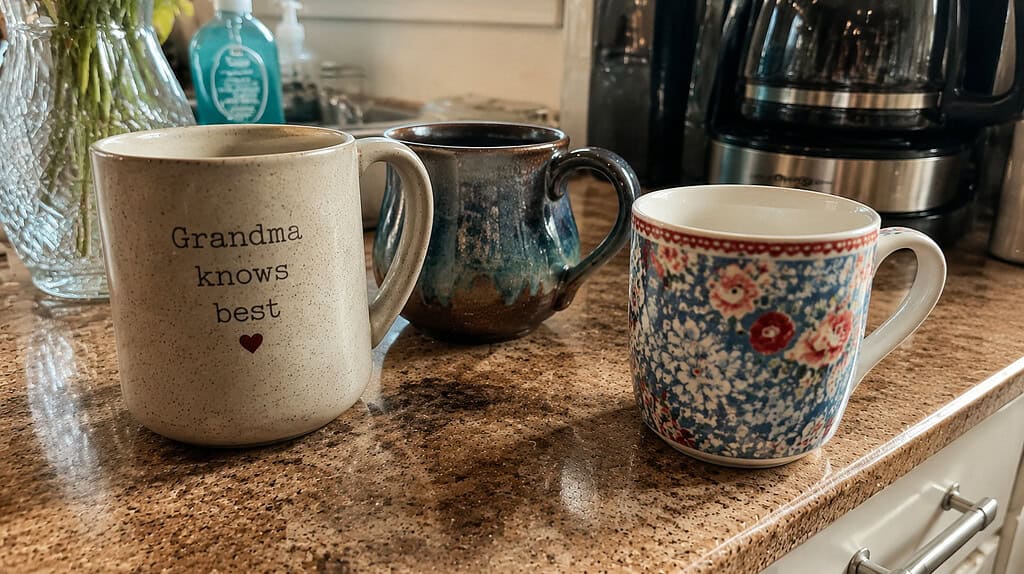
Now for the tender part, and the one that stops most of us.
Some mugs really do hold a memory. The “World’s Best Grandma” one my granddaughter chose with her own little hands. A mug my late sister gave me one Christmas. These aren’t clutter. These are keepsakes, and they earn their place.
So I kept them.
But here’s the thing I had to be honest with myself about.
A true keepsake mug is rare. It’s the one or two that bring a real person or moment right back to you. It is not every souvenir from every trip, or every mug anyone ever handed you.
I let myself keep a small handful of genuine keepsakes, the ones with a real story. For the rest of the sentimental ones, the ones that were nice but not truly special, I found it easier to let them go once I remembered that the memory was never really in the object. It’s in me. A mug leaving my cabinet doesn’t take my sister or that Christmas with it.
Take a Photo of the Ones You’re Ready to Release
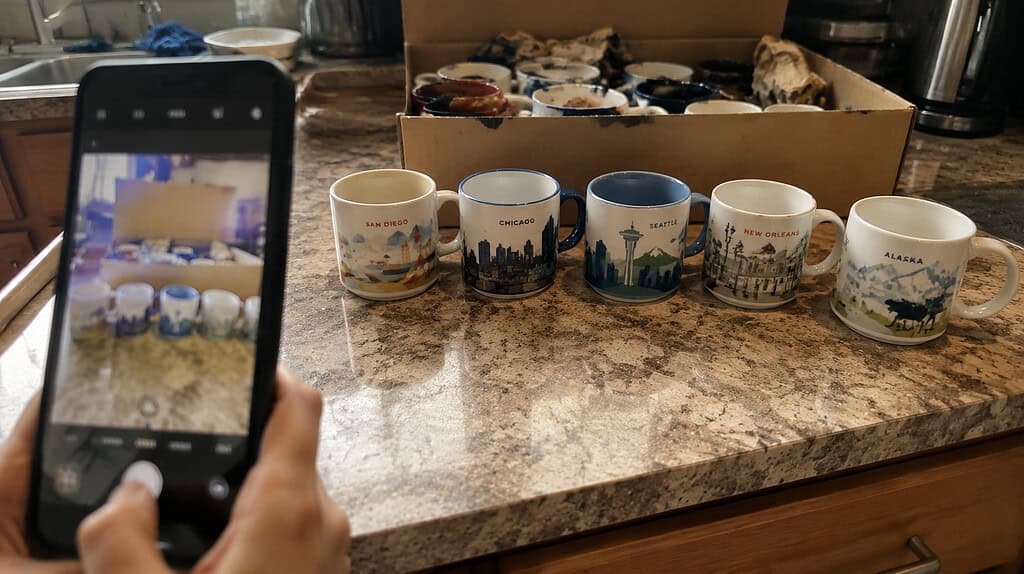
For the mugs that had a little sentimental pull but weren’t quite keepers, I used a trick that makes letting go so much easier.
I took a picture of them first.
I lined up the souvenir mugs from our trips and snapped a photo before they went in the donate box. Now I have the memory of that Grand Canyon trip in my photos, where it takes up no room at all, instead of a dusty mug in the back of a cabinet I never reached for.
It sounds almost too simple, but it works. The photo keeps the memory. The shelf gets the space back. And I get to remember the trip without storing a mug I was never going to drink from.
Decide How Many Mugs Your Life Actually Needs
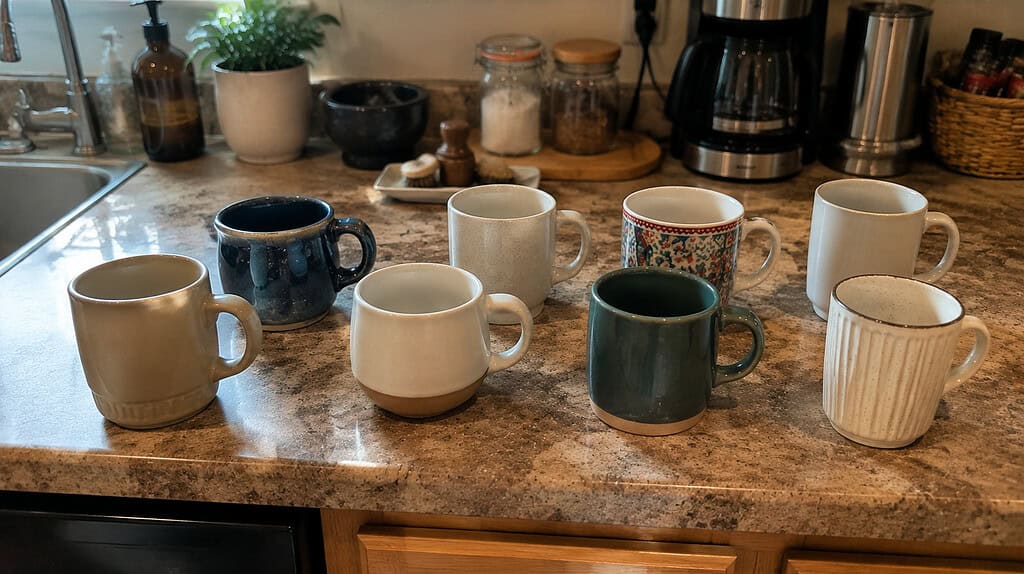
Before I put anything back, I decided on a number.
I thought about it plainly. Two of us live here. How many mugs do we truly need, even counting company? I landed on eight. Our few daily favorites, a couple of nice ones for guests, and one or two real keepsakes. Eight felt honest and roomy.
Your number might be different, and that’s fine. A big family that hosts a lot might land at twelve. Someone living alone might be happy with four. There’s no perfect answer, only the honest one for your life.
Picking a number ahead of time made the rest of the sorting simple.
Once I had my eight, everything else was just extra, and the deciding got much quieter. If it helps to have a few good questions to guide those calls, these honest decluttering questions are the ones I lean on.
Where to Send the Mugs You’re Letting Go
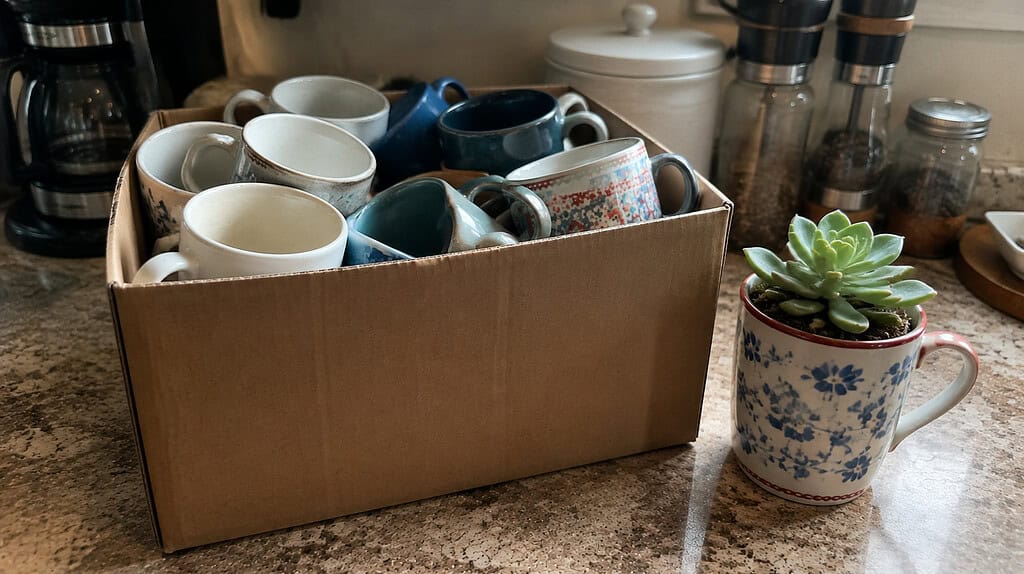
Once I had my “let go” pile, I didn’t just dump it all in the trash. Most of those mugs still had good life left in them, and there are better places for them to go.
Good mugs in good shape are easy to donate. Thrift stores almost always take them, and mugs are one of the things they can reliably sell. A local shelter, a church, a community center, or a food pantry may welcome them too, since sturdy mugs always get used. If you like knowing your things will actually be wanted, there are meaningful places to send your belongings after a declutter.
You can also pass a special one to a person who’d smile at it. I gave a gardening-themed mug to a friend who loves her flowers, and she was tickled to have it.
If a mug is truly special but you don’t drink from it, you can give it a new job instead of storing it. A pretty mug makes a good little planter for a succulent, a holder for pens on a desk, or a spot for buttons, hair ties, or paper clips.
That way it’s out where you see it, doing something useful, not hidden in a cabinet.
And the broken ones? The chipped, cracked, glued-together mugs go in the trash, and that’s alright. Most ceramic mugs can’t go in your regular recycling bin, so don’t feel guilty tossing the ones that are genuinely worn out. They served their purpose.
What You Really Keep When the Mugs Go
When I was done, I put eight mugs back into a cabinet that used to hold twenty-eight.
I won’t lie, opening that cabinet now makes me happy. There’s room. Nothing falls out. I can see every mug I own, and every one of them is either a favorite I use or a keepsake I love. Nothing in there is just taking up space anymore.
And when it was all done, one thing stood out above the rest.
Not one memory left with those mugs I let go.
My sister is still with me every time I use her mug. The Grand Canyon is still in my photos, and in my head, clear as ever. My granddaughter still picked out that silly “World’s Best Grandma” mug, and it still sits right up front where I see it every morning.
Letting the extra mugs go didn’t take any of that away. It just cleared out the ones that were never really about a memory in the first place.
That’s the part worth holding onto. The love and the memories were never in the mugs. They’re in you, and they stay with you no matter how many cups are in the cabinet.
So keep the few that make you smile. Use your favorites every day. Pass the good extras along to someone who’ll enjoy them. And let yourself have a cabinet you can open without catching anything.
A shelf with a little breathing room is a small thing. But it’s a small thing you’ll feel every single morning.
Ready to Clear More Than Just the Mugs?

If the mug cabinet was only the start, and you can feel how many other spots in your home are asking for the same attention, I made something to help you keep that good feeling going.
It’s my free Declutter for Self Care Checklist. It takes the whole house and breaks it into small, doable pieces, so you never have to face it all at once. It’s made for real kitchens and real closets, the kind with memories tucked into them, and it goes at a pace that feels kind instead of rushed.
You already know how good that clear cabinet felt. This just helps you find that feeling in one room after another.
FAQ
How many coffee mugs does one person really need?
There’s no single right number, but most people find they need far fewer than they own. A good approach is to count your daily favorites, add one or two for guests, and keep only your genuine keepsakes on top of that. For many households, somewhere between four and eight mugs per person covers everything comfortably. The honest test is simple: if you haven’t reached for a mug in a year, you probably don’t need it.
Can you recycle old coffee mugs?
Usually not in your regular curbside bin. Most coffee mugs are made of ceramic or stoneware, which standard recycling programs don’t accept, and the same is true for many glass mugs. Mugs in good shape are much better donated so someone else can use them. For broken, chipped, or cracked mugs, the trash is normally the right spot, though you can also repurpose a special one as a planter or a holder for small items.
What should I do with sentimental coffee mugs?
Keep the few that truly bring a person or a moment back to you, and let those be genuine keepsakes you use or display. For the ones that carry only a little sentiment, take a photo before letting them go, so you keep the memory without keeping the clutter. Remember that the memory lives in you, not in the mug. Giving a meaningful mug to someone who’ll love it can also feel much better than storing it out of sight.
Where can I donate used coffee mugs?
Thrift stores are the easiest option, since mugs are something they can almost always sell. Beyond that, local shelters, churches, community centers, senior centers, and food pantries often welcome sturdy mugs, because they get used constantly. Office break rooms and community gardens sometimes take them too. Just make sure any mug you donate is clean and free of chips or cracks, so it’s genuinely useful to whoever receives it.
How do I declutter mugs without feeling guilty?
Start by reminding yourself that a crowded cabinet of unused mugs isn’t honoring anyone, it’s just taking up space. Keep your daily favorites and a small handful of real keepsakes, photograph the ones with light sentimental value, and donate the good extras so they go on to be used. Knowing your mugs will be wanted by someone else turns the guilt into something warm. The memories stay with you, whether or not the mug stays in the cabinet.
Follow me elsewhere!

