
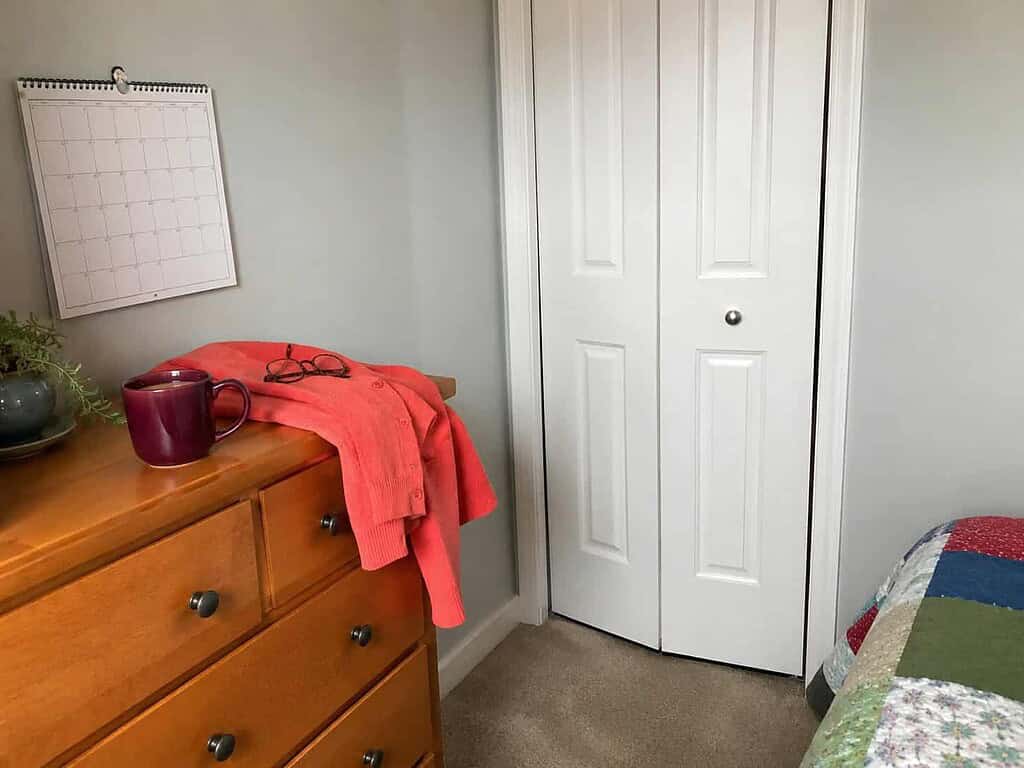
There's a closet in my bedroom I avoided for the better part of a year.
Every time I opened it, I told myself the same thing. Not today. When I have a whole free weekend. When I have more energy. When I can do it right.
So I'd shut the door and walk away.
The funny thing is, I'm not a lazy woman. Never have been. I raised a family and kept a clean house and rarely left a dish in the sink overnight (my mother trained that into me early). If anything, my problem was the opposite of lazy.
My problem was that I wanted it perfect. And if I couldn't do the whole closet, sorted and folded and beautiful in one sitting, I didn't want to start at all.
Weeks went by. Then months. The closet stayed exactly as messy as it was, and I felt worse about it every time I passed by.
It took me a long while to see what was really going on. I wasn't putting it off because I didn't care. I was stuck in something that has a name. They call it decluttering paralysis, and it happens to careful, capable women more than anyone would guess.
If you've ever stood in a doorway, looked at a job, and walked away because you couldn't do it all the way, please stay with me.
You're not lazy either. You might just be holding yourself to a standard that was never going to let you begin.
The Perfect Time Never Comes
For the longest time, I really believed the right moment was coming.
I'd get to that closet when the calendar cleared. When I had a full Saturday with nothing else on it. When I felt rested and in the mood and ready to do it properly, start to finish.
But that perfect day never actually showed up.
Some weekends I had the time but not the energy. Other days I had the energy, but the grandkids were coming, or there was a doctor's appointment, or I just wanted to sit with my coffee and not work.
There was always a reason. And every reason felt fair on its own.
Looking back, I can see I wasn't really waiting for the perfect time. I was putting it off and calling it planning. The wait felt responsible. It felt like I was being smart, holding out for the right conditions.
But the conditions were never going to be right. There is no perfect weekend. There is no day when the house is quiet, the body is rested, and the mood is just so, all at the same time.
While I waited for that day, the mess sat there and waited too. (It was very patient.)
Where “It Has to Be Perfect” Comes From

I had to ask myself where the “perfect or nothing” idea even came from. And the answer went back a long way.
I was raised by a mother who kept an immaculate home. The counters were always clear. The beds were always made, corners tucked tight. You could drop by unannounced and the house was ready for company.
I learned early that a clean home was something to be proud of. That how your house looked said something about who you were.
That training served me well for years. It made me capable and tidy and organized, and I'm grateful for a lot of it.
But it came with a hidden cost.
Somewhere along the way, “do it well” turned into “do it perfectly or don't bother.” A made bed wasn't good enough unless the corners were just right. A cleared counter didn't count if one drawer behind it was still a mess.
The standard I'd been given was company-ready or nothing. And carrying that standard into my later years, into a body with less energy and a house full of decades of things, it stopped helping me. It started freezing me.
Part of getting unstuck was learning to quiet that voice in my head, the one that whispered it wasn't worth doing unless I could do it flawlessly. (She meant well, that voice. She was just wrong.)
How All-or-Nothing Keeps the Clutter

The part that took me the longest to understand was this.
The higher I set the bar, the less I actually got done.
You'd think it would work the other way. You'd think high standards would mean a spotless house. But when perfect is the only outcome you'll accept, your mind takes one look at the whole job and freezes.
It's too big. There's too much. You can't see where to even start, because starting small feels pointless when the goal is a flawless, finished room.
So you do nothing. And nothing keeps the clutter right where it is.
I think this is why some of the tidiest, most capable women I know have the fullest closets and the most crowded spare rooms (mine included, for years). It isn't because they don't care. It's because they care so much that anything less than perfect feels like failure.
And failure is a scary thing to walk toward. So we don't walk toward it at all.
The all-or-nothing rule promises a beautiful result. What it actually delivers is a closed door and a growing pile behind it.
Once I saw that clearly, I couldn't unsee it. My high standards weren't keeping my house clean. They were the very thing keeping it cluttered.
The Shift That Finally Got Me Started

So what finally changed?
Not a burst of energy. Not a free weekend that magically appeared. What changed was the rule I was using. I traded “perfect or nothing” for something a lot kinder, and a lot more doable.
The first time I actually managed to declutter my closet, it wasn't pretty and it wasn't complete. But it was started. And started, I learned, is the whole ballgame.
Here are the four shifts that got me there.
Done Is Better Than Perfect

I wrote those four words on a sticky note and put it where I'd see it (taped to the closet door, fittingly).
Done is better than perfect. Not because perfect is bad, but because perfect was never actually on the table. My choices were never “perfect closet” or “messy closet.” They were “messy closet” or “a little better than it was.”
Once I let go of finished-and-flawless as the goal, I could pick up a single task and do it. Fold five shirts. Fill one bag for donation. Clear one shelf.
None of it was perfect. All of it was done. And done, it turns out, actually changes the room. Perfect just lives in your head.
Shrink the Job Until It's Almost Too Small
The whole closet was too big to face. So I stopped facing the whole closet.
Instead, I made the job so small it felt almost silly to say no to. Not “organize the closet.” Just “take one bag to the donation bin.” Not “sort every drawer.” Just “clear the top shelf.”
When a task is small enough, the frozen feeling can't get a grip on it. Your brain doesn't sound the alarm over one shelf (it saves that for the whole room).
Some days I gave it just five minutes and then let myself stop. That was allowed. Five minutes on a shelf beats a perfect plan for the whole room that I never touch.
Small is what got me moving. And moving, even a little, was something I hadn't done in months.
Let “Good Enough” Actually Be Enough
There's a difference between perfectionism and doing a good job, and it took me years to feel it.
Perfectionism says your best is never quite enough. There's always a flaw to find, always one more thing that isn't right.
Good enough says your best is enough. The shelf is tidier than it was. The bag is out the door. That counts, and you can stop now.
I started aiming for good enough on purpose. I'd clear a drawer, notice it wasn't perfect, and make myself walk away anyway (harder than it sounds).
It felt wrong at first, like I was lowering my standards. But I wasn't lowering them. I was setting a bar I could actually reach, instead of one that kept me frozen on the wrong side of the door.
A Little Progress Beats a Perfect Plan You Never Start
Something surprising happened once I let the jobs be small and imperfect.
They added up.
A shelf one day. A drawer the next. One bag out the door on Sunday. None of it looked like much on its own. But a few weeks of little imperfect efforts did more than a year of waiting for the perfect one ever did.
And the more I did it, the more it turned into a habit, something I reached for without a big debate in my head first.
That closet I avoided for a year? I cleared it. Not in one grand weekend. In a dozen small, ordinary, good-enough sessions.
The perfect plan kept me stuck for months. A little messy progress set me free. (I know which one I'd pick now.)
Your Best Was Always Enough
If you've been waiting for the perfect time to deal with your clutter, I want to gently let you off the hook.
That perfect time isn't coming. Not because there's anything wrong with you, but because it doesn't exist for anyone. Not for me, not for your tidiest friend, not for a soul on this earth.
You don't need a free weekend or a burst of energy or the right mood. You need one small, imperfect start. That's all.
Clear one shelf. Fill one bag. Give it five minutes and then rest.
It won't be perfect. It doesn't have to be. Perfect was never the point. A lighter home, and a kinder feeling inside it, that was always the point.
The high standards you carry aren't a flaw. They just need to make room for a gentler truth. Your best, even a small and tired best, was always going to be enough.
You can start today. Not perfectly. Just start.
A Kinder Place to Begin

If the thought of decluttering has always felt like too big a job to do right, I made something that might change that for you.
My free Declutter for Self Care Checklist is built for starting, not for finishing perfectly. It breaks the whole thing into small, doable pieces that fit a real life and a real energy level, so you never have to face the entire house at once. It meets you where you are, on the days you have a little to give and the days you have almost nothing.
Frequently Asked Questions
What is decluttering paralysis?
Decluttering paralysis is when you feel so stuck that you can't begin clearing your clutter, even though you truly want a tidier home. It often comes from looking at the whole job at once and feeling overwhelmed by how big it is. Holding impossibly high standards for the result can make it worse, because nothing ever feels good enough to even start.
Why can't I start decluttering even though I want to?
Often it's because part of you believes it has to be done perfectly, or not at all. When perfect is the only acceptable outcome, your mind sees the whole task as too big and freezes. Wanting a clean home and feeling frozen about it can live side by side. The way out is usually to make the first step much smaller, not to push yourself harder.
How does perfectionism cause clutter?
Perfectionism sets the bar so high that starting feels pointless unless you can finish flawlessly. So instead of doing a little, you do nothing, and the clutter stays right where it is. Many tidy, capable people get caught in this. The fix is lowering the bar on purpose, aiming for good enough instead of perfect, so you can actually begin.
How do I start decluttering when I feel stuck?
Shrink the task until it feels almost too small to matter. Don't aim to clear the whole closet. Aim to fill one bag, or clear one shelf, or spend five minutes and then stop. Small starts slip past the frozen feeling because they don't set off the alarm that the whole job does. Once you're moving, the next small step comes easier.
Is it okay to declutter a little at a time instead of all at once?
Yes, and for many people it works far better. Small, imperfect sessions add up over time, often more than one big push you keep putting off. A shelf here and a drawer there, done regularly, will clear a whole room. You don't need a perfect weekend. You just need to begin.
Follow me elsewhere!