How to Declutter a House You’ve Lived in for 40 Years (When You’re Not Moving Anywhere)

A few weeks ago, I opened our hall closet to find an umbrella.

I didn't find the umbrella.

But I found just about everything else.

There were the kids' old snow boots, the ones they wore sledding when they were eight and ten.

A box of files from a job I left years ago. A stack of phone books (do they even print those anymore?).

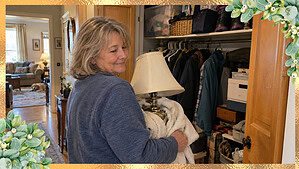
And a lamp from our very first apartment, still wrapped in a towel.

I stood there and laughed. Then, to my surprise, I felt a little lump in my throat.

That one closet held a piece of every stage of our life together.

We moved into this house when the kids were little, and we've been here ever since. Thirty-five years this spring.

Maybe for you it's been 40, or even longer.

And here's what I realized, standing there in the hallway.

We're not going anywhere. We love this house. We plan to stay right here as long as we can.

So this house needs to work for the life we live now. Not the life we lived 30 years ago.

If your home holds decades of living, and you're staying put, this is for you.

Here's how to declutter a house you've lived in for 40 years, one layer at a time, without moving and without wearing yourself out.

Where to Start When Your Home Holds 40 Years of Things

An older woman's hands holding a notepad in front of a full closet, taking notes before she starts sorting

When a house is this full, the hardest part is knowing where to begin. So let's start gently.

First, walk through your house once with a notepad.

Don't pick anything up. Don't move anything. Just open the closets, the cupboards, and the drawers, and write down what you see.

You'll probably notice something as you go. The things in your home come in layers.

There are the things from when your kids were small. The things from your working years. The things from hobbies you used to love.

The boxes your grown kids left behind. And a lifetime of keepsakes tucked in every corner.

Seeing it this way helps.

You're not facing one giant mess anymore. You're facing a few layers, and you can take them one at a time.

Next, pick the layer that gets in your way the most each day. Not the most emotional one. The one that makes daily life harder.

For me, it was the hall closet, because I open it every single day.

And before you start, keep three simple rules in mind:

Work in short sessions, about 15 to 20 minutes at a time.

Sit down whenever you can. Bring a drawer or a small box to the kitchen table.

Save heavy or high jobs for a helper. No climbing on chairs, and no carrying heavy boxes alone.

You're also far from alone in wanting to stay.

AARP found that 75% of adults 50 and older want to stay in their current homes as they age.

Read related post:   Gen Z Calls It "Underconsumption Core." My Mother Just Called It Keeping Our House From Filling Up.

So many of us are doing this same work, in the houses we love.

If you'd like a gentle overview first, my guide to decluttering for women over 70 is a good place to begin.

How to Declutter Each Layer of Your Home

Now let's walk through each layer together, one at a time.

We'll start with the years when the kids were small, and save the hardest one for last.

How to clear out the young family years

A woman in her 60s smiling with teary eyes as she sorts her grown children's old school drawings at the kitchen table

This layer holds the years when the house was loud and full of little shoes.

Open a closet or two, and you'll probably find it.

The baby gate you thought you'd need again. A high chair tucked in the basement.

Bins of outgrown toys, stacks of school papers, old crayons, and a box of kids' clothes you saved “just in case.”

You don't have to keep all of it to keep the memories.

Choose a small box for each child, and fill it with the very best. A few favorite drawings. One report card. The tiny outfit they wore home from the hospital.

That's enough to hold the memories, without filling a whole closet.

The rest can find a new home.

If your grown kids have little ones of their own, offer them the good toys first. Then donate what's left, and let the broken toys and old papers go.

Take it one box at a time. Bring it to the kitchen table, pour a cup of coffee, and go through it slowly.

It's okay to smile, and it's okay to get a little teary. (I read every one of my son's second grade stories before I chose my favorite three.)

Choosing the best few doesn't mean you loved the rest any less. It means you get to actually enjoy the best ones, instead of leaving them all buried in a box.

How to clear out the busy working years

Old work files, a worn briefcase, and a paper shredder at a home office desk, with one important folder set apart

This layer is from the years you rushed out the door every morning.

Chances are, a lot of it is still hanging around.

Work clothes and shoes in the back of the closet. A briefcase in the corner.

Boxes of old files, and maybe a home office that hasn't been used as an office in years.

Some papers are worth keeping close. Your will, the deed to your house, your insurance papers, and your Social Security and Medicare information.

Gather them into one folder, label it clearly, and keep it where you and your family can always find it.

The suits and work shoes you'll never wear again can go. So can the old manuals and the files from jobs long past.

Just be careful with papers that have personal information on them, like old bank statements. Shred those instead of tossing them in the trash.

And for tax records, ask your tax preparer how long to keep them, since it depends on your situation.

It can feel strange to let go of this layer. Those work clothes remind you of who you were for a long time.

But the woman who wore them is still right here. She just doesn't need the pantyhose anymore.

How to clear out the hobby and project years

A half-finished quilt, a bin of scrapbooking supplies, a basket of yarn, and an old sewing machine in a spare room corner

This layer holds all the things we meant to do “someday.”

Maybe it's a half-finished quilt folded over a chair. A sewing machine you haven't threaded in years.

An exercise bike that turned into a place to hang clothes. Or a box of yarn and a bin of scrapbooking supplies you keep meaning to get back to.

Keep the supplies for the hobbies you still enjoy.

If you still love to knit, keep your yarn. If you still bake every week, keep your baking things.

But the gear from hobbies you've finished with? It's okay to let it go.

Read related post:   Sorting Paper Clutter (My 5 Easy Steps To Efficiency)

We change, and our interests change too. There's no shame in that.

And someone who's just starting out would be thrilled to have your good supplies.

For each unfinished project, give yourself three choices.

Finish it this season, give it to someone who will finish it, or let it go. Any one of those is a good choice.

I had a scrapbooking bin in my closet for eight years. When I finally passed it to a young mom at church, I felt lighter right away.

She sent me a picture of her first page. That meant more to me than the bin ever did.

How to handle the boxes your grown kids left behind

A woman in her 60s sitting in her grown son's old bedroom, fondly holding a small trophy near a few packed boxes

This layer can feel tender, because it's tied to our children.

Their old rooms are often still full of them.

Trophies on the shelf, yearbooks in the closet, a stuffed animal or two, a letter jacket, and boxes with their names written on the side.

The kindest thing you can do is ask.

Call or text each of your grown kids, and let them know you're clearing out the house. Give them a clear date, maybe a month or two away, to come get anything they want.

If they live far away, take photos of their things and send them. They can tell you what to keep, and you can mail the few things they want.

Once that date comes and goes, you can donate whatever's left, with no guilt at all.

You gave them a fair chance. And most grown kids are relieved you asked, instead of leaving it for someday.

You might feel a pang when their old room starts to empty. I did.

But letting go of their boxes doesn't mean letting go of them. It just means the room gets to be useful again.

If you're surprised by what your kids do or don't want, you're not alone. I wrote about it in I thought my kids would want my things.

How to decide which keepsakes to keep after 40 years

One shelf holding a few chosen keepsakes, including a worn recipe box, a family photo, and an anniversary card

This last layer is the hardest, so we save it for when you've had some practice.

It's the greeting cards and the photos. The souvenirs from trips, the gifts from friends, your mother's things, and all the little treasures that ended up in every drawer.

What helped me most was this.

Choose one shelf or one bin for keepsakes, and let that space be your limit. Whatever fits, stays.

This makes the choosing easier. Instead of asking “should I keep this?” over and over, you're simply asking, “Is this one of my favorites?”

So keep the things that make you smile, or that tell a story you want to remember.

My mother's recipe box made the cut. So did the card my husband gave me on our 25th anniversary.

The rest, you can let go.

If it helps, take a photo first. That way, you keep the memory without keeping the thing.

Keeping only your favorites isn't losing your memories. It's keeping them where you can see them, instead of buried in a closet you never open.

How to Make Your Home Fit the Life You Live Now

A former spare room turned into a cozy reading room with an armchair by the window and a cup of tea

Once you've cleared a few layers, you'll have something wonderful. Space.

And now you get to decide how to use it.

This is the heart of staying put. The goal isn't an empty house. It's a house that works for you today.

Start with the things you use every day. Move them to where they're easy to reach, somewhere between your hips and your shoulders.

No more climbing for the good mixing bowl or bending low for the dish soap.

Keep your floors and walkways clear, especially the path from your bed to the bathroom.

Read related post:   4 Capsule Wardrobe Misconceptions (Busting The Myths And Simplifying Your Closet)

As we get older, a clear path matters more than ever. Here's more on decluttering for safety.

Then look at the rooms you don't use anymore. The old playroom. The sewing room that became a storage room. The guest room piled with boxes.

Ask yourself what you'd love that room to be now.

Maybe a quiet reading room with a comfortable chair by the window. A craft room for the hobby you still love. Or a guest room that's actually ready when the grandkids visit.

And the big spaces? The attic, the basement, and the garage?

Save those for helper days, when family or a friend can do the lifting. Take them one corner at a time.

As for my husband's garage, it's still his kingdom.

We've made a deal. I leave his garage alone, and he helps me carry boxes out of the house.

If your husband keeps everything too, you might like what I learned when my husband wouldn't throw anything away.

When you have bags and boxes ready to go but can't carry them, here's how to get clutter out of the house when you can't carry heavy bags.

A Home That Still Fits

I went back to that hall closet yesterday.

The snow boots are gone. So are the phone books and the old work files.

The lamp from our first apartment? I kept it. It sits on my nightstand now, and I turn it on every night.

Now the closet holds our coats, a few umbrellas, and nothing else. I can find what I need in two seconds.

It's a small thing.

But every time I open that door, I feel it. Forty years of life, and a home that still fits us.

That's what I want for you.

Not a perfect house, and not an empty one. Just a home that holds your life today, with room to breathe.

You don't have to do it all at once. Pick one layer this week.

Maybe it's the hall closet, or one box of school papers, or one drawer of old work files.

If you'd like a simple schedule to follow, my 12-week fall and winter decluttering plan walks you through it a little at a time.

Which layer of your home feels the hardest to you? I'd love to hear.

Make Your Long-Time Home Feel New Again

Declutter for Self Care Checklist

After 40 years, a house holds so much love, and so many things.

My free Declutter for Self Care Checklist helps you sort through it all one room at a time, so the home you've loved for decades works beautifully for the life you have now.

Frequently Asked Questions

How do you declutter a house you've lived in for decades?

Break it into layers instead of trying to tackle the whole house. Most long-time homes hold the same stages: the young family years, the working years, the hobby years, the grown kids' boxes, and keepsakes. Walk through your house once to notice these layers, then clear them one at a time in short, 15 to 20 minute sessions.

Where should I start decluttering a house full of stuff?

Start with the space that gets in your way every day, like a hall closet you open all the time or a kitchen drawer that won't close. Early wins give you energy to keep going. Save the hardest spaces, like keepsakes, the attic, and the basement, for later, once you've had some practice.

What do I do with my grown kids' things still in my house?

Reach out to each of your grown kids and give them a clear, kind date to pick up anything they want. If they live far away, send them photos so they can choose. After the date, you can donate whatever's left without guilt. Most grown kids are glad you asked.

How do I declutter if I'm not downsizing or moving?

Focus on making your home work for the life you live now. Clear out the things from life stages you've finished, move everyday items within easy reach, and keep your floors and walkways clear. Then think about how to use the space you free up, like turning an unused room into a reading room or a ready guest room.

How long does it take to declutter a whole house?

For a house you've lived in for decades, plan on several months, not a single weekend. Working in short sessions a few times a week is easier on your body and keeps you from burning out. Every layer you clear makes a difference, so it's worth going slowly and steadily.

Follow us on PinterestFollow
Follow me elsewhere!

Leave a Comment