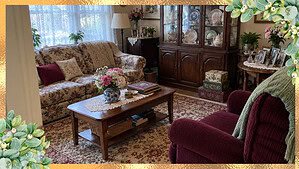
Decluttering for Women Over 70: A Kinder Way to Lighten a Lifetime of Things

If you're over 70 and looking around at everything you've gathered over a lifetime, wondering how you'll ever sort through it all, I want you to take a breath. This doesn't have to be hard or sad. And you don't have to do it the way anyone else says.

I'm in my sixties, so I'm a step or two behind you on this road. But I've spent years learning a gentler way to let go of things, and I'd be honored to walk it with you.

The first thing I want to say is this. What's in your home isn't a mess. It's a life. Decades of it (more than you can count, probably). The dishes from countless holidays, the gifts, the photos, the furniture that held your family through the years. Of course there's a lot. You've lived a lot.

So when the magazines talk about ruthless purging and clearing a house in a weekend, I want you to gently ignore them. That advice was never written for you.

Decluttering for women over 70 is its own thing. Your body has different needs now. Your things carry more history. And the decisions weigh more, because so many of them are tied to people you love.

But a lighter home is still within reach. A home that's easier to clean, safer to move through, and calmer to live in. One where the things you kept are the ones that truly matter to you.

The year is winding toward the holidays, which makes this a natural time to make a little room. Not through some big, exhausting push. Through small, kind steps, taken at your own pace.

Let's lighten the load together, gently, one room and one memory at a time.

A Lifetime of Things Is a Lot to Carry

One open drawer of old greeting cards and letters, the quiet weight of a lifetime of things

Nobody tells you how hard this gets with time.

When you were younger, clearing out a closet was a Saturday chore. You'd pull everything out, make quick work of it, and move on. Your back didn't ache. Your energy didn't quit by noon. And the decisions were easy, because the things hadn't had time to gather so much meaning.

It's different now, and that's not a failing. It's just the truth of where you are.

Your body tires sooner, so a big day of sorting costs you more. And every item asks a harder question. The vase from your wedding day. The books you've carried from house to house. The drawer of cards going back forty years (birthdays, anniversaries, all of it). How do you just toss any of that?

You don't have to. Not the way the ruthless folks say.

There's also this. Many women your age are doing all of it alone, with no one there to hold the other end of the box or say “keep it” or “let it go.” If that's you, please know the weight you're feeling is real, and it's not laziness. It's a lot to carry by yourself.

If you're a bit younger, somewhere in your sixties, my gentle guide for women over 60 walks a similar road. But if you're past 70, stay with me here. This one is written for exactly where you are.

Be patient with yourself. You've earned that patience many times over.

When the Kids Don't Want the China

One teacup to keep and one vase in a box to pass on, a gentle way to decide what stays

Let me talk about something that hurts, because I've heard it from so many women and I don't want you to feel alone in it.

You always thought your daughter would want the good china. Or the silver. Or the dining set you polished and protected for decades. You pictured it in her home someday, used for her own family's holidays.

Read related post:   9 Telling Signs You've Become the Keeper of Everyone Else's Things

And then you offered it. And she said no thank you.

Maybe kindly, maybe with an “I just don't have the room, Mom” (said gently, but it lands). It stung all the same. It can feel like she's turning down more than a set of plates. Like she's turning down your whole life.

I want to gently tell you what I've learned. It isn't that.

Younger women today live in smaller homes. They have different taste, simpler tables, less space for a china cabinet. Her no is about her life and her walls, not about you and your history. It truly isn't a rejection of you.

The thought that helps me most is this, and I hope it helps you. Your children inherited your values. Your kindness, your faith, your recipes, the way you love them. Those are the real heirlooms, and they already have them. The furniture was never the point.

So if the china has no taker, you're allowed to let it go without guilt. Letting go of sentimental things is one of the hardest parts of all this, and doing it gently, at your own pace, is more than okay.

Keep the few pieces that bring you joy to see. Let the rest find a new home. You are not failing anyone.

A Gentle Way to Decide What Stays

Once you make peace with letting go, the next question is how to decide. I use a simple way of thinking that I come back to again and again, and it works in every room.

First, keep what you truly love or truly use. If something makes you smile every time you see it, or you reach for it every week (the everyday things earn their keep), it stays. No guilt, and no rule about how much is too much. Loving it is reason enough.

Second, when you can't keep the thing, keep the memory. A photograph holds a memory beautifully, and it doesn't take up a shelf. I've taken pictures of things before passing them on, and the memory stayed with me just fine. I just don't have to dust it.

Third, pass things on with the story attached. An object means so much more when the person receiving it knows the quilt was your grandmother's, or the bowl came from your first kitchen. The story is the real gift.

And last, be honest about the guilt-keepers. Those are the things you hold onto only because someone gave them to you, or because it feels wrong to let them go. A gift has already done its job the moment it was given. You are allowed to release it now.

If you'd like more help with the deciding, these questions to ask while decluttering can make each choice a little clearer.

Four gentle ideas. Keep what you love, save the memory, share the story, release the guilt. Carry them into every room.

Going Room by Room, the Gentle Way

Now for the rooms. We'll start where it's easiest and save the tender spaces for last, once you've warmed up and built a little confidence. Do one room at a time, over days or weeks. There's no clock running. And remember, sitting down to sort is always allowed.

Start Easy in the Bathroom

An open medicine cabinet with a couple of old bottles set out to toss, an easy place to start decluttering

The bathroom is the perfect place to begin, because almost nothing in it will tug at your heart.

Start with your medicine cabinet. Toss anything expired, and there's usually more than you'd think (check the dates, you'll see). Old prescriptions, dried-up ointments, vitamins from years ago. Getting rid of them clears space and keeps you from grabbing the wrong thing by mistake.

Then the products. The lotions you didn't like, the samples you'll never use, the makeup that's long past its day. Into the bin they go.

Keep the counter and the floor as clear as you can. A clear bathroom floor is easier and safer to move around in, especially at night.

This room gives you a quick, satisfying win. And that good feeling is what carries you into the next one.

The Kitchen and Pantry

The kitchen is next, and it's mostly practical, which makes it easier on the heart.

Begin with the pantry and fridge. Clear out anything expired or stale. With the holidays and all that cooking coming up, you'll be glad for the clean, clear space.

Read related post:   When the Mess Makes You Sad, and the Sadness Makes More Mess

Then the gadgets and dishes. Most of us have three of some things and duplicates of others (how many wooden spoons does one woman need?). The bent spatula, the appliance you used once, the chipped mugs in the back. Let the extras go.

Now, the good dishes. This is the one kitchen spot that can tug at you. If you love your good set and still use it, keep it, of course. But if it only comes out once a year, and no one wants to inherit it, it's okay to keep a few favorite pieces and pass the rest on.

For more on this room, my guide to decluttering your kitchen walks through it step by step.

A lighter kitchen makes every meal easier. That's a gift you give yourself three times a day.

The Bedroom and Closet

A few folded sweaters on a bed during the seasonal swap, decluttering the bedroom closet gently

Your closet is a wonderful place to make real progress, and the timing is perfect right now.

As the weather turns cooler, you're swapping summer things for warm layers anyway. That makes this the natural moment to sort as you go. As you bring the sweaters forward, ask which ones you'll actually wear this winter, and let the rest move along.

Please do this part safely. Don't climb on a chair or reach high overhead for the top-shelf boxes. Ask someone to bring those down for you, or use a proper step stool with a handle. No sweater is worth a fall.

Let go of the clothes that don't fit, the ones you haven't worn in years, and the shoes that hurt your feet (you know the pair). If you haven't reached for it in a couple of seasons, it's probably ready to go.

My guide to decluttering your closet has more, if you want it.

A closet of only things you love and wear makes getting dressed a small daily pleasure.

The Living Room and Everyday Surfaces

The living room is where daily life happens, so keeping it clear does you the most good every single day.

Start with the surfaces that collect things. The coffee table, the side tables, the top of the mail pile. Paper is usually the biggest culprit. Old magazines, junk mail, catalogs you'll never order from. Recycle what you can and keep only what you truly need.

Then look at the knick-knacks. Over the years, shelves fill up with little things, some dear to you and some just there (they arrived and never left). Keep the ones you love to look at. Dust and boxes for the rest.

And give a thought to the floor. A clear path through the room, with no baskets or cords to catch a foot, makes your home safer as the darker months come on.

You don't need it bare. You just need it clear enough to feel calm and move through easily.

The Sentimental Spaces, Last

One open keepsake box with a few old photographs being sorted, the sentimental spaces saved for last

Save the hardest spaces for last, when you've had practice and you're feeling stronger about letting go.

These are the attic, the basement, the spare room, and the boxes of photos and keepsakes. They hold the most memory, so they take the most heart. Go slow here. Do a little, then rest.

With photos, you don't have to keep every single one. Choose the ones that bring a person or a moment right back to you, and let the blurry doubles go (every roll had a few). A smaller collection you actually look at beats boxes you never open.

For keepsakes, keep the few that mean the most. A handful of treasures, honored and displayed, says more than a basement full of boxes ever could.

And if your spare room has become a catch-all, clearing it now is a lovely thing to do before the holidays. You might just make room for a grandchild to sleep over.

Take these rooms gently. There's no rush, and no wrong pace.

Where It Can All Go

One open donation box with a sweater and a bowl by the door, showing where it can all go

Deciding to let something go is one thing. Knowing what to do with it is another, and this is where a lot of women get stuck.

Let me break it down simply.

For the special pieces, offer them to family first, with the story attached. The holidays are a perfect time, when everyone's together in your home anyway. Tell them where the piece came from and why it matters. Some things will find a happy new owner that way.

Read related post:   10 Simple Ways To Organize Your Receipts Like A Pro

For everyday usable things, donate them. Clothes, dishes, books, and linens in good shape can bless someone else, and many charities will even come pick them up (a blessing when lifting is hard).

For items with real value, especially if money is tight, it's perfectly fine to sell them. Good jewelry, silver, and antiques can bring in a little something, and there's no shame in that at all.

If you're facing a bigger move, my guide on how to downsize your home can help you think it through.

One gentle warning, with a smile. Sometimes the very family who didn't want a thing suddenly wants it the moment it's gone. So offer it clearly, give them a fair chance, and then let yourself move on. You can't hold onto everything on the chance someone changes their mind.

You Are Not Your Things

If you take one thing from all of this, let it be this. You are not your things.

You are the mother who stayed up all night with a sick child. The friend who always remembered the birthday. The woman who set a beautiful table, held a family together, and loved people with her whole heart for decades.

None of that lives in a china cabinet or a box in the attic.

It lives in you, and in every person lucky enough to know you.

I think that's what makes this so hard. We're afraid that if the things go, a little of the memory goes with them. But it doesn't. The love stays. It always stays.

Lightening your home isn't erasing your life. It's deciding, on purpose, what you want to carry into these years. It's keeping the things that still make you smile and gently thanking the rest for their time. It's a home that holds you now, instead of holding all of the past at once.

And here's something I hope you'll let yourself feel. There's a lightness that comes with this. A little more room to breathe. A little less to worry over. A quiet that feels less like empty and more like peace.

You've spent a lifetime taking care of everyone around you. Let this be one of the ways you finally turn some of that care toward yourself.

You've earned a home that feels good to live in. And you've earned the peace of mind that comes with it.

A Gentle Hand to Start With

If you're ready to begin but would love a little guidance to lean on, I have something that might help.

My free Declutter for Self Care Checklist walks you through it kindly and slowly, in small pieces made for real energy and real feelings. It treats a lighter home as an act of caring for yourself, which, after all these years of caring for others, you deserve.

Frequently Asked Questions

Where should a woman over 70 start decluttering?

Start with an easy, low-emotion space like the bathroom or a single kitchen drawer. Clearing expired medicine, old products, or duplicate gadgets gives you a quick win without tugging at your heart. That early success builds confidence and makes the next room feel easier. Save the sentimental spaces, like the attic or photo boxes, for last.

How do I declutter when my kids don't want any of my things?

First, try not to take it personally, even though it can sting. Younger people often live in smaller homes with different taste, so their no is about their space, not your history. Offer each piece clearly, with its story, then feel free to donate or sell what no one wants. Your children carry your values, which matter far more than the furniture.

What should I get rid of first when decluttering after 70?

Begin with things that are easy to release: expired food and medicine, duplicate kitchen gadgets, worn-out clothes, and old paper and junk mail. These take no emotional toll and clear real space fast. Getting these out of the way first makes the harder, more sentimental decisions feel more manageable later on.

How do I declutter sentimental items and heirlooms without guilt?

Keep the few pieces you truly love or use, guilt-free. For the rest, a photo can hold the memory just as well as the object. Pass meaningful things to family with the story attached, and remember that a gift has already done its job. Letting go of something you no longer love doesn't dishonor the person who gave it.

How can I declutter safely at 70 or older?

Work sitting down whenever you can, and go in short sessions with rest in between. Never climb on chairs or reach high overhead for boxes. Ask someone to bring those down, or use a proper step stool. Keep floors and walkways clear as you go, which also makes your home safer to move through every day.

Follow us on PinterestFollow
Follow me elsewhere!

Leave a Comment