My Mother’s Costume Jewelry: What I Wear, What I Gave Away, and What Went to a New Home

My mother’s jewelry box sat on the top shelf of my closet for almost three years (longer than I’d like to admit).

I brought it home the month we emptied her house. It was one of the first things I set aside, back when I was looking for her papers and anything that might matter. Then I put it on that shelf and didn’t open it again.

Last week, I finally carried it to the kitchen table.

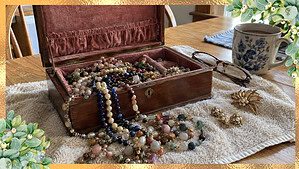
I lifted the lid and sat very still for a minute. There was the gold-colored brooch she pinned to her coat for church. There was a tangle of beaded necklaces, and a small pile of clip-on earrings (one had lost its partner years ago).

I put on my reading glasses and turned a few pieces over.

Almost all of it was costume jewelry. The real pearls she gave me when I turned forty were never in this box. They have been in my own jewelry box for more than twenty years.

So none of this was worth much money. But I could picture her wearing almost every piece. That’s what made it so hard to sort.

If you have a box of inherited costume jewelry like this, I understand. It can feel easier to leave it on the shelf and close the closet door.

But the jewelry was not doing anyone any good up there. Not me, and not the people who might love it.

So I’m going to share how I sorted my mother’s costume jewelry, one small pile at a time. I’ll show you what I wear now, what I gave to my family, and what went to a new home.

Not Worth Much, But Worth So Much to Me

Small wooden jewelry box on a closet shelf between folded sweaters, with coats hanging below.

When I cleared out my mother’s house, I had thirty days and a lot of big things to handle. The furniture, the dishes, and the basement all had to be done first.

The jewelry box was small. So I told myself it could wait.

It waited almost three years.

Part of the reason was simple. There were so many tiny pieces in that box. Every time I opened it, I saw knots of beads and loose earrings, and I closed it again.

But the bigger reason was this. Each piece was cheap, but each one reminded me of her.

The red bead necklace was from Christmas mornings. The little gold pin was from church. The big clip-on earrings were from the dressy dinners she and my father went to when I was a girl.

Nobody would pay much for any of it. I knew that.

It was a lot like the old china sets nobody wants. The money value was small, but the feelings were big.

I also had a real worry. What if something in there was worth more than I thought? What if I gave away a piece that my daughter would want someday?

That worry kept the lid closed for a long time.

So I made myself a promise. I would not decide everything in one day. I would just start, and I would go slowly.

Read related post:   Clean Mama Or FlyLady (Which Cleaning Routine Is Your Perfect Match)

How I Sorted It Without Getting Overwhelmed

Once I sat down with a plan, it went better than I expected. These five steps got me through the whole box, and none of them took much energy.

Sit Down and Work on One Small Pile

A woman's hands lifting a small handful of costume jewelry from a wooden box onto a towel on the kitchen table.

I spread an old bath towel on the kitchen table. The towel kept beads from rolling off the edge, and it was soft on the pieces.

Then I took out one small handful at a time. I did not dump the whole box out at once.

With my knee and my sore hands, I need to sit for this kind of job. A kitchen chair and good light by the window made it easy.

Before I started, I checked under the lining of the box. My mother hid twenties in the strangest places, so I always look.

Untangle and Group Like With Like

Costume jewelry sorted into small groups of necklaces, brooches, earring pairs, and bracelets on a towel, with a knotted necklace and a straight pin to one side.

Next, I put the pieces into small groups. Necklaces went in one spot, brooches in another, and earrings and bracelets in their own spots.

Some of the necklaces were knotted together. I used a straight pin to loosen the knots, slowly, a little at a time.

If a knot would not come loose after a few minutes, I set it aside. It was not worth hurting my hands over.

Grouping them made the pile look smaller right away. Twenty loose earrings look like a mess. Ten pairs in a row look like something you can handle.

Turn Each Piece Over and Look for a Name or Stamp

A woman's hands holding a magnifying glass over the back of a gold-colored brooch, with reading glasses on the towel below.

This is the step that helped me stop worrying.

I turned each piece over and looked on the back, near the clasp, and on the pin. I used a magnifying glass for the tiny marks (my reading glasses weren’t strong enough).

I was looking for two kinds of marks.

The first was a maker’s name. Some names that collectors look for include Trifari, Coro, Napier, Weiss, Miriam Haskell, and Sarah Coventry. A piece with a name like that can sell for more than one with no name.

The second was a metal stamp. A plain “10K” or “14K” means solid gold. So does “585,” which is how some countries mark 14K gold.

“925” or “Sterling” means the piece is real silver. But if you see letters like “GF,” “GP,” or “HGE” next to the number, it is not solid gold. Those letters mean a thin layer of gold was put over another metal.

A stamp is a good clue, but it is not proof. If you think a piece is real gold or silver, a jeweler can tell you for sure.

In my mother’s box, I found two pins with a maker’s name and one small silver bracelet marked “Sterling.” Everything else had no marks at all.

Use Three Trays: Wear, Family, and New Home

Three shallow dishes on a kitchen table holding sorted costume jewelry, with a small zip bag of marked pieces in one dish.

I set three shallow dishes on the table. One was for pieces I would wear. One was for family.

The last one was for pieces that would go to a new home. Every piece went into one of the three dishes, and there was no “maybe” dish.

The marked pieces went into a little zip bag inside the “new home” dish. That way I would remember to get them looked at before anything was donated.

Stop Before You’re Tired

I worked for about thirty minutes each day. Then I stopped, even when I wanted to keep going.

I put the towel, the dishes, and the box on a tray and slid it onto the counter. The next morning, everything was right where I left it.

It took me four mornings to finish the whole box.

What Stayed With Me

A gold-colored vintage brooch pinned to a navy wool coat hanging on a hook by the front door.

I kept less than I thought I would.

I chose the pieces I could picture myself wearing, not the pieces I felt I should keep. There is a difference.

Read related post:   11 Things I Removed From My Home Once I Started Taking Decluttering for Safety Seriously

The gold-colored brooch was the first thing I kept. I pinned it to my winter coat, the same way she wore it. Now I see it every time I go out the door, and it makes me smile.

I also kept a long strand of blue beads and a pair of pearl clip-on earrings. They are not real pearls (I checked), but they look lovely with my navy church dress.

These pieces did not go into a keepsake box. They went into my own jewelry box, right next to her real pearls.

That was important to me. A keepsake box goes back on a shelf. My jewelry box gets opened every week.

If you are not sure what to keep from your own box, these questions to ask when you declutter jewelry can help. They work just as well for a mother’s jewelry as for your own.

I kept the clip-on earrings even though they pinch a little after an hour. I wear them for church and take them off in the car.

My mother saved some of her nicer pieces for special days that did not come often enough. I don’t want to do the same thing with her jewelry.

So I wear it on ordinary days too. A plain Tuesday is a fine day to use the good stuff, even when the good stuff is costume jewelry.

What I Gave Away

A child's hand reaching for a charm bracelet in a dish of costume jewelry on a dining table after Thanksgiving dinner, with a woman seated nearby.

At Thanksgiving last year, I tried something that worked better than I hoped.

I set the “family” dish on the dining room table after dinner. I told everyone they could each pick one piece of Grandma’s jewelry if they wanted to. I made it clear that no one had to take anything.

My older granddaughter picked a bracelet with little charms on it. She put it on right away and wore it the rest of the evening.

My younger granddaughter picked the biggest, sparkliest brooch in the dish. She pinned it to her sweater and walked around like a queen (she’s still wearing it on special days).

My daughter picked one small gold-tone locket. That was all she wanted, and that was fine.

My sister took a string of green glass beads. She said our mother wore them every St. Patrick’s Day.

I added a small note to each piece before it left. I just wrote down what I remembered, like “Mom wore this to church on Easter,” or “She wore these to Dad’s work parties.”

Those little notes matter more than people think. Without the story, a piece of jewelry is just a piece of jewelry. I wrote more about this in decluttering after a death, and it is one thing I will always do now.

Not everyone wanted something. My son looked at the dish and smiled and said no thank you. I did not take it personally.

The whole thing took twenty minutes. It was one of the sweetest parts of the evening.

What Went to a New Home

A paper bag of costume jewelry and a clear bag of broken pieces in an open car trunk, ready to drop off.

That left the “new home” dish. It held more than half of the box.

I started with the marked pieces in the little zip bag. I took them to a jewelry store in town that buys old jewelry.

The man at the counter looked at each piece under a light. He told me the sterling bracelet was real silver and offered to buy it by weight. He said the two signed pins were nice, but not rare.

I sold him the bracelet. I sold the two pins to a woman who runs estate sales in our area, because she said her buyers like signed brooches.

Neither sale made me rich (it paid for a nice lunch). But now I know, and that worry is gone.

The unmarked pieces were next. Most of them were in good shape, just old-fashioned.

I bagged the necklaces and earrings that looked nice and took them to our church rummage sale. The ladies who run it said jewelry is one of the first things to sell.

Read related post:   8 Useful Steps To Decluttering Life And Reducing Stress In 2023

A thrift store works too. Just call first and ask if they take jewelry, because some stores have rules about small items. There are more meaningful places to send your belongings than most of us know.

Then there were the broken pieces. There was a necklace with a broken clasp and a few single earrings with no partner.

I did not want to throw them in the trash. So I gave them to a friend from church who crafts. She uses old beads and brooches to make Christmas ornaments and picture frames.

She was thrilled. She told me people bring her whole bags of broken jewelry, and she never has enough.

When the last bag left my car, the dish was empty. And the jewelry box was light enough to carry with one hand.

What I Kept Was Never Really the Jewelry

My mother’s jewelry box sits on my dresser now, not up on the closet shelf.

It has only a few of her pieces in it. The rest are with my granddaughters, my daughter, my sister, and people I will never meet.

I thought letting go of her jewelry would feel like letting go of her. It didn’t.

When I pin her brooch to my coat, I still think of her in the church pew beside me. When my granddaughter wears that big sparkly pin, I think of her too.

The memories were never inside the box. They were in me the whole time. I wrote about this once when I asked if keeping their things really keeps the people we lost.

If you have a box like hers on a shelf somewhere, you don’t have to finish it this week. Start with one small handful. Keep what you love and will wear.

Let the rest go to people who will enjoy it.

A Little Help for the Next Box on the Shelf

Declutter for Self Care Checklist

Most of us have more than one box like my mother’s. There’s the one in the closet, the one under the bed, and the one we keep moving from room to room.

My free Declutter for Self Care Checklist helps you decide where to start and what to do next. It keeps the work gentle, so you can go at your own pace.

Frequently Asked Questions

How do I know if costume jewelry is worth anything?

Turn each piece over and look for a maker’s name or a metal stamp on the back, near the clasp, or on the pin. Signed pieces from well-known makers, such as Trifari, Coro, Napier, or Miriam Haskell, can sell for more than unsigned ones. Most costume jewelry is not worth much money, but it’s worth checking before you give anything away. If you’re unsure, a local jeweler or estate-sale company can take a look.

What do the stamps on the back of jewelry mean?

A plain “10K,” “14K,” or “585” means solid gold. “925” or “Sterling” means real silver. Letters like “GF,” “GP,” or “HGE” next to a number mean a thin layer of gold over another metal, not solid gold. A stamp is a helpful clue, but a jeweler can tell you for sure.

Where can I sell old costume jewelry?

A local jewelry store may buy pieces made of real gold or silver. Estate-sale companies and antique shops sometimes buy signed vintage pieces, especially brooches. You can also sell online, but that takes more time and work. For a small amount of jewelry, one local buyer is often the easiest choice.

Where can I donate costume jewelry?

Church rummage sales and thrift stores often take jewelry that is clean and in good shape. Call first, because some stores have rules about small items. Broken jewelry can go to a friend or craft group that makes things with old beads and brooches. Some senior centers and schools also use it for craft projects.

What can I do with my mother’s jewelry if I don’t want to wear it?

Offer a few pieces to family and let each person pick one, with no pressure to take anything. Write a short note about when she wore each piece so the story goes with it. You can keep one small piece in a place you see every day, like a dish on your dresser. The rest can go to someone who will enjoy wearing it.

Follow us on PinterestFollow
Follow me elsewhere!

Leave a Comment