It was a slow, rainy afternoon, and my granddaughter had pulled an old shoebox of photos down from my shelf to keep herself busy.
She sat cross-legged on the floor, flipping through them one by one, until she stopped and held one up to me.
“Grandma, who's that standing next to you?”
I looked at it. A summer day, me in my twenties, my arm around a woman I knew I should know. And for a few long seconds, her name wouldn't come to me.
It came back eventually. (An old friend from my first apartment.) But those few seconds shook me more than I let on.
Not long before that, I had spent months going through my mother's photos after she passed. Boxes and boxes of them, and so many faces not one of us could name.
I thought that was her doing. Her unlabeled boxes, her loose ends.
Then I opened my own closet.
Every shoebox up there looked exactly like hers. Loose prints, not a name on a single one. Decades of my life, and no way for anyone to know who half these people were once I'm not here to say.
That's the part nobody warns you about. You spend your whole life taking the pictures. You never once think about being the last person left who knows the story behind them.
So I started labeling old family photos, my own this time. One shoebox at a time.
It turned out to be one of the kindest things I could do for my kids and grandkids. And I almost didn't think to do it at all.
Someday I'll Be the Only One Who Knew

Here is what I finally understood, sitting on my closet floor.
A photo can last a hundred years. But the story behind it does not.
The paper stays. The names fade. And the names fade a lot faster than the picture does.
Think about it for a second. Right now, I can name almost everyone in my shoeboxes. My husband can name most of them too.
But our kids only know some of the faces. And our grandkids know us, and maybe a few people they have met. That is about it.
So every year, fewer people can look at those photos and say who is who.
One day, I will be the only one left who knows. And one day after that, no one will.
That is exactly what happened with my mother's photos. When I went through the boxes she left behind, so many faces were a mystery. People who clearly mattered to her, and not one of us could say their names.
It was not that she didn't care. She knew every one of them by heart. She just never thought to write it down, because to her it was obvious.
That is the trap. The names feel obvious right up until the day they are gone.
And this isn't really about old photos at all. It is about the box each of us is quietly leaving behind for the people we love.
How I Kept the Names From Disappearing
Once I saw the problem, I wanted to fix it. But I did not want to turn it into a huge project I would quit halfway through.
So I kept it simple. Here is exactly what I did.
I asked the people who still remembered

The first thing I did was ask for help while I still could.
I brought a small stack of photos to my older relatives, just a handful at a time. My last living aunt was a big help here. So was my sister, who remembered things I had forgotten.
I did not hand anyone a giant box. That only makes people tired, and then they give up. A few photos at a time is plenty.
I made it a nice visit, not a chore. We had coffee. We laughed at the old hairstyles. And I asked simple questions. Who is this? Where was this taken? About what year?
One thing helped more than anything. I recorded us talking right on my phone. I hit record and let my aunt tell her stories, and later I could listen again and catch names I had missed.
If you are helping clear a loved one's home, ask about the photos early, while the people who remember are still here to tell you. There is more on handling a loved one's belongings if you are facing that right now.
The names are the part you cannot get back later. The photo will wait. The memory of it will not.
I wrote it down like a stranger would read it

This is the part I got wrong at first.
On my first few photos, I wrote things like “Mom and the girls at the lake.” It felt clear enough to me.
Then I pictured my granddaughter reading that in forty years.
She will not know which lake. She will not know who “the girls” are. She will not even know which “Mom” I meant.
So I started writing as if the reader knows nothing at all. Full names, not nicknames. The year, even if I had to guess and write “about 1985.” The place. And a few words about the day.
It takes a little longer. But “the family at the farm” helps no one down the road. A full name and a year is a real gift.
I used a pencil, not a pen

I almost ruined a photo before I learned this one, so please hear me out.
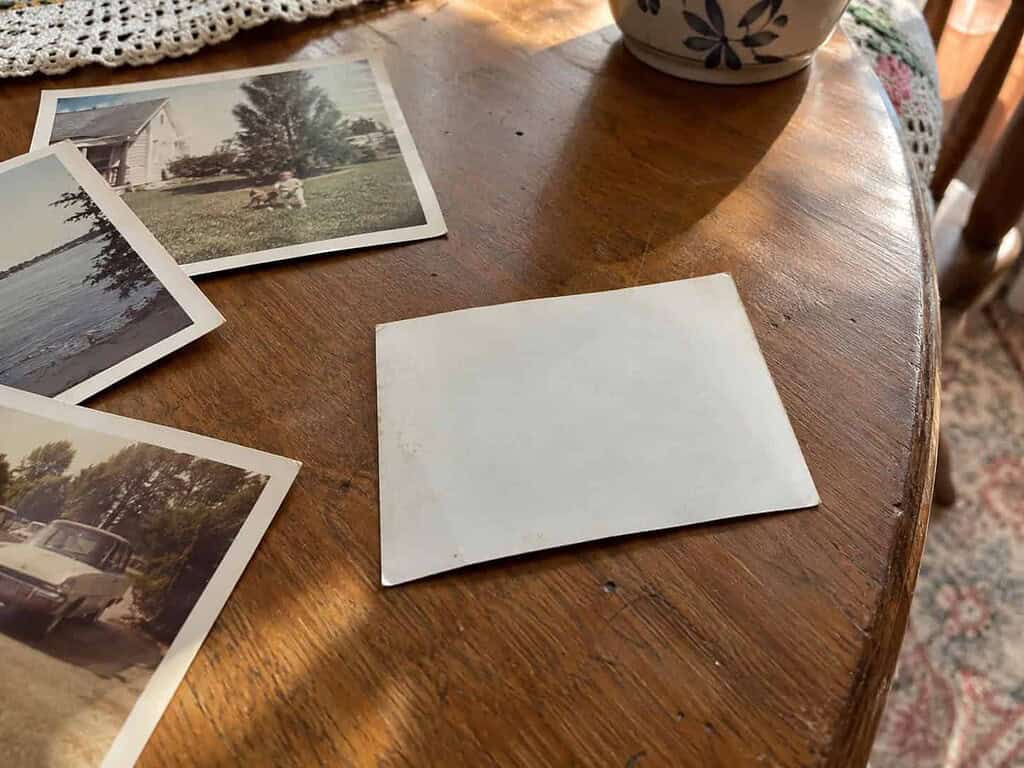
Do not use a ballpoint pen on the back of a photo. It presses a dent into the picture, and over time the ink can smear or soak through to the front.
Regular markers and Sharpies are no good either. They can bleed right through the paper.
Here is what actually works. For older photos with a soft, papery back, use a soft pencil. A regular number 2 pencil is fine.
Write gently, near the edge, on a hard flat table. A light touch matters, so you don't press a mark through to the front.
Newer photos are trickier. They often have a shiny, slick back that a pencil will not grab. For those, use a photo-safe pen, the kind marked “archival” or “acid-free.” Test it on one photo first, and let the ink dry before you stack them.
And if you already wrote on your photos in ballpoint years ago, don't lose any sleep over it. What is done is done, and we simply did not have the better tools back then.
I labeled a few at a time, not the whole closet

When I saw how many photos I had, my first thought was to block off a whole weekend and power through.
I am glad I didn't. That is the fastest way to burn out and quit.
Instead, I did one shoebox at a time. Some evenings I labeled for twenty minutes while the TV was on. Some weeks I did not touch them at all.
A little at a time added up faster than I expected. And it never once felt like a job I dreaded.
Once a box was labeled, I sometimes scanned the best ones so there was a backup copy. If you go that far, it helps to have a simple way of keeping your digital photos organized so they don't become a new mess on your computer.
But the labeling came first. Even if I never scanned a single one, at least the names would be there.
I let the unknown ones stay unknown

Even after all my asking, a few faces stayed a mystery. And that is okay.
I had a small pile of photos where nobody, not me, not my sister, not my aunt, could say who the people were.
At first this stopped me cold. I felt like I had to solve every last one before I could move on.
I didn't. I labeled everything I knew, and for the few true mysteries, I just wrote “unknown” on the back and set them aside.
I already learned this lesson with my mother's boxes. A photo that no one alive can name has quietly stopped being a family memory. It is a nice old picture, but the story is already gone. So it is fine to keep a few, or to gently let those ones go.
Don't let a handful of mystery photos stop you from labeling the hundreds you can.
What I Wish I'd Done Sooner

The one thing I would change is simple. I would have started years earlier.
I would have sat down with my mother while she was still here, her photos in my lap, and asked her to name every face.
I never did. I always thought there would be more time. And now there are people in her albums I will never be able to name, no matter how hard I try.
That is the part that stings. Not the photos I have to guess at, but the questions I can no longer ask.
So if your parents or older relatives are still here, please don't wait. Bring the photos out this month. Make the call. Ask while the answers are still a phone call away.
And think about your own boxes too. The labeling I did was not really for me. It was for my kids and my grandkids.
When I am gone, they won't have to guess. They will pick up a photo, turn it over, and there I'll be, telling them exactly who they are looking at.
If you want to turn your labeled keepers into something the family will actually enjoy, there are lovely ideas for displaying old photos and portraits once the names are safe.
Because in the end, the names are what our kids will treasure. It is a lot like learning what our children actually want from us. It is rarely the stuff. It is the story.
What a Labeled Photo Really Is
I used to think a label was just a small chore. A name, a date, a quick note on the back.
I see it differently now.
A labeled photo is a person kept from becoming a stranger. It is a way of saying, this was my friend, this was your great-grandmother, this day mattered.
It is a small act of love for people I may never meet. My great-grandkids, and theirs after them.
They will never shake my hand. But they will know my face, and the faces of the people I loved, because I took a few minutes to write it down.
That is what a labeled photo really is. Not a chore. A quiet way to stay together, long after the afternoon the picture was taken.
So pull one shoebox down this week. Grab a soft pencil. And start giving those faces their names back.
Don't Let the Names Slip Away

Labeling old photos is really about a bigger thing, which is sorting out what to keep before that job ever lands on your kids. My Free Declutter for Self Care Checklist helps you work through your whole home gently, on the days you feel up to it, so the things that matter don't get buried and nothing heavy gets left behind for your family.
Start wherever feels easiest. The checklist takes it from there.
Frequently Asked Questions
What pen is safe to write on the back of photos?
For older photos with a soft, papery back, a soft pencil like a regular number 2 is the safest choice. It won't bleed or soak through, and you can erase it if you make a mistake. Newer photos often have a shiny, slick back that a pencil will not grab, so use a photo-safe pen marked “archival” or “acid-free.” Test it on one photo first, and let the ink dry fully before you stack them.
How do I label old photos without damaging them?
Write on the back, near the edge, using a light touch on a hard flat table so you don't press a dent into the front. Never use a ballpoint pen, since it dents and smears, and skip regular markers, which can bleed through. If writing directly on the photo makes you nervous, you can write the details on the paper sleeve or envelope instead. Avoid sticky labels, because they can peel and leave a mark.
How do you identify people in old photos you don't recognize?
Start with the oldest people in your family, and show them just a handful of photos at a time so it stays fun instead of tiring. Ask simple questions like who this is, where it was taken, and roughly what year. Recording the conversation on your phone is a wonderful trick, since stories often come out that you would never get in writing. Clues in the photo help too, like the clothes, the cars, or the house in the background.
Should you write on the back of photos, or is it better to scan them?
Both help, and they work well together. Writing the name and date on the back means the information travels with the photo, even if it gets passed around or tucked in a drawer for years. Scanning protects the image itself and lets you share copies with family. If you do both, label the photo first and then scan it, so the details are saved right along with the picture.
What do you do with old photos when nobody knows who's in them?
It is okay to let those go. A photo that no one living can name has already lost the story that made it a family keepsake. Before releasing any, show them to your oldest relatives in case a face jogs a memory. For the ones that stay a mystery, you can write “unknown” and keep a few, recycle the rest, or offer old local scenes to a historical society if they show your town.
Follow me elsewhere!