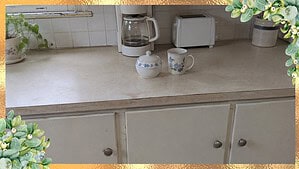
The sugar bowl is white, with little blue flowers around the rim and a tiny chip on the lid.
It belonged to my Aunt Ruth. Now it sits on my kitchen counter, and it holds my tea bags.
I use it every single day. And every time I lift the lid, I think of her.
For a long time, I didn’t know how to think about things like that sugar bowl. I’d read about decluttering and wonder how much I was allowed to keep. Was there a right number?
Many of us carry that worry. We want a calmer home, but we’re afraid we’ll have to give up the things we love to get it.
Then this fall, I came across a simple rule from a man who lived more than 140 years ago. It has no number in it at all.
It has just two questions. And it gave me permission to keep my sugar bowl, and to let go of a lot of things I never loved.
Who Was William Morris?
William Morris was a designer in England in the 1800s. He was born in 1834, in a part of east London called Walthamstow.
He made patterns for wallpaper and fabric, full of leaves, flowers and birds. He also designed carpets, tiles, books and much more.
In 1861, he and some friends started their own company to make things for the home. They made everything by hand.
The Victoria and Albert Museum in London holds a large collection of his work. You can read about his life in the museum’s article, Introducing William Morris.
Morris cared a lot about ordinary homes. He wanted the rooms where people lived every day to feel good to be in.