I first heard the term “Swedish death cleaning” a few years ago, and I'll be honest. I almost closed the article.
Death cleaning? That sounded heavy. Morbid. Like something you'd only think about if you were sick or very, very old.
But something made me keep reading. And by the time I finished, I wasn't thinking about death at all.
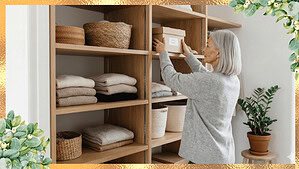
I was thinking about my hall closet.
The one crammed with coats nobody wears, bags I forgot I owned, and a box of scarves I keep meaning to sort through. I've walked past that closet a thousand times without opening it. Not because I didn't notice the mess, but because I didn't know what to do about it.
Swedish death cleaning gave me a way to think about it that finally made sense.
It's not about preparing to die. It's about deciding, while you're healthy and clear-headed, what actually deserves space in your life. And just as importantly, what doesn't need to follow you (or your family) into the next chapter.
Once I understood that, I started seeing everything in my home a little differently. Not with panic or sadness, but with a different sense of clarity I hadn't felt before.
In this post, I'm sharing what Swedish death cleaning actually is, why it hit me so personally at this point in my life, and how I started working through my own home without losing my mind in the process.
If the name made you flinch the way it made me flinch, stick around. It's not what you think.
It's Not as Morbid as It Sounds
Swedish death cleaning comes from a Swedish word, döstädning. “Dö” means death, and “städning” means cleaning.
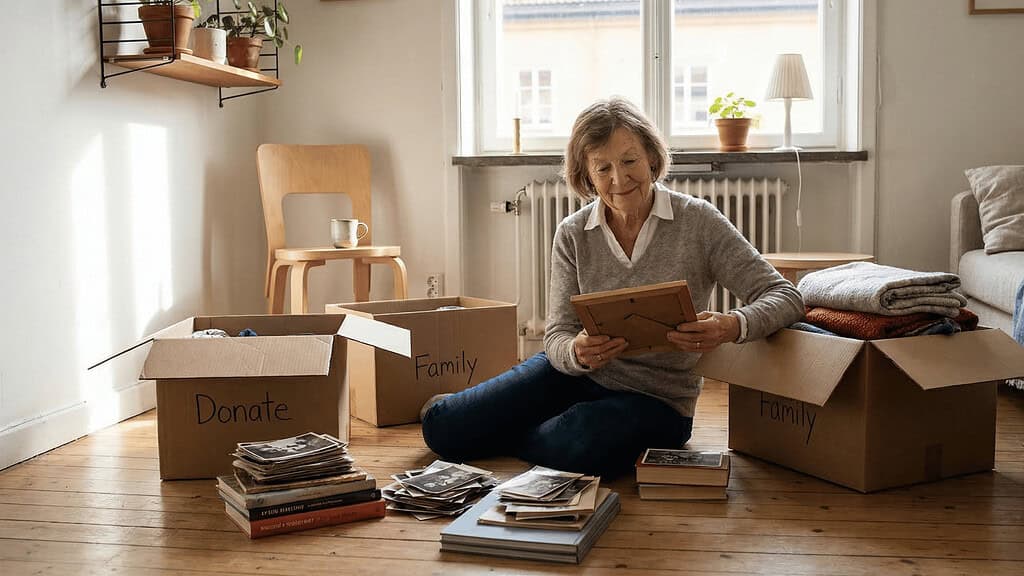
Put together, it's the practice of going through your belongings and simplifying your home so the people you love won't have to do it for you someday.
The concept has been part of Swedish culture for a long time, but most of us first heard about it through Margareta Magnusson's book, The Gentle Art of Swedish Death Cleaning.
Magnusson was an artist who wrote the book after spending years clearing out the homes of her parents and her husband after they passed.
She knew firsthand how exhausting and emotional that work was, and she didn't want to leave that job to her own children.
She suggested starting around age 65, but she was also clear that there's no wrong time to begin. The idea isn't to rush through your home on a weekend or to strip your life down to nothing.
It's a slow, thoughtful process. You go at your own pace. You decide what stays and what goes.
What makes it different from regular decluttering is the WHY behind it.
Most decluttering advice is about making your home look nicer or feel more organized. But Swedish death cleaning asks you to think bigger than that.
It asks you to consider what will happen to your things after you're gone. which is something most of us don't think about until we're forced to downsize.
Not in a scary way, but in a practical, loving way (the way you'd prepare anything important for the people who matter most to you).
That shift in perspective is what got me. I wasn't just cleaning out a closet. I was making a choice about what I wanted to leave behind.
Why This Feels So Personal at This Stage of Life
I think there's a reason this concept tends to land hardest with women around my age. We've had decades to accumulate things. And most of us didn't just accumulate randomly.
We collected with purpose. We saved with intention. We kept things because they meant something, or because we were sure they'd mean something to someone else eventually.
But at some point, the meaning gets buried under the sheer volume of it all.
I have bins in my garage that I haven't opened in years.
I have kitchen cabinets with dishes I never use but can't quite bring myself to give away.
I have a closet full of clothes that fit a version of my life I'm not really living anymore.
And I know I'm not the only one.
If you've ever had the experience of offering something to your kids and realizing they don't want it, you know exactly the feeling I'm talking about.
It's not anger.
It's this quiet sting of realizing that the things you've been holding onto for them were really being held onto for you.
That's not a bad thing. But it does change what you do next.
Swedish death cleaning gave me permission to stop saving things for a future that might not look the way I pictured it. Instead of asking, “What if someone wants this someday?” I started asking, “Is this adding anything to my life right now?”
Most of the time, the honest answer was no. And once I stopped pretending otherwise, the whole process got a lot easier.
One Simple Question That Changes How You See Your Stuff

Margareta Magnusson had a question she came back to over and over again throughout her book. It's simple, but it stopped me in my tracks the first time I really sat with it.
“Will anyone be happier if I save this?”
That's it. No complicated system. No checklist. Just that one question.
And it works because it pulls you out of your own head for a second.
Instead of going back and forth about whether you might need something or whether it still has sentimental value to you, it shifts the focus outward. It makes you think about the person who will eventually have to deal with this thing if you don't deal with it now.
I stood in my spare bedroom one afternoon holding a box of old greeting cards. Birthday cards, holiday cards, a few thank-you notes from people I honestly couldn't remember anymore.
I had kept every single one of them for years (longer than I'd like to admit) because throwing away a card someone wrote to you feels wrong somehow.
But when I asked myself that question, the answer was obvious. Nobody was going to be happier finding a box of faded cards in my closet after I'm gone.
They weren't going to read them. They were going to feel guilty about tossing them.
So I sat on the floor, read through a few of my favorites one last time, and let the rest go.(I'm planning to do the same thing soon with the old photos I've been storing in boxes for years.)
It wasn't sad. It actually felt like relief.
That one question has become my filter for almost everything now. And it makes decisions that used to take me twenty minutes take about twenty seconds.
Starting Small Is the Only Way This Works
If you're looking at your whole house right now and feeling that familiar wave of “where do I even begin,” I get it. I felt the same way.
But the biggest thing I've learned about Swedish death cleaning is that it was never meant to be done all at once.
Magnusson herself took years to work through her own home.
Years.
This isn't a weekend project or a 30-day challenge. It's something you chip away at slowly, in whatever order makes sense for your life.
Start With the Easy Stuff
The advice that helped me most was to start with the easiest, least emotional category first.
And for most people, that's their clothes.
You know which ones you wear. You know which ones you don't. There's less guilt attached to a blouse you haven't touched in three years than to your mother's jewelry box.
So that's where I started. One closet. One afternoon. No pressure to keep going if I didn't feel like it.
After that, I moved to the kitchen. I had doubles of things I didn't even realize I had (two colanders, three sets of measuring cups, an entire shelf of mugs when I only ever reach for the same two). Letting go of the extras was easy once I saw how much space they were taking up for no reason.
The key is to save the emotional stuff for later. Photos, letters, family items. Magnusson was clear about this.
Those things deserve your time and energy, and you won't have either if you've already worn yourself out sorting through the easy stuff.
Tell Your Family
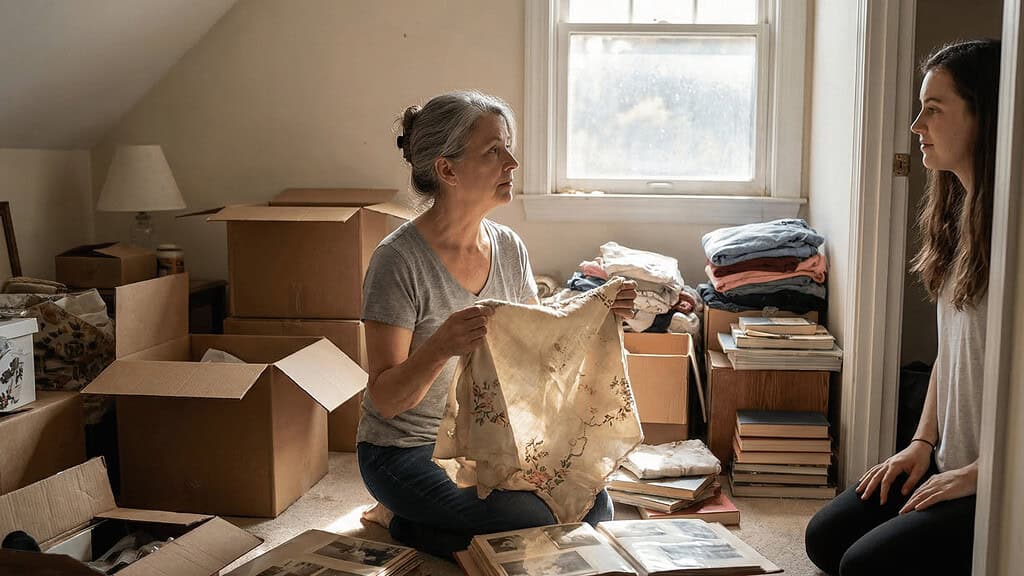
One thing that really helped me was telling my family I was doing this. Not asking for permission, just letting them know. It opened up conversations I didn't expect.
My daughter asked about a few things she actually did want (a small wooden recipe box that had been my mother's). My son said he'd love the old toolbox in the garage. I never would have known if I hadn't brought it up.
The “Throw Away” Box
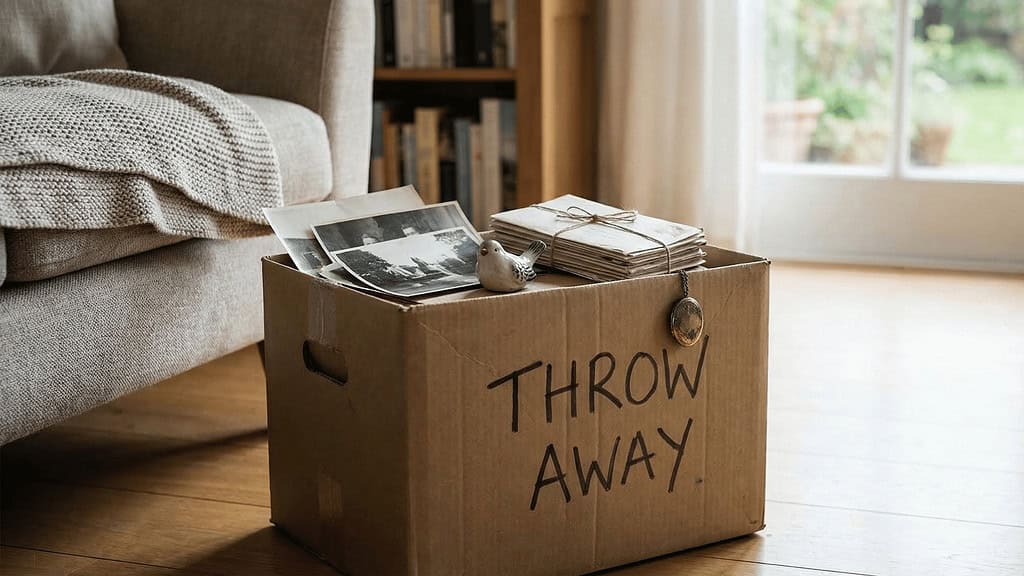
And then there's the “throw away” box. This was one of Magnusson's ideas that I thought was so smart.
You keep a box of things that are meaningful only to you. Things nobody else would care about, but that you're not ready to part with yet. You label it “throw away,” and when the time comes, your family knows they can let it go without guilt.
You've already given them permission.
That little box gave me more peace of mind than I expected. Some things don't need a new home. They just need to be honored while you're still here to enjoy them.
What to Do With the Things You're Ready to Release
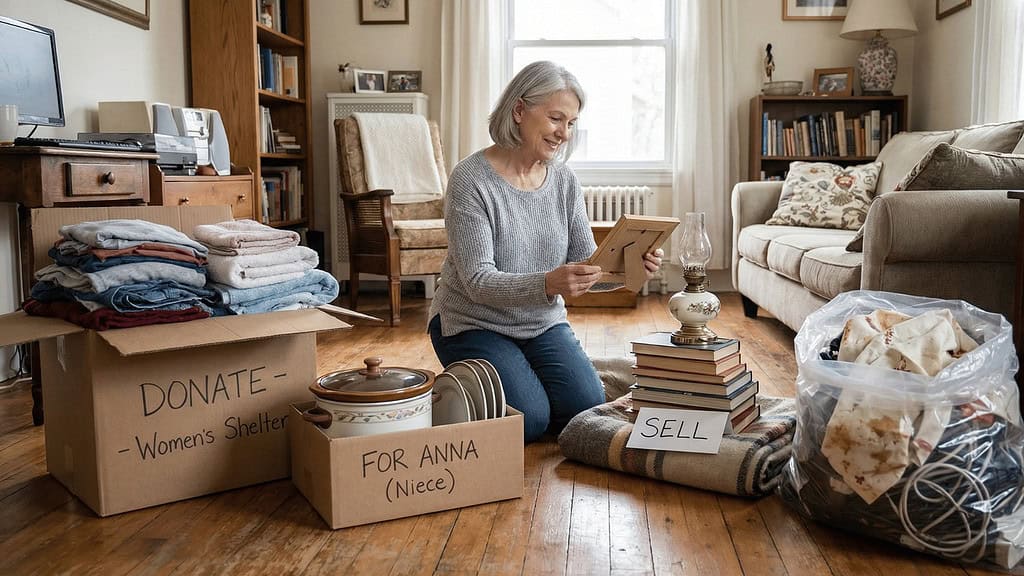
Once you start sorting, the next question is always the same. Where does it all go?
This was the part that used to trip me up with regular decluttering. I'd fill bags and boxes and then they'd sit by the front door for weeks because I couldn't decide what to do with them.
Swedish death cleaning helped me think about this differently, because the focus isn't just on getting things out.
It's on where they will end up.
Give It to Someone Specific
The first thing I'd suggest is giving things directly to someone you know will use them.
A neighbor who just moved into a new apartment. A friend at church who mentioned she needed a slow cooker. Your niece who is furnishing her first kitchen.
When you hand something to a specific person and see them light up, it doesn't feel like losing it. It feels like passing it along.
Sell What Has Value
For things that have real value, selling is a perfectly good option. I've had luck with Facebook Marketplace and a local consignment shop for furniture and home items.
The money is nice, but honestly the better part is knowing the item went to someone who wanted it enough to come pick it up.
Donate With Intention
Donating works too, but I've learned to be more intentional about it.
Instead of dropping everything at the nearest donation center, I look for places that actually need what I have. A women's shelter that furnishes apartments. A church that runs a clothing closet. A retirement home that accepts books and puzzles.
It takes a little more effort, but it feels so much better than just dumping bags at a drop-off and driving away.
Let the Rest Go
And then there are the things that nobody wants. The stained tablecloth. The broken picture frame you kept meaning to fix. The mystery cables in the junk drawer.
Those just need to go. No guilt. You kept them long enough.
The hardest part of letting go isn't the stuff itself. It's the feeling that you're letting go of the life attached to it. But what I've found is the opposite is true. The less I hold onto, the lighter everything feels.
And the memories that matter? Those stay with you no matter what.
This Isn't About Death. It's About How You Want to Live.
When I started this process, I thought I was doing it for my kids.
And part of it is for them.
I don't want them standing in my garage someday trying to figure out what to do with thirty years of stuff while they're already dealing with enough.
But the longer I've been at it, the more I realize I'm doing it for me.
My home feels calmer now. Not perfect, not empty, just more intentional. Every room has a little more breathing space.
Every drawer I open makes sense. And I don't have that low-grade guilt anymore about all the things I kept telling myself I'd get to eventually.
Swedish death cleaning sounds like an ending. But for me, it's been the opposite. It feels like clearing a path so the next chapter has room to actually happen.
You don't have to do this all at once. You don't have to start with the hard stuff. You don't even have to call it death cleaning if the name bothers you (I didn't for a while).
Just pick one closet. One shelf. One box you've been stepping around for months. Start there, and see how it feels.
I think you'll be surprised.
Ready to Make This Easier on Yourself?

If Swedish death cleaning has you thinking about your own home right now, my free Declutter for Self Care Checklist can help you take that first step without second-guessing where to begin.
It walks you through the process in a way that actually feels doable, even on the days when your motivation is low and the mess feels bigger than your energy.
FAQ
What is Swedish death cleaning?
Swedish death cleaning, or döstädning, is a slow and intentional way of going through your belongings so the people you love won't be left to do it after you're gone. It was made popular by Margareta Magnusson's book, The Gentle Art of Swedish Death Cleaning. The process isn't about getting rid of everything. It's about keeping what matters, letting go of what doesn't, and making thoughtful decisions about where your things end up.
At what age should you start Swedish death cleaning?
Magnusson suggested starting around age 65, but there's really no wrong time. The earlier you begin, the less overwhelming it feels because you're working through things while you still have the energy and clarity to do it on your own terms. Some people start in their 50s, especially if they're thinking about downsizing or just want a simpler home.
How is Swedish death cleaning different from regular decluttering?
Regular decluttering is usually about making your space look better or feel more organized. Swedish death cleaning goes a step further. It asks you to think about what will happen to your things after you're gone and whether keeping something is truly helpful or just creating a burden for someone else. The motivation behind it is different, and that's what makes it stick.
What should you start with when Swedish death cleaning?
Start with the least emotional category you can think of. For most people that's clothing, kitchen extras, or storage areas like the garage or a spare closet. Save photos, letters, and sentimental items for much later in the process. Starting with the easy stuff builds momentum and keeps you from burning out before you get to the things that really need your attention.
How do I talk to my family about Swedish death cleaning?
You don't need to make it a big formal conversation. Just let them know you've been going through things and ask if there's anything in particular they'd want to keep. Most of the time, people are relieved you brought it up. It opens the door to honest conversations about what matters to them and takes the guesswork out of what to do with your things down the road.
Follow me elsewhere!

