
A few years ago, my husband and I had what I'd call a quiet argument over a closet.
I had spent the better part of a Saturday clearing out our hall closet. Pulled everything out, sorted it, donated two full bags, and put back only what made sense. When I was done, you could actually see the back wall.
I even wiped the shelf down (that's how good I was feeling about it).
Two days later, I opened that closet and found a stack of his old magazines, a bag of tools from the garage, and a jacket he'd pulled out of the donation pile sitting right on top of the shelf I had just cleared.
He didn't think he'd done anything wrong. And honestly, from his side, he probably hadn't.
He just needed somewhere to put a few things and the closet had space now.
But I stood there staring at that shelf and thought, why do I even bother?
That feeling followed me around for a while. Because it wasn't just the closet.
There were weekends where I pulled everything out of a room with big plans and ran out of energy by 2pm, so I shoved most of it back in and closed the door.
There were days I spent a whole morning decluttering the kitchen, then stopped at a store on the way to pick up groceries and came home with a candle and a clearance basket I didn't need (without even thinking about it).
I kept telling myself I was bad at decluttering. That I just didn't have the discipline for it.
But the real problem wasn't effort. It was that there were things quietly working against me that I didn't even recognize until I stopped and looked at the pattern.
These are the five that got me the most. And once I finally saw them for what they were, everything started to change.
5 Things That Were Quietly Working Against Me
I didn't recognize most of these until I'd been stuck in the same cycle for a long time. Some of them were external. Some were completely internal. And one of them I didn't even notice I was doing until a friend pointed it out.
If your decluttering efforts keep stalling and you can't figure out why, one of these might be the reason.
1. The Person in Your House Who Doesn't See the Clutter the Way You Do
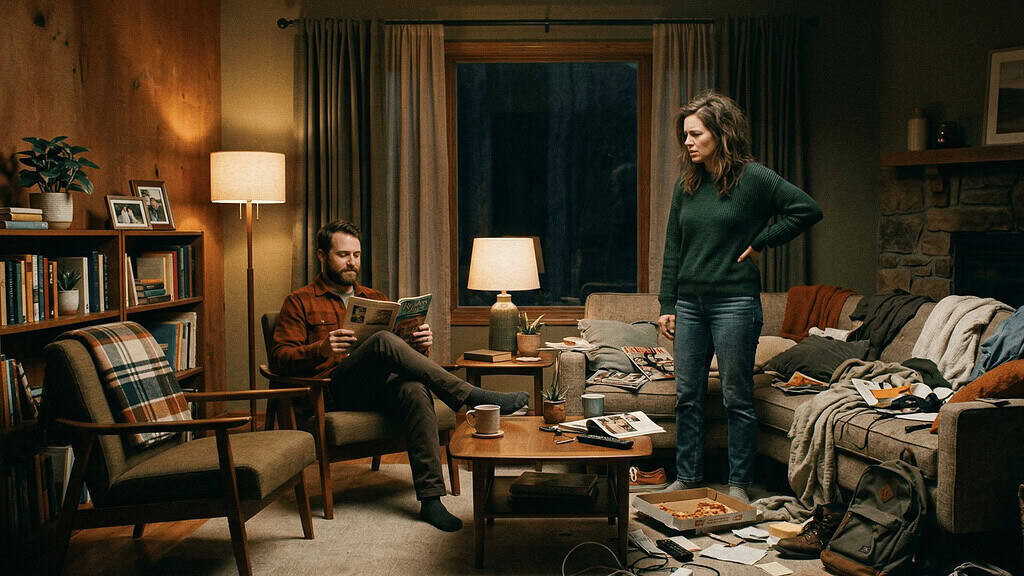
I want to be careful here because this isn't about blaming anyone.
My husband is a good man. He helps around the house. He's not lazy and he's not doing anything on purpose.
He just doesn't see the clutter the same way I do.
I'll walk into the kitchen and notice the stack of mail on the counter, the three coffee mugs by the sink, and the bag of stuff from the hardware store that's been sitting on the chair for a week.
He walks into the same kitchen and sees nothing wrong.
It used to drive me crazy.
I'd clear a space, and within a few days it would fill back up. Not with junk, just with his things that didn't have a home yet. To him, he was putting something down.
To me, he was undoing an hour of work.
The worst part was the donation pile. I can't tell you how many times I'd set something aside to give away and find it back in the closet a week later because he “wasn't sure if we still needed it.”
I tried explaining. I tried asking. I even tried decluttering while he was out of the house (which worked until he noticed things were gone and got quiet about it for two days).
What finally helped was a conversation that wasn't about the stuff at all. I told him how the clutter made me feel.
Not annoyed. Not angry. Just heavy.
Like I couldn't breathe right in my own home. That landed differently than “can you please stop putting things on the shelf I just cleared.”
He didn't become a minimalist overnight. He still leaves things on the kitchen counter.
But he stopped pulling things out of the donation bags. And he gave me the hall closet as my space to manage however I wanted (no questions asked).
That was enough.
If you're living with someone who doesn't share your vision for the house, the answer probably isn't a bigger argument.
It's a different conversation.
One that's less about the stuff and more about how the stuff makes you feel.
Not everyone will get on board completely. But most people will meet you somewhere in the middle if they understand what's really at stake for you.
2. The Emotional Weight Nobody Warns You About

Every decluttering article I've ever read makes it sound so simple. Sort your stuff. Keep what you use. Let go of the rest.
Nobody mentions that you might end up sitting on the floor of your spare bedroom holding a box of your daughter's baby shoes and crying at 2 in the afternoon on a Tuesday.
That happened to me. More than once.
The practical side of decluttering is easy to understand. The emotional side is what actually stops people. And at this stage of life, the emotions hit differently than they do when you're thirty.
Here's what I mean.
Guilt…
… will convince you that getting rid of a gift means you don't love the person who gave it to you. I kept a set of dishes from my aunt for over a decade because I couldn't separate the dishes from the woman.
They weren't my taste. I never used them.
But every time I tried to put them in the donation pile, I felt like I was giving her away.
Grief…
… makes certain objects feel irreplaceable. After my mother passed, I kept things I would have never kept otherwise. Worn-out kitchen towels. A chipped mug. A sweater that didn't even fit me.
They weren't valuable. They just smelled like her house.
Identity…
… is the sneaky one. Some of the hardest things for me to let go of were things tied to a version of myself that doesn't exist anymore.
The sewing supplies from when I thought I'd take up quilting. The books from a career I retired from years ago.
Letting go of those things felt like admitting that chapter was really over.
None of these feelings are wrong. But if you don't recognize them for what they are, they'll keep you frozen in front of every closet and cabinet in your house.
What helped me was naming the feeling before making the decision.
I'd pick something up and instead of asking “do I need this?” I'd ask “what's actually making this hard to let go of?” Once I could name it (guilt, grief, identity), the grip loosened. Not all the way.
But enough to make a decision and move forward.
3. All the Preparing in the World Won't Clear a Single Shelf

This one took me the longest to admit to myself. Because it felt so much like progress.
I spent weeks getting ready to declutter.
I watched YouTube videos about organizing methods. I read blog posts (the irony is not lost on me). I joined two Facebook groups about simplifying your home. I made a room-by-room checklist with color-coded categories.
I even bought matching bins from Target before I even knew what was going in them.
And after all of that, not a single thing had left my house.
I was planning to declutter the way some people plan to exercise. The research felt productive. The supplies felt like commitment.
But the actual doing kept getting pushed to “next weekend” or “when I have a full day free” or “after the holidays.”
The truth is, preparing felt safe. But starting? it felt scary.
Because starting meant opening a closet and making real decisions about real things. And I already knew from experience that those decisions weren't always easy.
So I stayed in planning mode, where everything was still theoretical and nothing could go wrong.
What finally broke the cycle was embarrassingly simple.
My friend Karen came over one afternoon and said, “Show me one drawer that's bothering you.” We stood in my kitchen and went through the junk drawer together in fifteen minutes.
No system. No bins. No checklist.
Just two people making quick decisions and putting things in a trash bag.
That fifteen minutes did more than all my weeks of preparing combined.
If you've been getting ready to declutter for a while now but nothing has actually left your house, I'm not judging you. I've been exactly where you are.
But at some point, the planning has to stop and the doing has to start.
Pick one drawer. Set a timer for ten minutes. And just begin.
The bins can wait.
4. The Big Dramatic Reset That Backfires Every Time
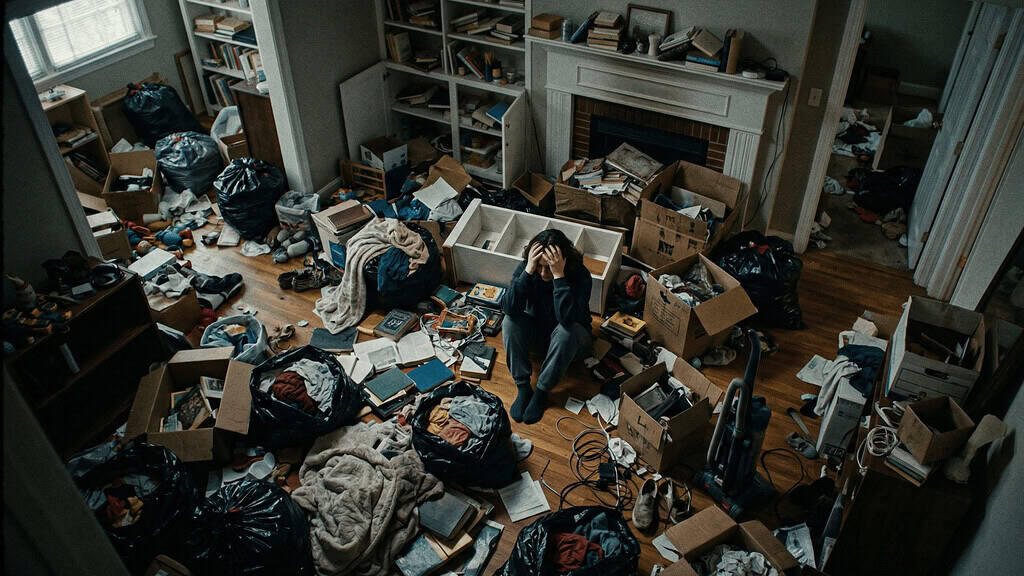
I have done this more times than I want to admit.
You wake up on a Saturday morning full of energy. Today is the day. You pick a room, maybe the guest bedroom or the garage, and you pull everything out.
All of it. Boxes, bags, bins, piles. You spread it across the floor because you saw someone on YouTube do it that way and it looked so satisfying.
By noon, you're making good progress. By 2pm, you're tired. By 3pm, you're standing in the middle of a room that looks worse than it did when you started, and the energy you woke up with is completely gone.
So you do what I've done at least four times.
You shove everything back in. Maybe a little less neatly than before. You close the door. You tell yourself you'll finish next weekend.
Next weekend never comes.
The problem isn't the motivation. The motivation was real.
The problem is that decluttering a whole room in one shot takes more time and more emotional energy than most people have in a single afternoon. Especially when you're sorting through things that carry any kind of weight.
What works better (and what I finally switched to) is smaller, contained sessions.
One shelf. One drawer. One box.
Fifteen to twenty minutes at a time, and then you stop. Even if you want to keep going, you stop. Because the goal isn't to finish in one dramatic sweep. The goal is tokeep showing up without burning out.
The women I know who have actually transformed their homes didn't do it in a weekend.
They did it in ten-minute stretches over months. Slowly, steadily, and without ever ending up standing in the middle of a room wanting to cry.
That's the version that actually works.
5. You Can't Declutter Your Way Out of a Shopping Habit

This is the one nobody wants to talk about. Including me.
Because I didn't even realize I was doing it until my daughter pointed it out.
She was visiting for the weekend and watched me come through the front door with a bag from HomeGoods. I had just spent the morning clearing out a kitchen cabinet.
She looked at the bag, looked at me, and said, “Didn't you just get rid of stuff this morning?”
She wasn't being mean about it. But it hit me right in the chest because she was absolutely right.
I had spent two hours making space in my kitchen. And then, without even thinking about it, I stopped at a store on my way to get groceries and brought home a new cutting board, a set of tea towels, and a ceramic dish I had no plan for.
Just because they were pretty and on sale.
This was my pattern, and I'd never seen it clearly until that moment.
One bag goes out. One bag comes in.
The house never actually changes.
And it wasn't just HomeGoods. It was the Amazon boxes that showed up two or three times a week. It was the clearance aisle at Target. It was the “treat yourself” purchases after a long day that ended up in a drawer and never came back out.
I wasn't shopping because I needed things. I was shopping because it felt good in the moment. And that quick hit of “something new” was quietly undoing every decluttering effort I made.
What finally helped me was a simple rule I gave myself. Nothing new comes into the house for 30 days unless it's replacing something that's broken or genuinely used up. Groceries and essentials, fine. Everything else waits.
The first week was uncomfortable. By the third week, I stopped noticing. And by the end of the month, I looked around my kitchen and realized that for the first time in years, the progress I'd made actually stayed.
The clutter wasn't coming back because I'd finally stopped feeding it.
Your Decluttering Efforts Were Never the Problem
If you've been beating yourself up for not making progress, I want you to hear this. You were never lazy. You were never bad at decluttering.
You were just working against things you couldn't see.
- A spouse who fills the space you just cleared.
- Emotions that turn a simple decision into an hour-long standoff with yourself.
- Planning that feels productive but never actually moves anything out the door.
- Weekends that start with big energy and end with everything shoved back in.
- And a shopping habit that keeps bringing in what you're trying to get out.
Those aren't failures. Those are patterns. And once you can name them, you can start working around them instead of wondering what's wrong with you.
You don't need more motivation. You don't need a better system. You don't need to try harder.
You just need to know what's been getting in the way. And now you do.
Start with the one that hit closest to home. (just that one) Figure out what it looks like in your life and make one small change.
That's enough for now.
Need a Place to Actually Start?

If you've been stuck in the cycle of decluttering and re-cluttering for a while now, my free Declutter for Self Care Checklist can help you break out of it.
It gives you a clear starting point and a process that won't burn you out or leave you standing in the middle of a room wondering what just happened.
Frequently Asked Questions
Why do my decluttering efforts never seem to stick?
Most of the time it's not about effort. It's about patterns you haven't noticed yet. Things like bringing new items in while trying to get old items out, or trying to do too much in one session and burning out before you finish. Once you identify what's quietly working against you, the progress starts to hold.
How do I declutter when my spouse doesn't want to?
Start with your own things and your own spaces. Don't touch their stuff without asking. The conversation that tends to work best isn't about the clutter itself but about how the clutter makes you feel. Most partners will meet you somewhere in the middle once they understand it's not about their things being wrong but about your need for a calmer home.
How do I stop getting emotionally stuck when decluttering?
Name the feeling before you try to make a decision. Ask yourself what's actually making it hard to let go. Is it guilt? Grief? Fear of regret? Once you can identify what's behind the hesitation, the decision gets clearer. And give yourself permission to skip the emotional items and come back to them later. You don't have to tackle the hardest stuff first.
Why does my house look the same even after I declutter?
The most common reason is that new things keep coming in at the same rate old things go out. If you're decluttering regularly but not seeing a difference, take a look at your shopping habits. Even small purchases add up quickly. Try pausing all non-essential purchases for 30 days and see if the progress starts to show.
How long should a decluttering session last?
Shorter is almost always better. Fifteen to twenty minutes is enough to make real progress without draining your energy. The people who stick with decluttering long term are the ones who go in small, consistent stretches rather than marathon weekends that leave them too exhausted to do it again.
Follow me elsewhere!

