Why Hoarding Often Starts (Or Gets Worse) After 60

I was up late reading the other night. One of those long articles I'd been meaning to get to about something else entirely. And somewhere in the middle of it, a single line stopped me.

A researcher at the University of California San Diego, a psychiatry professor named Catherine Ayers, has been studying this for years. She put it about as plainly as anyone can.

There's only one mental health condition besides dementia that gets more common, and more severe, the older you get.

It's hoarding.

Not anxiety. Not depression. Not anything else.

Just hoarding.

And the statistics are honestly stunning when you sit with them. Researchers studying late-life hoarding estimate it affects around seven percent of adults over sixty. Among adults over seventy, the rate goes even higher. The clinical work on this comes from groups like the CREST treatment trial, an NIH-funded study currently looking at why hoarding gets worse with age and what actually helps people who are dealing with it.

I set the article down.

Looked across the living room at the bookshelf I'd been meaning to deal with for six months.

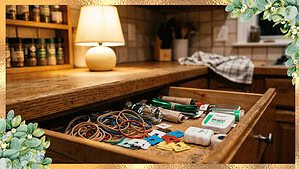
Walked into the kitchen and stared at the drawer with the rubber bands and the twist ties and the dental floss containers I keep saving for some reason I still can't quite explain.

And I asked myself the question I keep coming back to lately.

When did this start?

Because it wasn't like this when the kids were home.

It wasn't like this when I was forty-five.

Something has been changing in the last few years, and I don't think it's me, exactly. I think it's me-plus-the-math-of-being-sixty-something.

If you've been wondering the same thing about your own house, about your own slow-growing piles, about why this seems to be getting harder instead of easier, this post is for you.

What I'm about to walk through isn't a diagnosis. It isn't a checklist. It isn't an alarm.

It's an honest acknowledgment that for a lot of women our age, the house started filling up around the same decade. And there are real, specific reasons for that, none of which mean we're hoarders.

Some of them are about our lives.

Some of them are about our brains.

Some of them are about our loved ones.

And once you can name what's actually happening, the whole conversation gets easier.

Why Hoarding After 60 Is More Common Than Anyone Talks About

A wooden bookshelf in a living room with books stacked horizontally on top of vertical ones and small decorative items filling the gaps with warm lamplight beside it

The clinical research is hard to ignore once you go looking.

Researchers used to assume hoarding tendencies started in middle age and just stayed steady. More recent studies, with longer follow-ups, suggest hoarding tendencies often intensify rather than level off after sixty. For women who have any tendency toward saving, accumulating, or struggling to let things go, those tendencies don't always stay where they were.

That isn't a failure of willpower.

It isn't a sign of declining character.

It's something measurable that happens to a lot of us, and almost nobody is talking about it in a way that doesn't make us feel pathological.

The women I know in their sixties and seventies are not, by and large, in trouble. They're not living in homes that look anything like what you'd see on a Sunday-night documentary. They have safe houses. They have visitors. They have lives.

But almost every one of them has noticed something.

The closet that didn't used to look like this.

The garage that's harder to walk through than it was three years ago.

The drawer in the kitchen that has, somehow, gotten away from her.

The room she avoids on a Saturday morning because the thought of dealing with it feels heavier than it used to.

Most of these women are not clinical hoarders. Most of them never will be. But the slow drift toward fuller houses is real, and it isn't a moral failing.

It's a combination of things happening in our lives right now that we mostly don't notice because they happen one at a time, over years, in different rooms of the house.

When you put them all together, the picture is pretty clear.

Let me walk you through six of them.

Why the House Got So Full Without You Adding Much

A wooden kitchen counter holding a ceramic casserole dish a small pile of unopened catalogs a glass jar with kitchen utensils and a folded dish towel

This is the one almost nobody warns you about.

When the kids were home, the house had a kind of natural breathing rhythm. Things came in. Things went out. Toys got donated. Outgrown clothes got passed along. Old furniture got broken or replaced. The house was a machine for processing belongings, and the kids were the engine.

When the kids moved out, the engine left.

But the house kept doing what it had always done. It kept receiving things. Just not at the same pace, and not in the same way.

Now it's birthday gifts you don't really need.

Read related post:   How to Declutter Multiple Rooms on Your Own (Especially if you have Chronic Illness)

Holiday decorations from neighbors who downsized.

A casserole dish a friend brought over and never came back for. Inherited objects from your mother's house. Inherited objects from your husband's parents' house.

The yarn from the project you were going to finish.

None of this is dramatic.

You barely added anything yourself.

But the house kept receiving, and now there's nobody leaving with a U-Haul to balance the equation.

This is the most common reason women in their sixties find themselves with a fuller house than they want. Not because they hoarded anything. Because the natural emptying-out of the previous decades stopped happening, and nobody mentioned that it would.

If you've been blaming yourself for the volume, please stop.

You didn't get worse.

The math of your life changed.

Retirement Changed Where You Live

A quiet living room with a comfortable armchair a small side table holding a coffee mug an open book and a folded blanket with morning light through a window

I know not every woman reading this is retired.

Some of you are still working. Some of you have husbands who retired and made the house feel different overnight. Some of you took on grandkid duty that means you're home more even if you're technically still working part-time.

But whatever your version of it looks like, something happened in your sixties that changed the relationship you have with your house.

Your house stopped being where you sleep and started being where you are.

That sounds small. It isn't.

When you're at home eight hours a day instead of two, you notice things. You see piles you used to walk past on the way out the door. You start projects in rooms you used to barely enter. You bring home craft supplies because suddenly you have time for crafts.

You also start finding yourself online a lot more. Shopping a little more. Ordering a little more.

None of this is failure.

It's what happens when a house transitions from being your in-between space to being your main space.

The volume of stuff in the house has to grow to match how much living you're now doing inside of it. And nobody tells you that the rebalancing takes a while. Some women never quite rebalance, because the volume of stuff keeps growing faster than the energy to manage it.

If this is what's been happening to you, you're not unusual.

You're just doing your sixties.

Every Loss Comes With a Box

A single plain cardboard box sitting on the wooden floor of a spare bedroom near a closed closet door with soft afternoon light coming through a window

This is the section I almost didn't want to write.

In your sixties, the math of loss starts to feel different.

Your parents are likely gone, or going. Your in-laws are gone. The friends who were old when you were young are gone. Sometimes a sibling. Sometimes a husband, although I hope that hasn't happened to you yet.

And the thing nobody tells you about loss is that every single person who dies leaves a house full of objects somebody has to sort.

Some of that sorting falls to you.

Some of those objects come home with you.

Almost every woman I know in her sixties has at least one box, often several, that came from a parent's house and has not been opened since. Sometimes it sits in the garage. Sometimes it sits in the spare bedroom. Sometimes it sits in the basement, where you can't see it but you can feel it.

You can't throw it away because it's the last physical trace of your mother or father or brother.

You can't open it because you don't have the emotional bandwidth to sort through it yet.

So it sits.

And eventually, another loss happens, and another box arrives, and another box sits.

This is not hoarding.

This is grief that hasn't had time to finish its work, sitting in the spare bedroom in cardboard form. The grief that comes after losing a spouse has its own specific shape, but every kind of loss can leave a trail like this.

The first step out of it, when you're ready, is gentle. Not the whole basement at once. Not the whole spare bedroom. Just one box. On one Saturday. When you have someone you trust nearby.

There's no rush.

But the boxes are real, they add up, and they're one of the biggest reasons the houses of women in their sixties and seventies start to feel fuller than they used to.

The Decisions Got Harder

A folded cream-colored wool sweater on a wooden closet shelf with several other folded sweaters stacked beside it and a soft natural light from the side

You used to walk into a closet, look at a sweater, and decide.

Donate. Done.

Now you walk in, look at the same sweater, and stand there.

You don't know if you'll wear it again. You don't know if your daughter would want it. You don't know if it would fit you next year if your weight changes. You don't know if it cost too much to give away. You don't know if you'll regret it.

So you put it back.

This isn't laziness. It isn't even indecisiveness, exactly. It's something the researchers actually have a name for. The frontal lobe of the brain, the part that handles quick decisions about what to keep and what to let go, gets slower with age. Not impaired, in most cases. Just slower. More careful. More committed to making sure each decision is the right one.

That's a beautiful thing in some contexts. You make fewer impulsive decisions about money, about relationships, about the big stuff. The same protective slowdown that keeps you from making bad calls also keeps you from making fast calls.

But it makes the closet harder.

Every object becomes a small decision. And after sixty years of making thousands of decisions a day, sometimes the well of decision-making just runs lower than it used to.

Read related post:   What To Do With Perfumes You No Longer Enjoy

You're not getting worse at organizing.

You're getting more careful with every choice.

Which means more of those choices get postponed. And the closet, slowly, fills.

This is one of the most validating things to understand. The pile isn't growing because you don't care anymore. It's growing because you care almost too much, and your caring takes longer than it used to.

The Energy Doesn't Match the Pile

A single kitchen drawer pulled open showing a few utensils neatly arranged in dividers with a wooden cutting board and a glass of water on the counter above it

This is the one nobody wants to say out loud.

The body in your sixties is not the body you had at thirty-five.

The closet you used to clean in an afternoon, with energy left over for laundry afterward, now feels like a three-day project. The garage that used to be a Saturday job is now a weekend job, and you don't really have weekends like that anymore.

It's not that you've lost interest in keeping the house the way you want it.

It's that the math of energy versus volume has tipped in a way it didn't used to be.

When you were forty, your energy was higher than the pile. When you're sixty-five, sometimes the pile is higher than your energy. And that gap, on a Saturday morning when your back hurts and you didn't sleep well, is the gap between a house that empties and a house that doesn't.

This is normal. It's also fixable, although not in the way most decluttering advice would suggest. The fix isn't a bigger weekend project. The fix is breaking the project into the smallest possible pieces and accepting that you'll need months instead of days.

One drawer this Saturday.

One shelf next Saturday.

One box the Saturday after that.

If you wait until you have the energy to take on a whole room, you might be waiting forever.

But one drawer is almost always possible.

And the women I know in their sixties who have made real progress on their houses haven't done it through marathon weekends. They've done it the way you eat a long meal. One bite at a time, over months, with rest in between.

The Frugality That Served You Until It Didn't

A clean Ziploc bag draped over the back of a wooden kitchen chair to air dry with a row of clean glass jars on the windowsill behind it in soft morning light

This is the section about the women who taught us to save.

If you were raised around women who lived through the Depression or the war years, you were raised around the kind of thrift that ran deep.

Maybe it was your mother. Maybe your grandmother. Maybe an aunt who watched you on Saturdays, or a neighbor lady who became like family, or a great-aunt who lived with you for a few years when you were small.

They saved things. Glass jars. Aluminum foil. Bread bags. String. Buttons from worn-out shirts. The little plastic bins that yogurt comes in.

You watched them wash a Ziploc bag at the kitchen sink and hang it on the back of a chair to dry, and you absorbed something deep without anyone teaching it to you explicitly.

You don't throw things away that still have life in them.

That's what they taught you.

And it was the right lesson for their time. They lived through real scarcity. They raised families, sometimes during decades when whole communities had almost nothing. The thrift they practiced wasn't a quirk or a hobby. It was how a generation of women kept their families fed and clothed through impossible decades.

You inherited that lesson, and for most of your adult life it served you well.

You bought better quality so things lasted longer. You saved on small things so you could spend on big ones. You took care of what you had instead of replacing it.

But your sixties are not their sixties.

You don't live in scarcity. You live in abundance. The world you actually live in does not require you to wash and re-use Ziploc bags. It does not require you to save the string from the meat-counter wrapping. It does not require you to keep three working coffee makers because one of them might fail.

The thrift instinct that served them, and that served you for forty years, is still active in you at sixty-five, but the conditions it was built for no longer apply.

Your kitchen does not need ten years of glass jars. Your closet does not need every “could be useful” garment from the last decade. Your basement does not need to be a backup supply chain.

This isn't a criticism of the women who raised you. They were right for their time.

It's a permission to be different for yours. The “I might need this someday” voice was a gift from the women in your life, and it was a good one. But you get to decide which parts of it still apply.

Most Women Aren't Actual Hoarders (And You're Probably Not Either)

A tidy front room with a vase of fresh flowers on a small wooden table a comfortable armchair with a folded throw blanket and a window letting in warm afternoon light

Almost everything I just walked you through can sound, on paper, like the early stages of something serious.

It isn't.

Real hoarding disorder, the clinical kind, looks fundamentally different. Rooms can't be used for what they're meant for. The person feels real distress at the idea of letting any object go. Visitors aren't allowed. Safety becomes a real issue.

If that's not your house, you're not a hoarder. You're a woman in her sixties whose life has filled up the same way most of our lives fill up at this age.

I wrote a longer post about the difference between resourceful savers, pack rats, and actual hoarders, and it might be worth reading if you want to figure out where you actually land.

Read related post:   15 Easy DIY Home Organization Ideas For A Clutter-Free Life

Most women fall in the middle. Pack-rat tendencies, growing slowly, with some real reasons behind them. Not in crisis. Just a little fuller than ideal.

What concerns me about how this conversation usually goes is that women in their sixties get scared by articles like this and rush to overcorrect. They throw out things they later regret. They start treating their own house like a problem to be solved instead of a home to be tended. They get aggressive with themselves about decluttering, and they often don't feel any better afterward.

I don't want that for you.

The math of your house didn't change because you got broken.

The math of your life changed. Your kids moved out. You're home more. You inherited boxes. Your decisions got more careful. Your body has less energy. The lessons from the women who raised you are still talking to you. All of that is true at once.

You don't need to fix yourself.

You need to notice what's happening, name it accurately, and decide which of these things you actually want to address. Finding the motivation to keep going often starts with this kind of honest naming, not with a guilt trip.

Some of you will read this and realize the slow drift has gone further than you knew. If that's true, please don't panic. Get an honest second opinion from someone you trust. Talk to your doctor if you're worried. Read my fuller piece on the question of whether you're a hoarder.

Most of you, though, will read this and realize you're fine. You're just sixty. Your life shifted, and your house followed along.

That's not a failure.

It's just where the math landed.

What Comes Next

Free Declutter for Self Care Checklist printable guide

If reading this has made you want to do something, even one small thing, that's the only thing that matters.

Not a whole-house reset. Not a guilt-driven purge. Just one small acknowledgment that some of the volume in your house no longer matches your life, and you'd like to start making space for the woman you actually are now.

My free Declutter for Self Care Checklist is exactly that. A gentle, room-by-room companion that doesn't ask you to do anything dramatic. It just helps you notice what's no longer serving you and gives you permission to take it as slowly as you need.

It was made for women in their sixties and seventies. Women whose houses have been slowly filling up, whose energy has been quietly running shorter, whose decisions have been getting more careful.

No timeline. No schedule. Whenever you're ready, even if that's months from now, the checklist will be here.

Frequently Asked Questions

Is hoarding really more common after 60?

Yes, and the research is unusually consistent on this.

Researchers studying late-life hoarding, including Catherine Ayers at UCSD and the team behind the NIH-funded CREST treatment trial, have shown that hoarding is one of the only mental health conditions where prevalence and severity both increase with age. Around seven percent of adults over sixty are believed to be affected, with rates climbing higher in those over seventy.

This doesn't mean every woman over sixty becomes a hoarder. Most don't. But it does mean the slow drift toward fuller houses is real, measurable, and not something you imagined.

How do I know if I'm a hoarder or just a normal woman in her sixties?

The clearest test is whether your house still functions.

If you can walk through every room safely, use rooms for what they were designed for, have visitors when you want to, find what you're looking for most of the time, and feel okay letting things go when it's time, you are almost certainly not a hoarder.

A pack rat with some accumulation? Probably. A woman whose life changed and whose house followed along? Likely. But hoarding is a specific clinical condition that involves significant impairment in daily function, and most women noticing extra clutter in their sixties aren't there.

If you're genuinely worried, please talk to your doctor or a therapist who specializes in hoarding behaviors. The conversation alone usually helps clarify things.

My mother kept everything. Am I going to repeat her pattern?

Probably not in the way you're afraid of.

Research on this is hopeful. Daughters who grew up around heavy savers tend to be more aware of clutter, not less. The awareness usually protects you. What you might want to watch for is the opposite pattern, where you overcorrect and throw out things you later regret.

If your mother was a frugal saver who never crossed into clinical hoarding, you've inherited some of her thrift instincts, but you're operating in a different world than she was. The lessons that served her don't all need to apply to you anymore.

What should I do if I notice my house has gotten away from me?

Start small.

The most successful women I know who've turned this around did it in tiny pieces over months, not weekends. One drawer. One shelf. One box from your mother's house when you have the emotional energy for it.

Don't try to fix the whole house at once. Your sixties are not the decade for that kind of project, even if you had the energy. They're the decade for slow, steady, kind attention to what's no longer serving you.

If you want a starting structure, the free Declutter for Self Care Checklist above is a good entry point. Otherwise, pick the smallest possible space in your house and start there.

When should I worry about a parent or family member?

Worry isn't quite the right word.

Pay attention. Is the home still safe to walk through? Is your parent still eating well? Are they still allowing visitors? Are they avoiding certain rooms?

If you have real concerns, a conversation with their doctor or with a geriatric care manager in their area can help you think through what to do next. Forced cleanouts almost always make hoarding worse, so if you're worried about a parent, please don't try to fix it without their participation. Their cooperation is what makes any progress stick.

Follow us on PinterestFollow
Follow me elsewhere!

Leave a Comment