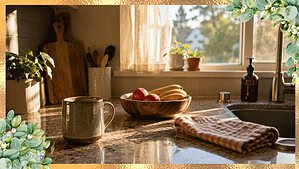
9 Habits That Keep My Home Clutter-Free Year After Year

I didn't sit down one day and decide to have a clutter-free home.

The habits crept in slowly, over years. I didn't even notice I was building them. Some came from watching my mother. Some came from a magazine article I read in my fifties. Some came from a friend I admired whose house always felt different from mine. And some came from making the same mistake so many times that I finally, without planning to, stopped making it.

Last month, I was standing in my kitchen one morning with a cup of coffee, looking around, and I realized something.

The counter was clear. The mail wasn't piled up. The chair where I drop things had nothing on it. The closet by the front door, the one I used to dread opening, had been opened twice that week without me bracing first.

For the first time in maybe twenty years, my house had stopped feeling out of control.

I hadn't done anything big. There was no weekend purge that fixed it. There was no system I'd downloaded. There wasn't even a particular method I'd followed. The habits had just slowly added themselves into my days, one at a time, until the house caught up.

I wanted to write them down before I forgot what they were.

Because if you're reading this and your house feels like mine used to (full, heavy, slightly out of your control, like the math is always working against you), I want you to know something.

You don't need a method. You don't need a marathon weekend. You don't need a personality transplant.

You just need maybe nine small things to slowly become the way you live.

Here are the ones that worked for me.

1. Put It Away, Not Down

A soft cream-colored cardigan hanging on a wooden wall hook by an entryway door with a folded scarf beside it and warm afternoon light on the wood floor

This is the one that sounds too small to matter.

It does, though. More than any other habit on this list.

The way clutter actually accumulates isn't through dramatic events. It's not through bad weeks or busy seasons. It's through one small action, repeated a thousand times: putting something down somewhere it doesn't belong, and telling yourself you'll deal with it later.

The mail goes on the counter. The cardigan goes over the back of the chair in the entryway. The grocery bag, still full, goes on the kitchen floor while you go check your phone.

Each one of those, by itself, is nothing.

Multiplied by every day for forty years, those choices are why your house feels the way it does.

The habit I built (slowly, and after years of doing the opposite) is to give myself one extra moment, one extra step, one extra reach. The cardigan goes on the hook by the door instead of the chair. The mail gets opened standing next to the recycling. The groceries get unpacked before I do anything else.

It takes maybe four extra seconds per item.

But it means that by the end of the day, there's nothing on the dining room table that doesn't belong on a dining room table.

I didn't do this on purpose at first. I noticed I'd been doing it gradually, the way you notice you've started taking the stairs more without remembering when you stopped taking the elevator.

If you adopt only one habit from this entire post, please let it be this one.

2. Process Mail Before It Has a Chance to Pile

Several opened envelopes and a magazine resting on a wooden kitchen counter next to a small recycling bin with morning light from a window

The mail pile on the counter is one of the most universal forms of clutter in American homes.

It's also one of the easiest to fix, because the mail enters your house at a single predictable point, on a single predictable schedule, with most of it being things you'd throw out anyway if you just opened them.

I stand next to the recycling bin and the trash can in my kitchen. I open every piece of mail right there. The catalogs from places I don't shop at go straight into recycling. The credit card offers go straight into recycling. The pleas for donations from charities I never gave to in the first place, recycled in real time.

What's left is typically two or three pieces. A bill. A reminder from the dentist. A letter from someone I love.

Read related post:   How Do You Manage All the Books You’ve Said You’ll Read One Day?

Those get dealt with the same day, before they get a chance to become a pile.

This habit took me about two years to actually adopt. I knew I should. But I'd come home with a stack and just set it on the counter and tell myself I'd get to it that night. Or the next day. Or the weekend.

The shift, for me, was deciding that the mail doesn't get to enter the rest of the house. It stays in the kitchen, by the recycling, until it's either gone or important enough to file. There's no in-between.

The counter is now permanently clear.

3. Wait 24 Hours Before Buying Anything

A closed silver laptop on a wooden kitchen table with a ceramic coffee mug beside it and morning light filtering through a curtained window

This habit started as a money habit. It turned into a clutter habit. They're the same habit.

When I see something online I want to buy, I add it to the cart and close the tab.

Twenty-four hours later, one of two things has happened. I either don't remember it (which means I didn't really want it, my brain was just bored), or I open the tab and the item still genuinely appeals to me. The 24-hour pause exposes the difference between those two states almost every time.

About half the time, I don't go back. The item just stops mattering. Twenty-four hours of regular life were enough to disconnect me from the impulse.

The other half of the time, I do go back, and I buy it. And those purchases tend to be the ones I actually use, because they survived the test.

This is the same pattern that any reverse decluttering approach is built on. The question isn't whether you can get rid of clutter. The question is whether you can stop bringing it in faster than you're letting it out.

The 24-hour pause is the simplest filter I know for that question.

It also saves me, conservatively, several hundred dollars a year.

4. Check the House Before You Check the Cart

An open wooden kitchen drawer showing a wire whisk and a few cooking utensils neatly arranged inside

The duplicate purchase is the most preventable kind of clutter there is.

It's also one of the most common, because almost nobody actually checks before they buy. You see something you need (or think you need), and you order it. A few weeks later, when you're cleaning out a drawer, you find the version of it you already owned and forgot you had.

I've done this with scissors. With reading glasses. With the same exact pillow, twice, three years apart.

The habit I built is the smallest possible intervention. Before I order anything, I take ninety seconds to actually walk into the house and look for it.

If I want a candle, I check the cabinet where candles live. If I want a new notebook, I check the office shelf. If I want anything for the kitchen, I open every drawer first.

Most of the time, I find I already own at least one of the thing I was about to buy.

Sometimes I still buy it. Maybe the one I have is in the wrong place, or worn out, or not exactly what I wanted. But the check protects me from the most common version of duplicate-clutter, which is the one where I buy something I forgot I already owned.

I now have one pair of black scissors instead of three.

It's a small change. The math of it adds up over years. Most of what I've quietly stopped buying falls into the same category: things I already owned and didn't need to own again.

5. One New Sweater Means One Old Sweater Leaves

A wooden closet with neatly folded sweaters in soft neutral colors stacked on wooden shelves with soft natural light

The one-in, one-out rule isn't new, and I didn't invent it, but I'll tell you the version that actually worked for me, because most versions don't.

The mistake I made for years was treating “one-in, one-out” as a same-day rule. You buy the new sweater. The same day, you're supposed to choose which old one leaves.

That never worked. Because in the moment you're holding the new sweater, every old sweater has a story, a memory, a “but it still fits” attached to it. Same-day decisions are almost impossible.

The version that worked is gentler. When a new sweater comes in, I put a sticky note on my closet door. “One sweater needs to leave this week.”

Then for the rest of that week, I notice. I pay attention to which sweaters I reach for, which ones I look at and skip, which ones make me feel uncomfortable for reasons I can't quite name. By the end of the week, one sweater has nominated itself.

That's the one that leaves.

The same rule applies to shoes, hats, and most things in the kitchen that I would otherwise accumulate forever. Coffee mugs. Reusable water bottles.

One in. One out. Within a week, not a day.

The closet has not grown in five years.

6. Don't Bring It Into the House Just to Be Polite

A folded brown paper bag containing clothes resting in the open trunk of a car with sunlight streaming through the back window

This one is harder to talk about, because it sometimes requires you to be a slightly different kind of person than the one you were raised to be.

I was raised to take whatever was offered.

The free sample at the conference. The hand-me-down clothes from your sister-in-law that don't quite fit. The kids' artwork from the friend whose daughter loves you and is now in college.

Read related post:   Quick And Easy Stain Removal Methods (Remove Stains Like A Pro)

You took it. You smiled. You said thank you.

You brought it home.

And then it sat in your house forever, because once it's inside your walls, getting it out feels like rejecting whoever gave it to you, even months later.

The habit I built (which still feels rude to me sometimes, honestly) is to make the decision before the object crosses my threshold. If I know I don't want it, I leave it in the car on the way home, or in the donate bag in my trunk, or in the trash at the venue. If I know I do want it, I bring it in.

Nothing enters my house just because it was offered to me.

The trick that helped me was realizing that the person who gave it to me almost certainly isn't keeping track. The neighbor who gave you the bag of zucchini doesn't expect you to keep the bag. The friend who handed you the swag from her work event doesn't expect to see it on display when she visits.

You can smile. You can say thank you. And you can still decide what gets to live in your home.

7. Never Let a Pile Start (Catch It at One)

A small stack of hardcover books resting on a wooden staircase step with soft natural light from a nearby window

The pile is the unit of clutter.

A pile starts the minute you have two of something together that don't have a home. Two pieces of mail on the counter. Two books on the chair in the bedroom. Two grocery bags on the kitchen floor.

If you catch it at two, it's nothing. You move both items to where they belong. The pile ends.

If you don't catch it at two, it becomes six. Six becomes twenty. Twenty becomes the thing you keep meaning to deal with.

I trained myself to notice the second one.

When I walk into the kitchen and see one piece of mail on the counter, I put it where it belongs immediately. When I walk into the bedroom and see one book on the chair, I shelve it before I do anything else. When the grocery bag is sitting on the floor, I unpack it before I sit down.

I don't always catch them. But I catch most of them. And the math has been transformative.

Most of the piles in our houses are not from one big event. They're from a thousand small failures to intervene at two.

If you can intervene at two, you almost never have to deal with twenty.

8. Fix It or Toss It Within Seven Days

A vintage silver wristwatch resting alone on a wooden kitchen table next to a small white notepad and a pen

The broken thing is its own category of clutter.

The drawer that doesn't quite close. The watch that needs a battery. The shoe with the strap that came loose, the one you keep thinking you'll get repaired.

These things accumulate quietly, because we don't see them as clutter. We see them as “things to deal with eventually.” And eventually never comes.

The habit I built is a seven-day rule. The minute something breaks, I have seven days to either fix it or get rid of it. Not “fix it someday.” Not “deal with it eventually.” Seven days. By the time the next Sunday comes around, the item either works or it's gone.

This rule alone solved about a third of the clutter in my house.

Because so much of what I'd been keeping wasn't even functional. It was just broken stuff I'd been carrying around for years, telling myself I'd deal with it when I had time. The seven-day deadline forced the decision. And the decision was almost always “this isn't worth fixing.” Out it went.

The watch turned out to be one I hadn't worn in eight years.

The shoe with the strap was a shoe I didn't love anyway.

The drawer just needed me to take everything out and put fewer things back.

Seven days. Decide. Then move on.

9. Use the Nice Things Instead of Saving Them

A crystal wine glass filled with water on a wooden kitchen table beside a small white plate with a sandwich and afternoon light through a window

This is the most important habit on this list.

I almost didn't include it, because it sounds less like a decluttering habit and more like a life philosophy. But the longer I've lived in this house, the more I realize they're the same thing.

The reason most homes feel cluttered isn't because they have too many useful things. It's because they have too many things that have stopped being useful, because their owner stopped using them.

The wedding china that lives in the cabinet, untouched, since 1987. The cashmere sweater you're saving for something nice that never quite arrives. The pretty notebook from your daughter, still on the shelf, because it's too pretty to write in.

If you don't use them, they're not nice things. They're clutter that happens to be expensive.

I started using mine, slowly, in my early sixties. The good plates come out for Tuesday dinner. The cashmere sweater gets worn to the grocery store. The wine glasses come down for water with lunch on a Wednesday.

Two things happened.

The first was that my house started to feel like a home I actually lived in, instead of a museum of objects I was saving for later.

Read related post:   What to Do with Old Computers and Phones That You’re Not Using Anymore

The second was that, slowly, the special things I wasn't using either got used, or got given to someone who would use them. The cabinet emptied. The linen closet got smaller. The shelves stopped being full of things I was preserving for a future that never quite arrived.

Use the nice things.

You aren't saving them. You're losing them, one Tuesday at a time, to a future where you'll never enjoy them.

Why These 9 Worked When Nothing Else Did

A clear kitchen counter at the end of the day with a single vase of fresh flowers a folded dish towel and warm golden light from a window

I want to be honest with you about something.

I've tried other systems. The big weekend purges. The marathon decluttering challenges. The KonMari method. The thirty-day declutter calendars. The “fill a trash bag a week” hacks.

Most of them worked for a little while. Then the house refilled.

These 9 habits worked when the others didn't because they aren't about decluttering. They're about not creating clutter in the first place. Or catching it when it's still small enough to fix in thirty seconds.

The other thing I want to be honest about is that I didn't build all 9 of these at once. They came in over years, in no particular order. Some of them I built without knowing I was building them. Some of them I had to consciously work at for months before they became automatic.

If you read this post and try to adopt all 9 at once, you'll burn out by next Thursday.

Pick one. The one that makes you think “oh, that's me, I do that backwards.” Do that one habit for thirty days. When it feels automatic, pick the next one.

A year from now, three or four of these will be the way you naturally live, and your house will be measurably different.

Building habits this way, slowly, is also how you learn to loosen your grip on things that have stopped serving you, which is the deeper work underneath all nine of these.

You won't even remember when it changed.

Where to Start (When You're Ready)

Free Declutter for Self Care Checklist printable guide

If reading this has made you think “I want to actually start somewhere,” the simplest place to begin is also the smallest.

You don't need to overhaul anything. You just need a gentle starting structure that asks the right questions of each space in your home, one small place at a time.

My free Declutter for Self Care Checklist does exactly that. It's a room-by-room companion that helps you notice what's no longer serving you, on your own timeline, with no pressure and no marathon weekend required.

It was made for women in their 60s and 70s who don't need another system. Women who just want a little structure to do the next small thing.

Whenever you're ready. Even if that's six months from now. The checklist will be here.

Frequently Asked Questions

How long did it actually take you to build all 9 of these habits?

About twelve years, honestly.

Some of them I built quickly because they were easy. The 24-hour buy pause took maybe a month to feel natural. Others took years. The “use the nice things” habit was one I struggled with for most of my fifties because I'd been raised to save the good stuff. I had to mentally let go of that training before I could even start.

The point isn't to build all 9 at once. The point is to build one, then notice what changes, then build another. The pace is yours to set.

Which habit should I start with?

If you don't know, start with Put It Away, Not Down. It's the foundational habit that makes all the others easier. Once you can train yourself to put something where it belongs instead of where you happened to be standing, every other habit on this list becomes possible.

If you want a more immediate change, start with Process Mail Before It Has a Chance to Pile. You'll see results within a week.

What if my house is so cluttered that habits feel pointless?

If your house already has years of clutter built up, habits alone won't dig you out. You need a starting purge first, even a small one.

The 5-Minute Decluttering Rule is a good entry point, or the Move-Out Decluttering Method if you want something more substantial. Once you've cleared even one space, the habits become the maintenance system that keeps it that way.

Habits are the system that keeps clutter from coming back. They're not the system that removes clutter that's already there.

Does this work if you live with people who don't share these habits?

Partially.

The buying habits (24-hour pause, check-before-you-buy, one-in-one-out) work regardless of whether anyone else in your house adopts them. They're about you and your own purchases.

The flow habits (put it away, process mail, catch piles at two) only work for the items you personally control. The piles your husband or kids create aren't yours to manage. But your own contribution to the household clutter can become close to zero with these habits, even if no one else changes a thing.

That alone is usually enough to make a noticeable difference.

What's the most underrated habit on this list?

Use the Nice Things Instead of Saving Them.

Almost no decluttering advice talks about it, because it doesn't sound like decluttering. But the cabinets, drawers, and closets full of “good” things we never use are some of the largest sources of clutter in most homes over 60. And when you start using them, two things happen at once: the unused items either become used items (no longer clutter), or you realize they're not as special to you as you thought, and you let them go.

This is also the habit that changes how you feel about your home, not just how it looks. Which is the whole point.

Follow us on PinterestFollow
Follow me elsewhere!

Leave a Comment