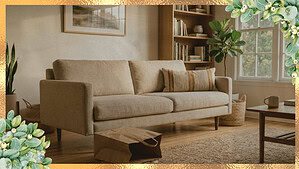
I have six throw pillows in a bin in my front closet.
None of them are on my couch.
Most still have tags on them.
And last spring, I almost walked out of HomeGoods with a seventh.
I was standing in the aisle holding a beautiful blue cushion.
Soft texture. The right shade for the living room. And a price tag that felt reasonable.
(Reasonable was always how it started.)
I almost put it in my cart on autopilot, the way I'd done a hundred times before.
But then something stopped me.
Three weeks earlier, I'd cleared out that front closet.
And there, behind the vacuum, were the six pillows I'd bought over the years and forgotten about.
None of them had been on my couch in months.
I stood there with that pretty blue cushion for a long minute.
And then I put it back on the shelf and walked out empty-handed.
That was the moment something shifted in me.
It wasn't a grand decluttering revelation.
I didn't suddenly become a minimalist.
I just realized, standing there, that I'd been buying the same kinds of things for years without ever asking whether I needed them.
The decluttering hadn't just cleared out my closet.
It had cleared out the part of my brain that used to say “yes” without thinking.
In the months since, there are quite a few things I've stopped buying.
Not because I made a rule. Not because I read a book that told me to.
Just because once you've held a sweater you forgot you owned, or sorted through a drawer of things that never got used, your relationship with shopping is never quite the same.
These are the 9 things I stopped reaching for.
What Decluttering Taught Me About the Way I Was Shopping

For years, my shopping ran on autopilot.
I'd see something pretty, throw it in the cart, and tell myself it was a good deal or a small treat.
The thinking part of my brain wasn't really involved.
It was muscle memory.
Then I started decluttering.
The first time I went through a closet seriously, I found things I'd forgotten I owned.
Tags still on. Receipts still stuck to them.
(One sweater, I genuinely couldn't remember buying.)
That stuck with me.
Because every one of those forgotten items had felt important enough to bring home at some point.
I'd handed money over for it. I'd carried it through a parking lot.
And somewhere along the way, I'd stopped caring about it entirely.
The pattern wasn't really about the items.
It was about me.
About a way of shopping that started long before I ever picked anything up.
So I started asking myself painfully honest questions before I bought things.
Do I already have something like this at home?
Will I still want this in three months?
Is this filling a real need or just a small itch?
Most of the time, the answer was NO.
And once I started saying no in the store, the inside of my house started feeling lighter without me having to do another full round of decluttering.
Sometimes the best decluttering happens before you ever bring something home.
The 9 Things I Took Off My Shopping List
These aren't items I made some big rule about.
There was no spreadsheet. No vow.
Each one started with a single moment in a store where I caught myself reaching for something I didn't need.
1. Single-Use Kitchen Gadgets

The waffle iron has been in the cabinet above my fridge for nine years.
We've used it twice.
Both times, my husband tried to make Sunday brunch, and both times he gave up halfway through and made pancakes instead.
Single-use kitchen gadgets are everywhere.
The fondue pot that came out for one New Year's Eve.
The bread machine I was sure I'd use weekly.
The juicer that lasted exactly one health kick.
(Every one of them seemed practical when I bought it.)
When I decluttered my kitchen, the gadgets were the first to go.
And they're the easiest to walk past in the store now.
Even the cute ones at Williams Sonoma. Even the ones on sale.
If a gadget only does one thing, and the thing it does isn't part of my regular life, it doesn't come home with me anymore.
2. Holiday and Seasonal Decorations
I have a bin of Easter decorations in the basement that I haven't opened in three years.
Another bin for Halloween.
One for Thanksgiving.
And four for Christmas.
(Yes, four. I counted.)
Holiday decor is sneaky.
Each item feels small when you buy it.
A set of pumpkins for fall. A few twinkle lights. A wreath that was on sale at Michael's.
None of it seems like much.
But it adds up over thirty years of decorating.
The kicker is, I don't even use most of it anymore.
The kids are grown.
We don't host the big Thanksgivings like we used to.
Christmas is quieter than it used to be.
But every September, I still saw the cute fall decor at HomeGoods and thought “ooh.”
I don't anymore.
The bins in the basement are already full.
If it doesn't fit in my existing storage, it doesn't come home.
3. Throw Pillows and Decorative Blankets

You already know about the pillows.
Six in the closet, none on the couch, almost a seventh from HomeGoods.
(And that's before I tell you about the blankets.)
The blankets are worse, honestly.
There's a basket next to my couch with four neatly folded throws inside.
Two more on the back of the couch itself.
And the cedar chest in the bedroom holds five more for “guests” who never seem to ask for one.
That's ELEVEN throws for two people who like the same one and never reach for the others.
Throw pillows and blankets are decoration that pretends to be useful.
They look cozy in the store, but my couch only ever needs the same two cushions and the same one blanket.
The rest is accumulation.
So I stopped.
The basket I have is the limit.
If something new comes in, something old has to go.
4. Travel Souvenirs
We've been to a lot of places.
And until a few years ago, we came home from every one of them with a small piece of the trip.
A magnet from Charleston.
A ceramic dish from Santa Fe.
A snowglobe from Niagara Falls when the kids were little.
A coffee mug from a B&B in Vermont I haven't drunk out of in a decade.
The fridge in our kitchen looked like a passport.
The shelves in the living room held trinkets from places I could barely remember the names of.
Then I started letting go of sentimental keepsakes, and something hit me.
The magnets weren't keeping the trips alive.
The trips were alive in the photos, in the stories, in the way I still remember the smell of the bakery where we had breakfast.
Now when I travel, I bring back something we'll actually use.
A bag of good coffee. A small bottle of olive oil. A jar of jam.
Things that get finished and remembered without taking up shelf space.
5. Specialty Cleaning Products

Under my kitchen sink used to be a graveyard of half-used bottles.
The granite spray. The stainless steel polish. The wood floor cleaner.
The bathroom mildew remover. The shower glass spray. The stove top degreaser.
(All bought because a label promised something miraculous, and all sitting there now, mostly full.)
Most of them did the same thing.
Some of them did less than the basic spray I already had.
When I cleaned out that cabinet, I kept three things.
An all-purpose spray. A bottle of dish soap. A jug of distilled vinegar.
That's it.
And my house is cleaner than it was when I had thirty bottles, because now I actually know where everything is.
If a label promises to clean one specific thing, I walk past it.
My house has never known the difference.
6. “Just in Case” Backup Linens
The linen closet was its own special category.
Three sets of sheets I never put on the bed.
Six bath towels I was saving for “company.”
Two mattress pads still in their packaging.
A set of guest towels with embroidered flowers I bought for a guest who has stayed exactly once in fifteen years.
(Plus a stack of beach towels for grandkids who are now teenagers and bring their own.)
It took me a long time to admit I was buying linens for a version of my life that wasn't happening anymore.
The big holiday gatherings.
The houseguests for a week at a time.
The kids splashing in the kiddie pool.
Those days had passed.
Once I organized the linen closet honestly, I kept what we ACTUALLY use.
Two sets of sheets per bed. Enough towels for the people who live here.
Now when I see a bath towel in a pretty color at Target, I remind myself the closet has a limit.
And I leave it on the shelf.
7. Cute Mugs

The cabinet above my coffee maker won't close.
That's because behind the door, I have at least twenty-five mugs.
(I stopped counting because it was depressing.)
There's the “World's Best Grandma” one from my grandkids.
The “I'd Rather Be Reading” one from my book club friend.
The mug from every B&B we've ever stayed at.
A Mother's Day mug from 2008.
The one with the cat on it I don't even remember buying.
We are two people.
We drink coffee from the same mug every morning.
We have, at most, four people over for coffee at any given time.
We do not need TWENTY-FIVE mugs.
Mugs feel like little harmless treats.
But they multiply faster than anything I've ever owned.
So I stopped buying them.
The grandkids gift me one occasionally and that's enough.
8. Decorative Knick-Knacks
HomeGoods is dangerous.
So is TJ Maxx, Marshalls, World Market, and that one section at Target with the seasonal decor.
The aisles are designed for women like me.
Pretty things. Reasonable prices. Just the right amount of “ooh, that would look nice on the bookshelf.”
For years, I came home from those stores with little decorative items.
A small ceramic bowl. A pretty wooden tray. A figurine that caught my eye.
None of it had a purpose.
All of it was just for looking at.
The shelves in my living room used to hold close to forty of those small objects.
Now they hold seven.
(And the room actually looks nicer.)
When I started questioning the decluttering rules I'd grown up believing, I realized one of the most stubborn ones was that a shelf has to be full.
It doesn't.
I still go to HomeGoods.
I just look, admire, and leave.
Honestly, that's most of the fun anyway.
9. Gift Wrap, Gift Bags, and Ribbon in Bulk

The Tuesday after Christmas is a dangerous day.
That's when the holiday wrap goes 75% off.
And for years, I would load up.
Rolls of paper. Boxes of bows. Gift bags in every size. Tissue paper in bulk.
(All for “next year.”)
I had a whole bin in the garage just for gift wrap supplies.
I had so much, I'd forgotten what was in it.
Each Christmas, I'd add to the bin without using up what was already there.
It took me sorting through that bin one December to realize I had wrap from 2014 still unused.
Three tubes of the same red foil paper. Twelve gift bags I'd forgotten I'd bought.
I don't shop the after-Christmas wrap sales anymore.
I use what I have.
When the bin is empty, I'll buy more.
(Spoiler: it's not getting empty anytime soon.)
What I Buy Now Instead
Decluttering didn't make me stop spending money.
It just changed where the money goes.
I buy fewer objects now, but the ones I do buy I tend to actually use.
A really good pillow that lasts.
A pair of shoes I'll wear all summer.
A decent skillet that will outlive everything else in the kitchen.
I also spend more on things I can't put on a shelf.
Lunches with friends. A weekend away with my husband. Tickets to the symphony. A class on something I've always wanted to try.
The change wasn't dramatic.
It was a thousand small “no thanks” moments at the register, and a hundred small “yes” moments to things that don't take up storage space.
The decluttering habits that have stuck all share one thing in common.
They started inside the house and worked their way out, into the way I shop, the way I gift, the way I think about what's enough.
It turns out, what I'd been calling “small treats” were costing me more than money.
They were costing me my attention, my space, and the calm of a house that wasn't full of forgotten things.
These days, I'd rather have the CALM.
The Best Thing About Buying Less

The best thing about buying less isn't the savings.
It's the calm.
It's the absence of having to find a place for something.
The not having to clean around it.
The not having to pack it up someday for the donation pile.
The space, both literal and mental, that stays open because you never filled it in the first place.
When I look back at the version of me who bought all those mugs and pillows and souvenirs, I don't feel critical of her.
She was doing what most of us do.
Trying to bring something nice into her life one small purchase at a time.
What I've learned since is that the niceness wasn't in the objects.
It was in the moment, the visit, the trip, the season.
The objects were just placeholders.
Now I let the moments stay where they are.
And I leave the placeholders on the shelf.
Before You Stop Buying, Start by Seeing What's Already In Your Home

It's hard to stop buying things you don't need until you've seen, really seen, what you already have.
That's the whole reason decluttering changed my shopping habits.
Once I'd held the third pair of black pants in my hand, or counted the mugs, or sorted through the bin of holiday decor, the urge to buy more lost a lot of its power.
If you'd like a place to start, my free Declutter for Self Care Checklist walks you through your home, room by room, with the gentle prompts that help you actually see what's there.
It's the kind of guide I wish I'd had years ago.
Practical, honest, and made for women who want a calmer home without having to overhaul their whole life to get one.
Frequently Asked Questions
How does decluttering change your shopping habits?
Decluttering forces you to see what you already have.
When you spend a Saturday holding sweaters you forgot you owned, or sorting through a cabinet of mugs you can't stack, the urge to bring more home gets quieter.
It doesn't go away completely.
It just stops being automatic.
You start asking, “do I already own this?” before you reach for it.
That ONE small question changes everything.
What are the most common things people buy and don't use?
Research consistently shows the same items end up unused in American homes.
Single-use kitchen gadgets like bread machines and waffle irons. Holiday and seasonal decor. Throw pillows and decorative blankets. Specialty cleaning products. Decorative knick-knacks. And mugs, lots of mugs.
Studies show 80% of items in the average home are never used, which lines up with what most of us would find if we took a hard look at our own cabinets.
How do you stop buying things you don't need?
Start by going through what you already have.
The act of sorting, holding, and deciding what stays will make the impulse to buy more a lot quieter.
Other things that help: shop with a list, give yourself a 24-hour rule on anything that isn't essential, and ask whether the item is solving a real problem or just filling a small want.
Most wants pass within a day. Most needs stay needs.
Why do I keep buying things I don't need?
Because shopping is designed to be easy and emotional.
Sales feel like savings. Pretty objects feel like small rewards. The dollar section feels harmless.
None of those feelings are wrong. They're just not the same as actually needing something.
Once you start noticing the pattern, the autopilot loosens, and you can interrupt the loop before it ends with another bag on your kitchen counter.
What should I stop buying to declutter my home?
Start with the categories that already overflow in your house.
If your linen closet is bursting, stop buying linens.
If your kitchen has gadgets you haven't used in a year, stop buying single-use appliances.
The most useful answer to this question isn't a generic list.
It's the one you'll find by walking through your own home.
Whatever you have too much of is exactly what you can stop buying first.
Follow me elsewhere!