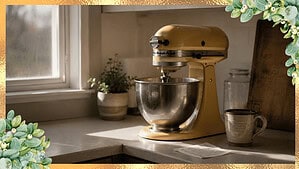
There's a yellow KitchenAid mixer in the corner of my counter that I haven't used in two years.
It was a wedding gift.
My mother-in-law picked it out from the Macy's registry, almost forty years ago.
She was so proud of herself for choosing “the good kind.”
It's heavy. It takes up valuable counter space.
The yellow doesn't match anything in my kitchen anymore.
(Honestly, I'd rather use my hand mixer for the few times a year I bake.)
But every time I think about passing it on, something pulls me back.
It's a really nice mixer. I might want it again someday. What if I start baking more?
I know I won't. But I think it anyway.
Last winter, I stood in front of it and tried to picture handing it to a young couple who'd actually love it.
A woman in her thirties, just starting out.
I couldn't do it.
I lifted the heavy thing, set it back on the counter, and walked into the next room.
It's still there.
For a long time, I thought I was just sentimental. Or weak-willed.
Then I read about something called the endowment effect.
And it changed how I look at every object in my house.
What Is the Endowment Effect, Anyway?
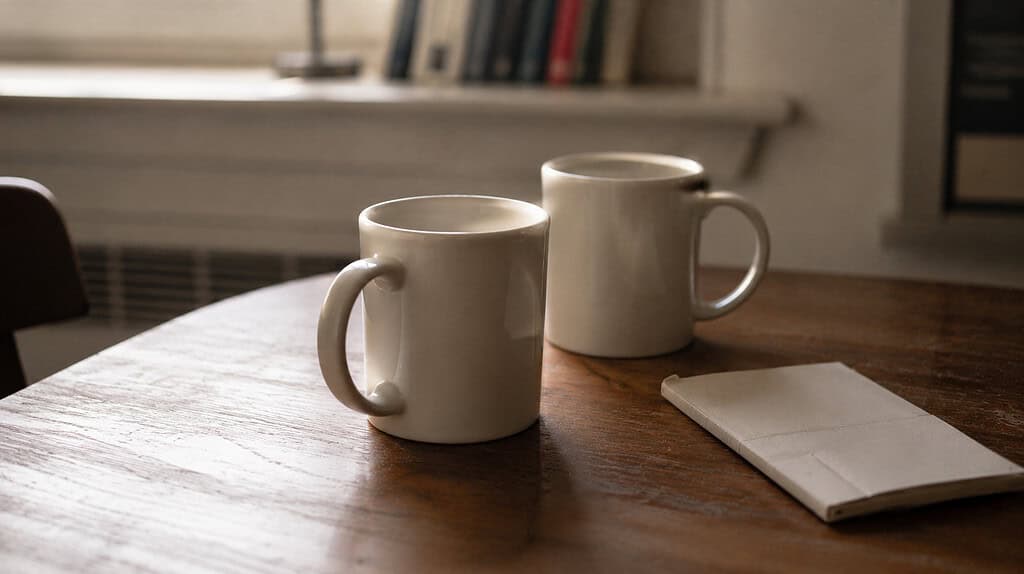
Years ago, a researcher named Daniel Kahneman ran a very simple experiment.
He gave coffee mugs to half the students in a class. Plain ones, nothing special.
Then he asked the people who got mugs how much money it would take for them to sell their mug.
He asked the students who didn't get mugs how much they'd pay to buy one.
The mug-owners wanted, on average, twice as much to sell their mug as the non-owners were willing to pay.
Same mugs. Same room. Same five minutes of ownership.
But the second the mug was theirs, it was suddenly worth more.
That's the endowment effect.
It's a fancy term for a very ordinary feeling.
Once something is yours, your brain raises its price tag. Without you noticing.
Not just in money. In meaning. In effort. In future regret.
Your brain treats letting go of an object you own as a loss, even when the object is taking up space and giving nothing back.
This is why your closet, your kitchen, and your basement are full of things you wouldn't pay a dollar for if you saw them on a thrift store shelf today.
You wouldn't buy them.
But you can't bring yourself to part with them.
Once I read about this, I started seeing it everywhere.
In my own home. In my mother's. In my sister's garage.
And in eight different ways, I found out, the endowment effect was running in the background of my decluttering.
Without me even knowing.
8 Reasons the Endowment Effect Has You in Its Grip
These aren't separate problems with eight different solutions.
They're eight faces of the same psychological pull.
Once you can name what's happening, the grip starts to loosen.
1. The Mug Becomes Worth More the Moment It's Yours
This is the original.
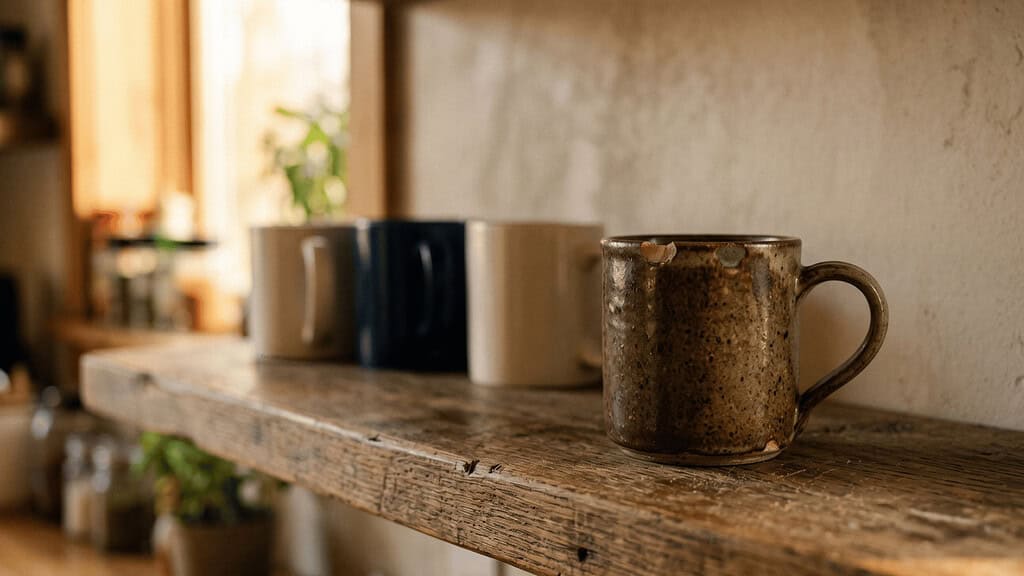
The same coffee mug from Kahneman's experiment, sitting in my own cabinet right now.
I have a chipped pottery mug from a craft fair I went to in 1998.
It says “Coffee Lover” in dripping letters.
If I saw it on a thrift store shelf for fifty cents, I'd walk right past.
But it's mine. So somehow it's worth more.
This is the endowment effect at its purest. Ownership itself raises the price.
The way to break it: ask yourself, “If I saw this in a store today, with no history, no story, would I buy it?”
If the answer is no, that's your brain's real valuation talking.
The rest is just attachment dressed up as worth.
2. You Remember What You Paid, So Letting Go Feels Like Losing Money
I have a pair of Italian leather boots in my closet that I wore exactly twice.
They cost almost three hundred dollars.
They've been sitting on the shelf for nine years because every time I look at them, I hear the price tag.
Three. Hundred. Dollars.
Throwing them out, donating them, even selling them for less than I paid feels like admitting I made a bad call.
Behavioral economists have a name for this: sunk cost.
The money is already gone.
It's gone whether the boots stay in my closet or in the donation bin.
But our brains can't tell the difference. Keeping the object feels like protecting the money.
(It isn't.)
This was one of the decluttering rules I had to unlearn before I could get through my own closet.
Letting go isn't losing the money.
The money was lost the day I bought the boots and didn't wear them.
3. You're Saving It for the “Future You” Who Might Need It
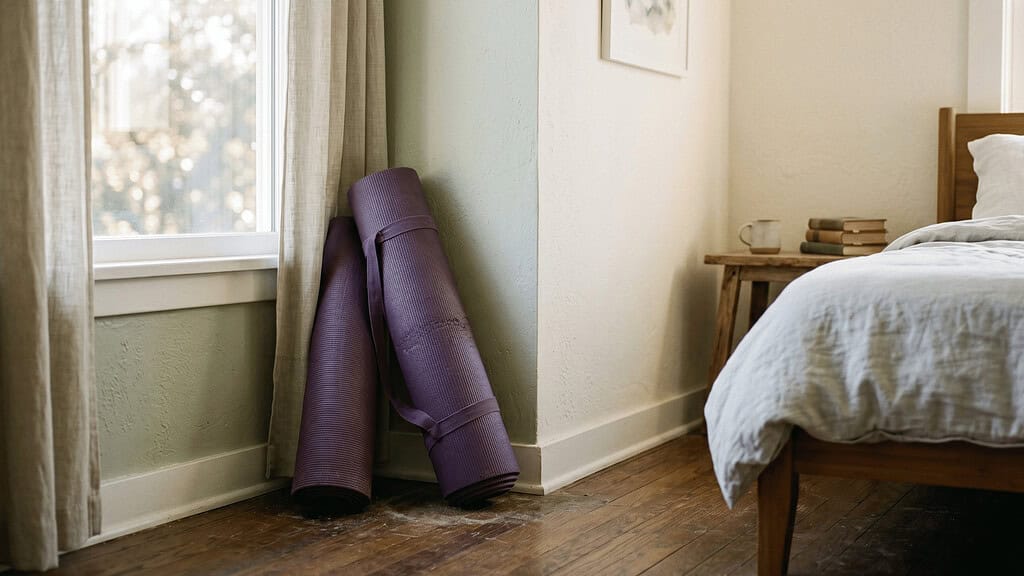
The yoga mat that's still rolled up in the corner of my bedroom.
I bought it during a phase when I was sure I was going to start doing yoga every morning.
That phase lasted about three weeks.
But I keep the mat because future me might pick it back up.
This is one of the trickiest forms of the endowment effect.
Your brain doesn't just attach to who you are now. It attaches to who you might be someday.
The runner you used to be.
The crafter you keep meaning to become.
The gardener you'd be if you had more time.
So you keep the running shoes. The yarn. The seed packets.
(All of them gathering dust while you live a life that has nothing to do with them.)
When I tried the move-out decluttering method, this was the test that broke through.
Would I pack this and pay to move it?
If not, why am I keeping it now?
Future you is allowed to buy a new yoga mat if she ever shows up.
4. The Object Becomes the Memory
This is the hardest one.
So we have to talk about it gently.
I have a small wooden box on my dresser that holds a movie ticket from 1976.
It's the first movie my husband and I ever saw together.
(Rocky.)
The ticket is faded. You can barely read the date.
If anyone else found that ticket, they'd throw it away in two seconds flat.
But to me, it's not paper anymore. It's the night I knew.
This is the endowment effect wearing its kindest face.
The object stops being an object and starts being a memory.
The trouble is, our brains do this with everything.
Not just the ticket from the night you fell in love.
Also the magnet from a vacation. The mug from a friend's wedding. The dish your aunt gave you that you never use.
They become memory containers.
But here's what I learned from letting go of sentimental items one box at a time: the memory was never actually inside the object.
The memory is inside you.
Take a picture of the ticket. Write down the story.
The memory will still be there when the paper is gone.
5. Letting Go Hurts More Than Keeping Helps
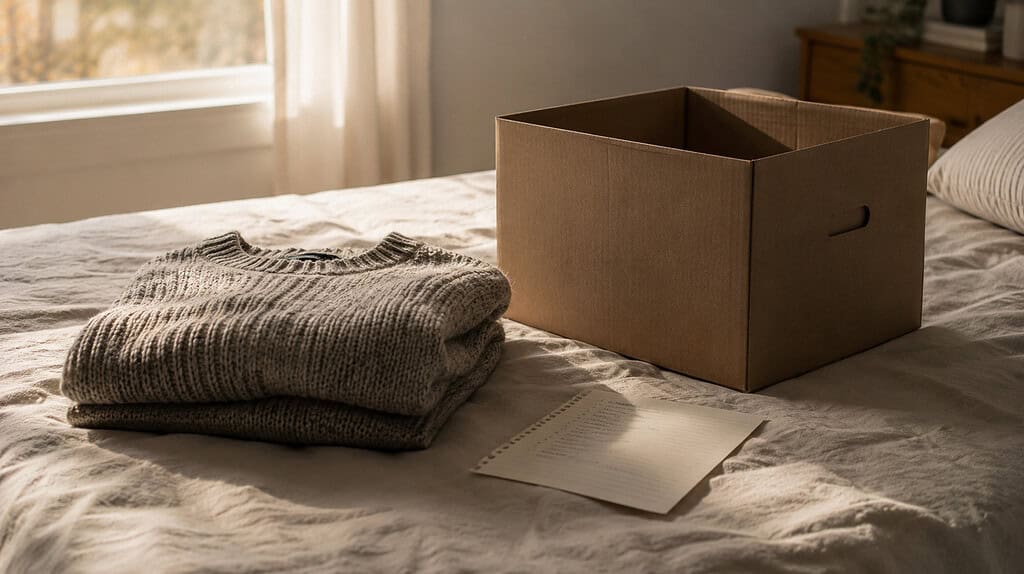
Researchers have known for decades that humans feel the pain of losing something about TWICE as strongly as the pleasure of gaining something equivalent.
Twice.
So if you imagine donating an old sweater, the part of your brain that says “you'll lose this!” shouts twice as loud as the part that says “you'll have a tidier closet!”
That's why decluttering can feel heavy even when the rational part of you knows it'll feel good after.
Your brain is doing math, and the math is rigged.
The fix isn't to fight the math. It's to know it's happening.
When you feel that wave of resistance, it isn't proof the item is precious.
It's proof your brain is running its default loss-aversion program.
Once I learned to recognize that feeling, staying motivated to declutter got a whole lot easier.
The hard part isn't deciding what to keep.
It's getting through the bias.
6. It Feels Like Betraying the Person Who Picked It Out
A friend of mine gave me a set of placemats in 2003.
She was visiting from out of state.
She picked them out specifically because she thought they'd match my dining room.
They don't match my dining room anymore.
(My dining room hasn't existed in eleven years. I redecorated.)
But every time I find them in the linen drawer, I think of her.
And I think: she'd be hurt if I gave them away.
She wouldn't.
She probably doesn't remember she bought them.
But that doesn't matter to my brain.
The endowment effect attaches to the giver, not just the gift.
Letting the object go can feel like letting the person down.
This is especially true for things from people who've passed.
Your mother's china. Your grandmother's pin. The casserole dish from a friend who's gone.
I had to learn that decluttering gifts isn't disrespectful.
The love was in the giving. Not in your forever-keeping.
If she's still around, she'd probably want you to use the space for joy, not for storage.
7. The “Just in Case” Trap
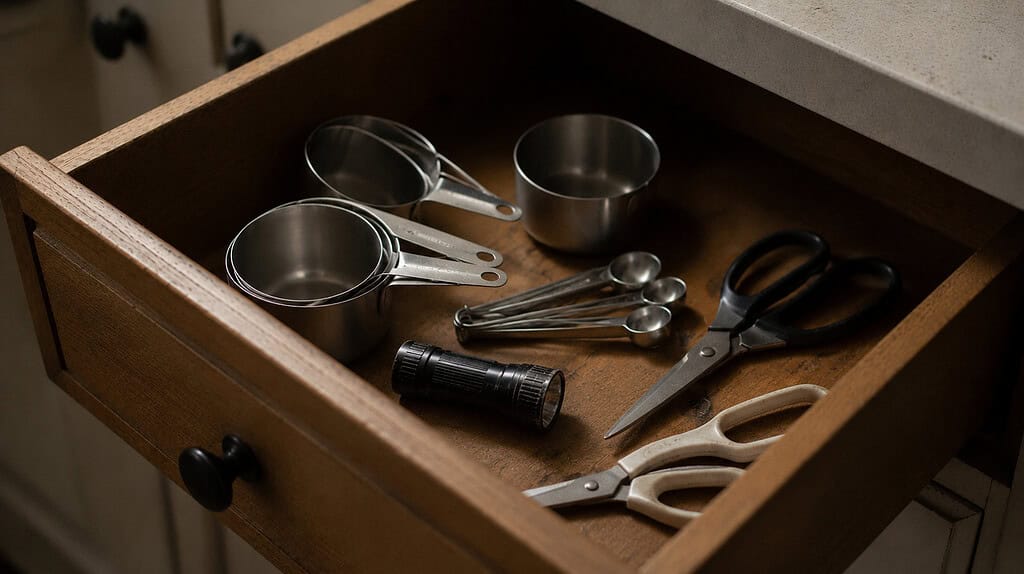
The extra set of measuring cups in the back of the kitchen drawer.
The third pair of scissors in the office.
The flashlight with the dead batteries in the hall closet.
(I haven't used the flashlight in seven years. I haven't even checked the batteries.)
These are the “just in case” items.
The ones we keep because some hypothetical future moment might need them.
But the truth is, when that moment comes, we either don't remember we have it, or we go buy a fresh one anyway.
Your brain hangs on to “just in case” objects because letting them go means accepting a small risk of regret.
Keeping them feels like insurance.
It isn't insurance. It's clutter.
I wrote about this recently in the context of stopping the buying habit, but the same principle works in reverse for letting go.
If you haven't reached for it in a year, the “case” you're keeping it for has almost certainly already passed.
8. You Imagine Someone Else Will Treasure It Someday
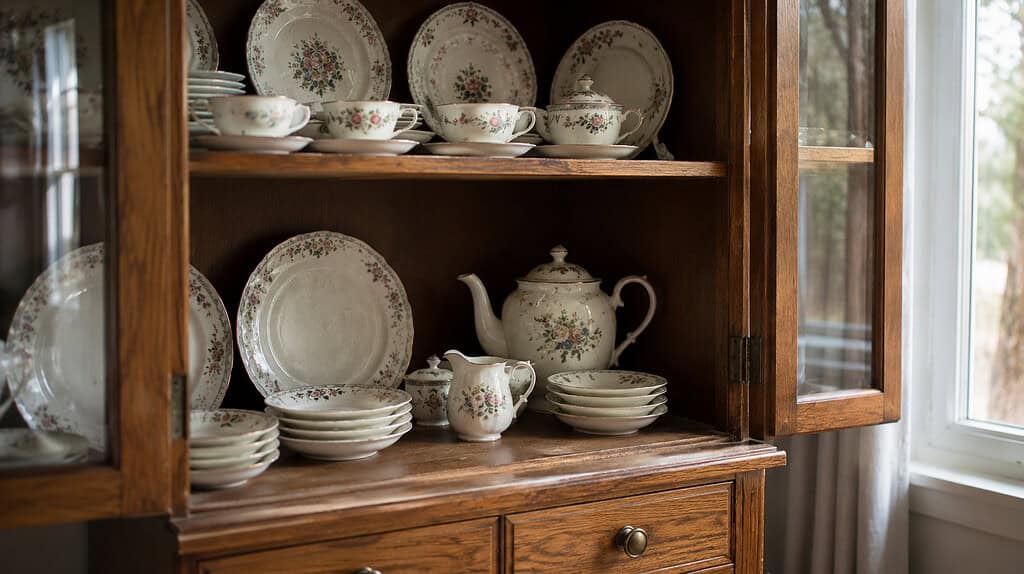
The hutch full of my grandmother's china.
The boxes of my old photo albums.
The Christmas ornaments my kids made in elementary school.
I keep them all because someday, someone will want them, right?
Someday is doing a lot of heavy lifting in that sentence.
The endowment effect can extend forward in time.
We project the future love of our children, our grandchildren, even strangers, onto things we ourselves don't use.
The hard truth I had to face: my kids didn't want most of my things.
They live different lives. They have different tastes.
The hutch I picture passing down is, to them, a piece of furniture they'd have to find a place for.
You can ask them. You can have the honest conversation now.
If they say yes, beautiful. Set it aside.
If they say no, you've just freed up the space for someone who will love it.
Or for the calmer home you can have today.
How to Start Throwing Things Away Without the Guilt
The endowment effect is a quirk of the brain.
Once you know about it, you can work around it.
Here's what helped me the most.
Ask the “if I saw this today” question. If I found this item at a thrift store right now, with no history, would I bring it home? If the answer is no, the object is being held up entirely by ownership.
Set a “trial donation” box. Put items in a box. Tape it shut. Put it in the garage for thirty days. If you didn't reach for anything in it, donate the whole box without opening it.
The pain you feared probably won't show up.
Take a photo before letting go. This works especially well for sentimental items. The photo holds the memory. The shelf gets the space.
Replace “What if I need it?” with “What is it costing me to keep?” Storage. Cleaning around it. The mental weight of seeing it.
The endowment effect makes us notice the loss and ignore the cost.
Make the choice once, not over and over. Every item you keep is a decision you'll have to make again the next time you declutter. Letting it go now means never having to think about it again.
I worked through a list of questions like these when I first started letting go of things in earnest.
Reading them out loud helped quiet the resistance.
You don't have to fight the endowment effect.
You just have to outlast it.
What Changes When You Stop Falling for the Endowment Effect
Once I learned the name of what was happening to me, my whole house got lighter.
Not all at once.
But every drawer I opened, every box in the basement, every cupboard I sorted, I could feel my brain trying to play its old tricks.
“You paid good money for that.”
“You might use it someday.”
“What about the person who gave it to you?”
And instead of getting stuck, I'd say (sometimes out loud), “I see you, endowment effect. Keep moving.”
It became almost funny.
Naming the thing took a lot of its power away.
The KitchenAid mixer? It went to a young woman who saw it on a Buy Nothing group and wrote me the sweetest message.
She uses it every Sunday.
The Italian boots? Gone. Some other woman is wearing them.
The yoga mat? Donated. Future me has never come looking.
The endowment effect doesn't go away.
Your brain will run the same loops on the next thing you try to let go of, and the one after that.
But now you'll know what's happening.
You'll know that the resistance is your brain doing its job, not the object asking to be saved.
And as the decluttering habits I built over time taught me, the more you practice letting go, the easier it gets.
You stop owning your stuff.
It stops owning you.
Ready to See Your Stuff With Fresh Eyes?

Sometimes the hardest part of decluttering isn't deciding what to let go of.
It's seeing what's there in the first place.
Once you start walking through your home with the endowment effect in mind, things you've owned for decades suddenly look different.
The shelf that always seemed full looks heavy.
The drawer you've never quite emptied looks like a museum of your old selves.
If you'd like a place to start, my free Declutter for Self Care Checklist walks you through your home, room by room, with prompts that help you see what's there.
It's the gentle, practical kind of guide I wish I'd had years ago.
Made for women who want a calmer home without overhauling their whole life.
Frequently Asked Questions
What is the endowment effect in simple terms?
The endowment effect is the tendency to value something more once you own it, even if it's identical to one you don't own.
Daniel Kahneman proved it in 1990 with a simple experiment: people who were given a coffee mug demanded twice as much money to sell it as people without mugs were willing to pay to buy one.
Same mug. Different value, just because of ownership.
Why is it so hard to throw things away even when I don't need them?
Because your brain is wired to feel loss more sharply than gain.
This is called loss aversion, and it's one of the engines behind the endowment effect.
When you imagine letting go of something you own, the pain of losing it feels about twice as strong as the pleasure of gaining the empty space.
The math is rigged against decluttering. Knowing that helps you push through it.
Is the endowment effect the same as being sentimental?
Not exactly.
Sentimentality is one flavor of the endowment effect, but the effect also shows up around items with no emotional weight.
It explains why we hold on to old electronics, half-broken kitchen tools, and “just in case” items we'll never use.
The object doesn't have to be precious to us. It just has to be yours.
How do I overcome the endowment effect when decluttering?
The most useful trick is to ask: “If I saw this item at a thrift store today, with no history, would I bring it home?”
If the answer is no, the object is being held up by ownership, not value.
Other strategies include trial donation boxes, taking photos of sentimental items before letting them go, and asking what the item is costing you in space and mental energy.
Does the endowment effect apply to gifts and inherited items too?
Yes, and often more strongly.
With gifts and inherited items, the endowment effect attaches not just to the object but to the person who gave it.
Letting it go can feel like betraying them.
The truth is, the love was in the giving.
The person would almost certainly want you to use the space for joy, not for storage.
Follow me elsewhere!

