
A few weeks ago, I came across an article about women my age and what we're doing with our houses.
I was halfway through, half-paying-attention, when the writer used a word I'd seen before but never quite registered.
“Rightsizing.”
I set the article down.
I sat with that word for a minute. Read the sentence again. Then I noticed something strange. My whole body had relaxed a little, the way it does when you finally hear someone name a thing you've been carrying around without knowing it.
I'd been using the wrong word for years.
I'd been saying “downsizing,” especially when I talked about decluttering. So had every woman I knew. The word came out automatically. I never sat down and decided to use it. It was just the word I'd been handed.
And until that moment, I hadn't realized how much I'd been bracing every time I said it.
“Rightsizing” was different. The word didn't make me think of giving things up, or being asked to fit into something smaller. It just felt like a real word for a real thing. A word that pointed forward, not down.
I started using it the next day.
Over the last couple of months, I've watched something change in the way I declutter, the way I think about this house, and the choices I make about what stays and what goes.
The word “downsizing” had been making the entire conversation about my belongings feel like dread. The word “rightsizing” doesn't do that. It's a different word, it points to a different action, and once you start using it, decluttering starts to feel like something you actually want to do.
I'm still in the middle of all this (with my husband, with the spare bedroom we haven't quite figured out). But the word swap has changed almost everything about how I approach decluttering at this point in my life, and I want to give you the same chance to notice the change.
Most of what's been written about rightsizing online is written by people trying to sell you something. A senior community. A real estate service. A whole new lifestyle that, oddly, comes with a monthly fee.
What I'm going to talk about is different. Rightsizing doesn't require a move. It doesn't require a checkbook. It just requires a different conversation with yourself about the items already in your home.
Here's what I've learned.
Why the Word “Downsizing” Has Been Making You Dread Decluttering
The word “downsizing” was not invented for women our age. It came from the corporate world, originally. The polite term for layoffs.
The home industry picked it up in the 1990s, and the word has been with us ever since. But it never quite shed its origins.
Every time you say it, your brain hears the older meaning. Smaller. Less. Reduced. The word implies, without meaning to, that you have too much. That you are too much. That the right answer is contraction.
That's not a feeling you imagined. It's what the word is built to do.
And it's why so many of us, when we sit down to declutter a closet or a drawer, feel a small wall come up before we've touched a single item. The word that frames the project has already told the body to brace.
The other problem with “downsizing” is that it tells you the goal before you start. Less.
But the actual question women our age are sitting with when we declutter isn't “how can I have less?” It's something more like what should I keep, what should I let go of, and what would actually make this home work for the way I live now?
“Downsizing” can't answer that question.
Rightsizing can.
The Difference Between Decluttering to Shrink and Decluttering to Fit
Decluttering to shrink asks: what can I get rid of?
Decluttering to fit asks: what belongs in the life I'm actually living now?
They sound similar. They aren't.
When you declutter to shrink, you're cutting. The success metric is volume removed. You stand in front of a closet and ask which items you can afford to lose, and your brain treats the whole thing like a triage. You leave the closet feeling tired, slightly grieved, and uncertain whether you did the right thing.
When you declutter to fit, you're matching. The success metric is alignment. You stand in front of the same closet and ask which items actually belong to the woman you are now. You leave feeling lighter, clearer, and slightly more like yourself.
Same closet. Same items. Completely different experience.
Most women I know who have rightsized their homes didn't move. They reconfigured. They decluttered the items that no longer fit the life they were actually living. The kid's old bedroom became the sewing room. The formal dining room became a reading library. The garage that had become a graveyard became a workshop again.
None of that was downsizing. All of it was decluttering with a different question in mind.
The Decluttering Question That Changes Every Room
According to Redfin, about seventy-eight percent of homeowners over sixty plan to stay in their current home as they age. Most of us don't want to move. Most of us aren't planning to. And most of our decluttering will happen inside the walls we're already standing in.
The question that changes every room is this:
What does this room actually want to be now?
Not what it was when we moved in. Not what it's been for the last twenty years. Just: what is the actual purpose this room could serve in my current life?
Try it in the formal dining room that hasn't held a meal since 2019.
Try it in the home office set up for a job you retired from in 2021.
Try it in the spare bedroom that's still set up as a kid's room, even though the kid is in his forties now.
Each room, when you ask the question honestly, will tell you something. And what it tells you turns into a concrete decluttering project. The dining room that wants to be a library means the formal china can find a new home. The home office that wants to be a hobby space means the work files can finally go. The kid's bedroom that wants to be your sewing room means the bunk beds, the old toys, and the storage bins from 1998 can leave. The move-out method helps if you want extra structure, but the core question is already enough.
None of this requires a moving box.
When the Decluttering Reveals You Need to Move
Sometimes, as you declutter room by room, the answer that emerges isn't “this room wants to be something different.” It's “this whole house can't fit my life anymore.”
When that happens, the decluttering itself is what reveals it.
The women I know in their sixties and seventies who genuinely have moved didn't start with the moving decision. They started by decluttering their current home, and over weeks or months they noticed something. The stairs were a daily problem no amount of decluttering could fix. The maintenance was unmanageable. The location had stopped working.
When those things are true, the decluttering does its job. It reveals what was already true under the clutter.
But even when rightsizing does mean a move, it doesn't always mean smaller. One friend rightsized into a slightly larger home with a single floor and a real guest room. The total square footage was almost the same. The match with her life was completely different.
The size of the house is the least interesting variable. What matters is whether the home matches the life. If the decluttering reveals a move is your answer, the practical work follows.
But the only way to know is to start with the decluttering, not the moving company.
The Three Decluttering Questions That Replace “Should I Downsize?”

If you're sitting with this in your own life, here are the three questions to ask instead.
First: Which rooms in my house am I actually using, and which are still set up for a life I no longer live?
This turns into concrete decluttering. Walk through your house and notice. Each unused room is a project waiting. Start with the room you use the least; the items there are usually ones you've already stopped needing.
Second: What does my body need from this house in the next ten years?
This turns the closet and kitchen into decluttering projects. The clothes that no longer fit the body you have today can leave. The kitchen equipment you can't lift safely can leave. The heavy serving dishes that require two hands can leave.
Third: What do I want my life to look like at seventy, and what would I need to keep to support that life?
If you want quiet, the entertaining equipment can leave. If you want a hobby room, the decluttering means clearing everything that isn't the hobby. If you want grandchildren visits, the decluttering means keeping just the items that matter for those visits.
These three questions, sat with honestly over a week or a month, will give you a far better decluttering plan than any “should I downsize” article.
My Own Spare Bedroom Story
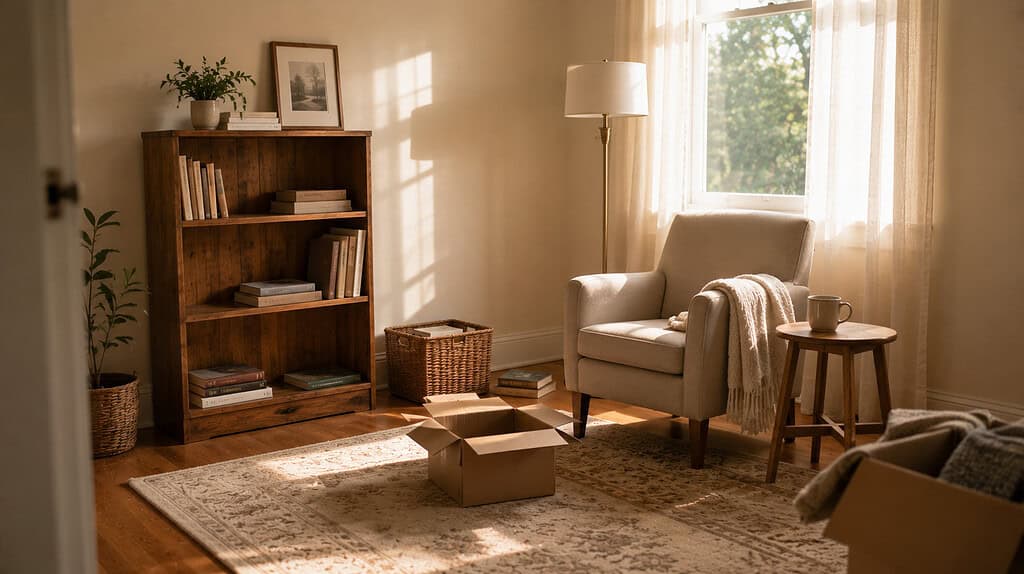
The day I started using “rightsizing” instead of “downsizing,” something small happened.
I stopped dreading certain decluttering projects.
The spare bedroom is the example I keep coming back to. It had been a guest room for years, even though guests stayed three nights a year. It had also become, slowly, the room where everything we didn't know what to do with ended up. The exercise bike we hadn't ridden. The sewing machine I hadn't touched in fifteen years. Boxes from my mother that I hadn't been ready to open.
Under the old framing, I'd have approached the decluttering as a project of removal. Make a pile to get rid of. Subtract.
Under the new framing (“what does this room actually want to be?”), the project changed.
The room is becoming a small library. The exercise bike went to my niece. The sewing machine got donated to a friend who actually sews. My mother's boxes are slowly getting opened in small batches, the way I've learned to do with sentimental things at this stage of life.
The decluttering happened because the framing changed.
The same items I'd been keeping for years suddenly had a reason to leave. Not because I was downsizing them away. Because they didn't fit the room I was building.
Why Changing the Word Changes How You Declutter
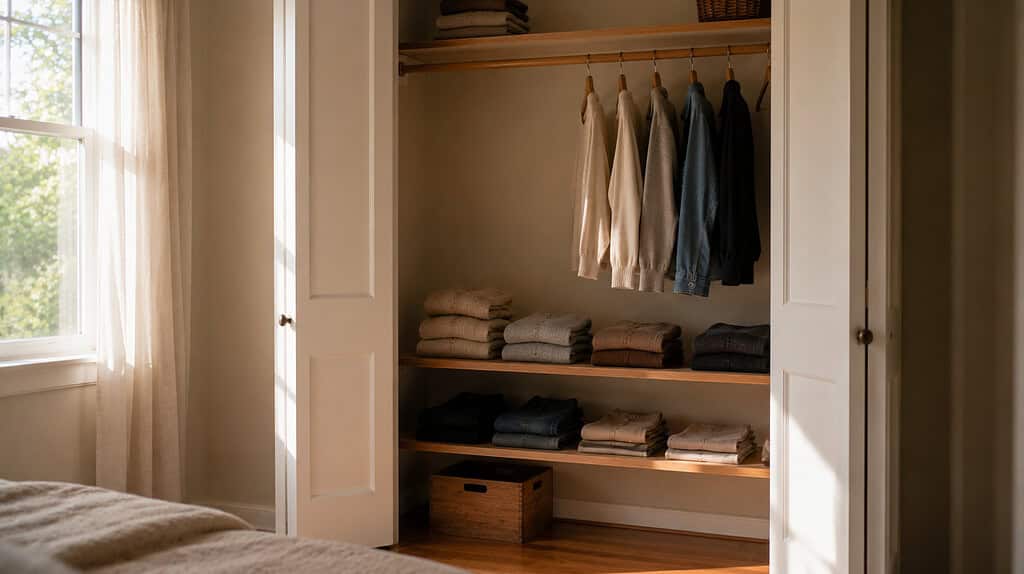
The word “downsizing” tells your brain what to do before you've had a chance to decide.
Your brain hears the word and prepares for loss. It starts inventorying what you might have to give up. It steels itself against discomfort. You haven't even started, and your defenses are already up.
So when you finally walk into the closet, you're already tired. Already grieving in advance. Already looking for reasons to stop.
“Rightsizing” doesn't do that. The word lands neutrally. Your brain hears it and gets curious instead of defensive. What would right mean here? Right for who I am now?
The questions that follow are the questions that actually help you declutter well.
A friend of mine used to dread her closet. Every time she opened it, the downsizing word was right there, and she'd close the door without doing anything. She switched to asking “what does this closet want to hold now?” Same closet. Same items. She started making decisions she'd been unable to make for years.
The word change isn't a magic trick. It's just the difference between approaching decluttering as a loss to be survived and approaching it as a clarity to be earned.
You can try it the next time you walk into a room you've been avoiding. What does this room actually want to be now?
The decluttering will follow.
Where to Start (When You're Ready)

If reading this has made you want to start decluttering your own home differently, the simplest place to begin is also the smallest.
You don't need to make any big decisions. You don't need to put your house on the market. You just need to walk into one room with a different word in your head and notice what changes.
My free Declutter for Self Care Checklist is the gentle starting structure for that work. It goes room by room and asks the right questions of each space. Not “what can I get rid of?” but “what does this room actually want to be now?”
It was made for women in their 60s and 70s who don't need another senior community brochure. They just need a different conversation with themselves about the home they're already in.
Whenever you're ready. The checklist will be here.
Frequently Asked Questions
Is rightsizing the same as decluttering?
Almost, but not quite.
Decluttering is the action. Rightsizing is the framing. The action looks similar from outside, but feels completely different from inside. Most women find rightsizing makes decluttering easier, because the goal stops being “less” and becomes “right.”
Do I have to move to rightsize?
No.
About 78% of homeowners over 60 plan to stay in their current home, and most of them will rightsize without moving a single box out of the house. They'll declutter rooms with intention, let go of what no longer fits the life they're living, and reconfigure spaces that had become frozen.
How do I know if my decluttering is telling me I need to move?
Sit with the three questions in this post for at least a month before deciding anything.
If the answer that keeps coming back is “this house itself can't fit my life,” then a move is your form of rightsizing. If the answer is “this house can work, it just needs to be lived in differently,” then staying is.
Where should I start with the actual decluttering?
Start with one room. The one most out of sync with your current life. Usually the spare bedroom, the formal dining room, or the home office for a job that ended years ago.
Walk in and ask: what does this room actually want to be now?
Sit with the question for a few days. When the answer becomes clear, the decluttering decisions will follow naturally.
Follow me elsewhere!

