
As we grow older, our style changes. No surprise there.
But what catches most of us off guard is that it keeps changing after 60.
The seventies bring shifts of their own, and they're not the ones we saw coming.
Feet change shape and size, so shoes that fit for years quietly stop fitting.
Hair loses the last of its color, and shades we've worn for decades stop sitting right against our faces.
Skin gets thinner, and fabrics we never used to think about start to feel scratchy.
Nobody really tells us this. So when clothes start behaving differently, it's easy to decide the problem is us.
But it usually isn't, my friend.
And that's what this post is all about.
Below are ten fashion mistakes over 70 that commonly add years to our look.
Some are habits we picked up decades ago and never questioned.
Others are things that changed while we weren't looking.
Either way, every one of them has a fix.
Why Dressing At 70 Isn't The Same As Dressing At 60
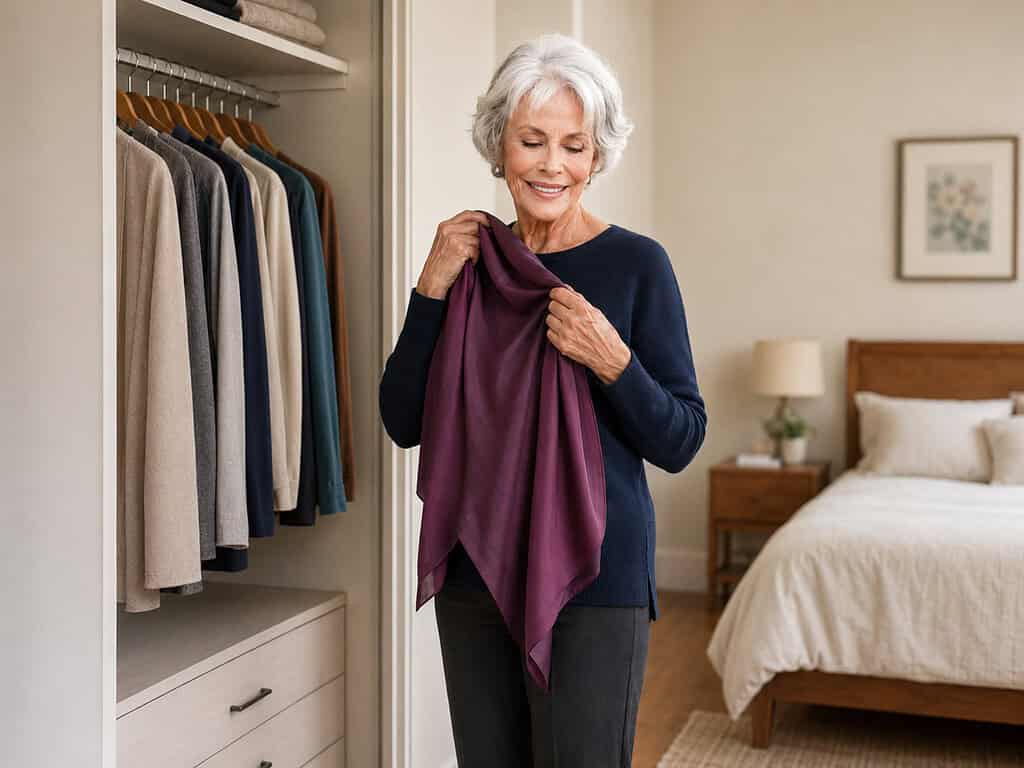
At 60, most of what changes about our style is taste.
We get clearer about what we like. We stop wearing things just because we're supposed to. Maybe we retire, the suits go, and we need a completely different kind of closet.
That's a change of mind, and it's a good one.
The seventies are different. What changes now is the body itself.
Not dramatically, and not all at once. But the upper back rounds a little. We lose a bit of height. Feet spread. Hands stiffen in the morning. Skin thins enough that a sweater we've owned for years starts to feel like steel wool.
None of that is a catastrophe. It's just Tuesday.
It matters for one reason. Most of the style advice we've collected over the years assumes a body that hasn't done any of those things yet.
Tuck your top in. Belt your waist. Wear the pointed flats.
Good advice, all of it. It just quietly stops working when the body it was written for isn't the body we have.
And none of this arrives on a birthday. These shifts start somewhere in the fifties and creep along slowly enough that we barely notice. Which is exactly why it's easy to blame ourselves instead of the blouse.
So this isn't about looking younger. That was never the point.
It's about clothes that fit well and feel good, so we can stop thinking about them and get on with the day.
10 Fashion Mistakes Over 70 And Their Fixes
Every one of these is small. Most are things we picked up without ever deciding to.
And every one has a fix that takes a few minutes rather than a shopping trip.
Let's start with the one that causes the most trouble.
1. Dressing By Rules Instead Of By Fit
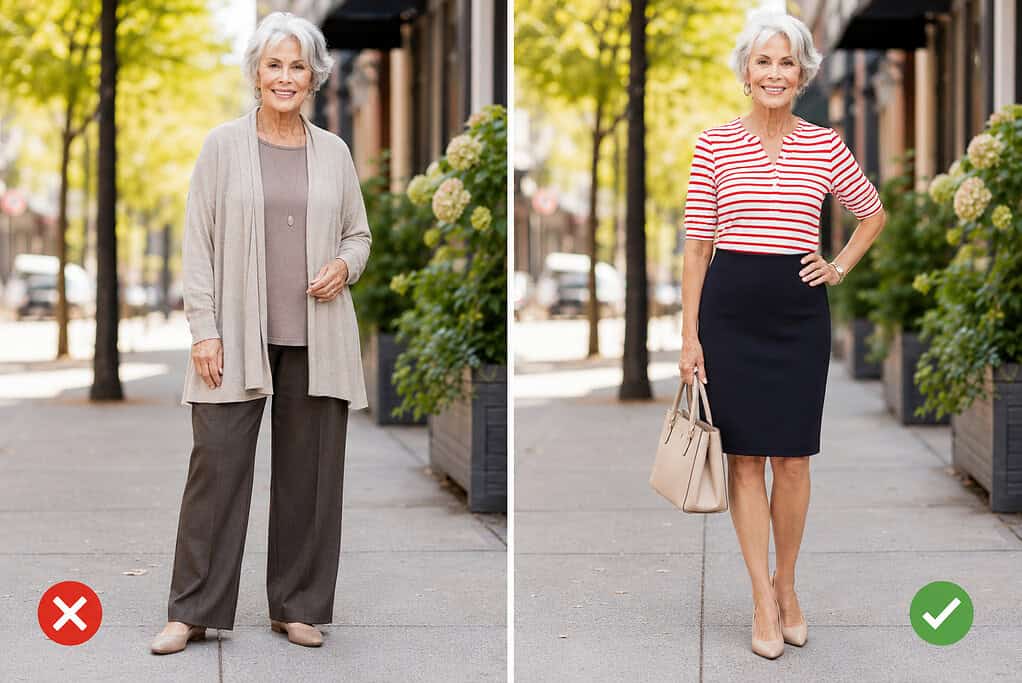
Most of us picked up a few rules along the way about what to wear after a certain age.
Hems come down rather than up. Long hair gets cut. Bright colors get quieter.
Some of those will suit you beautifully. A longer hem is genuinely lovely on a lot of us, and there's a reason it stuck around.
The trouble starts when we follow one without checking whether it's true for us.
Instead, three questions settle it. Does it fit? Is it comfortable? Does it feel like me?
Pass all three and wear it, whatever the rule says. Fail one and that's useful to know, though it's usually about cut or fabric rather than age.
Keep in mind to always try it on before deciding. A rule can tell you what tends to work. Only the mirror knows what works on you.
Shop Your Capsule

2. Tucking And Belting Out Of Habit
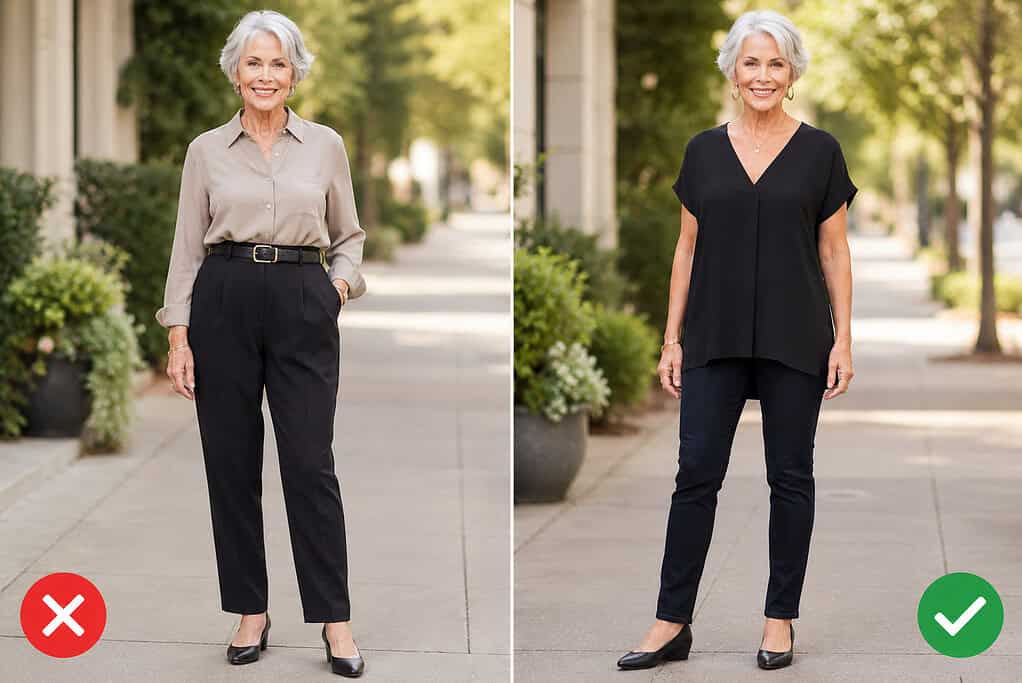
Tucking a top in and adding a belt is one of the best tricks there is. It defines the waist, lengthens the leg, and pulls an outfit together in about four seconds.
It works right up until it doesn't.
Somewhere in our seventies the upper back tends to round a little, and we lose a bit of height. The distance between the ribs and the hips gets shorter. There's less room in the middle for a waist to be defined.
So the tuck starts to bunch. The belt sits somewhere that isn't quite the waist anymore. A dress that's fitted through the middle rides up at the back when we sit down.
Nothing has gone wrong here. The proportions just moved.
Instead, try letting the top hang. An overblouse that skims past the hip, a longer cardigan, a two piece instead of a fitted dress. The same trick, adjusted.
One small rule: if a dress rides up at the back when you sit, that's the dress telling you something. Not your body.
Shop Your Capsule
3. Choosing Sleeves For The Wrong Reason
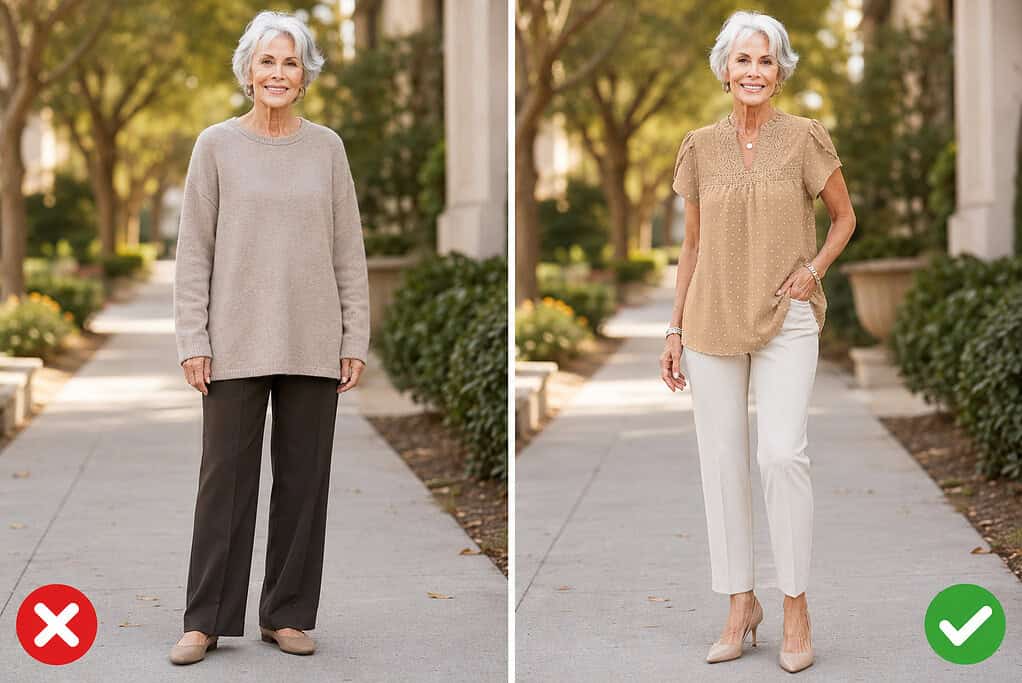
Upper arms come up a lot in conversations about dressing after 70.
Usually the question is whether we're still allowed to show them, which is a question about what other people think.
There's a better one underneath it, and it gets tangled up with the first: how does the sleeve actually feel?
Because skin does get thinner in our seventies. That part is real. A wool sweater we've owned for fifteen years can start to feel scratchy in a way it never did. Stiff cuffs pinch. Anything clingy stops being comfortable somewhere around lunchtime.
That's a fabric problem. It isn't an arm problem, and the two get confused constantly.
Instead, pick the sleeve for the weather and for how the fabric sits on your skin. Long, short, three-quarter, none at all. Soft cotton, fine knit, a smooth lining rather than a raw seam.
A light layer because the room is cold is a good decision. A light layer because you've decided your arms are a problem is a different thing entirely.
One small test: rub the fabric on the inside of your wrist, not your palm. Your palm has been through too much to be honest with you.
Shop Your Capsule
4. Wearing The Colors That Suited Your Old Hair
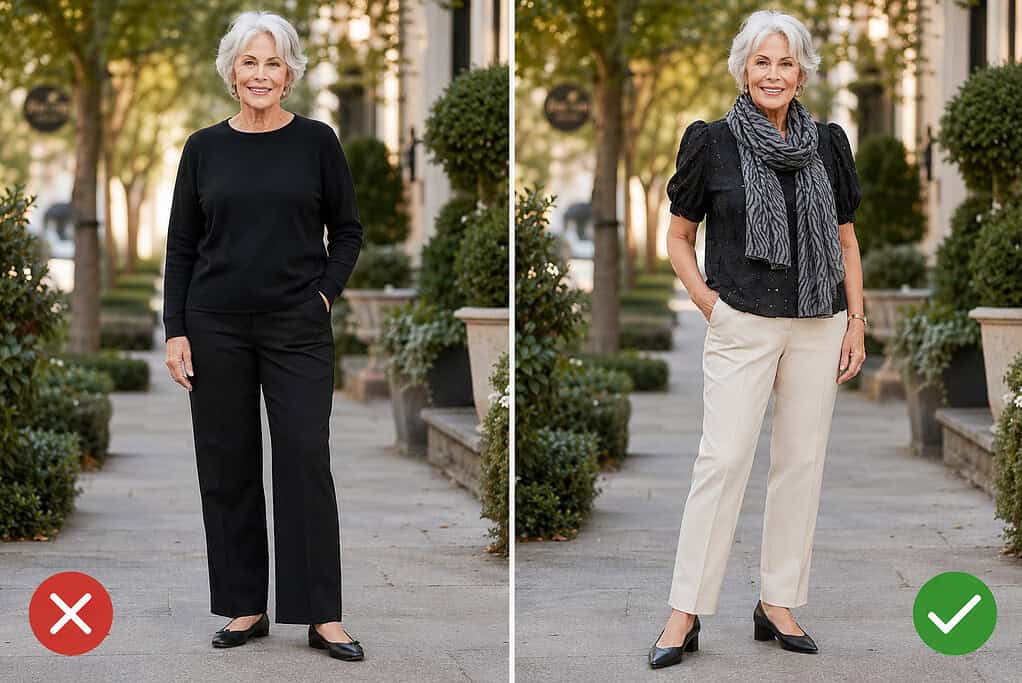
This one catches almost everybody, because the change happens so slowly.
When hair still had its color, there was natural contrast between hair, brows, skin, and eyes. Strong colors had something to push against. Black at the neckline read as sharp.
As hair goes fully silver or white and skin thins, that contrast softens. The same black now sits against much less, and it can pull the eye down instead of up to your face.
Nothing about the color changed. What it's sitting next to did.
Instead, put softer or richer mid-tones nearest your face. Navy, charcoal, camel, cream, or a real color you like. Teal, plum, moss, rust. Silver hair takes color remarkably well, better than it ever did before.
You don't have to replace the black. Just break it up at the neckline. A scarf you already own will do it, and it costs nothing to try.
Working out a color palette that works together makes this easier than guessing item by item.
One small rule: judge color by a window, never under a bulb. If your face looks tired in daylight, it's usually the color and not you.
Shop Your Capsule
5. Buying The Size Instead Of The Fit
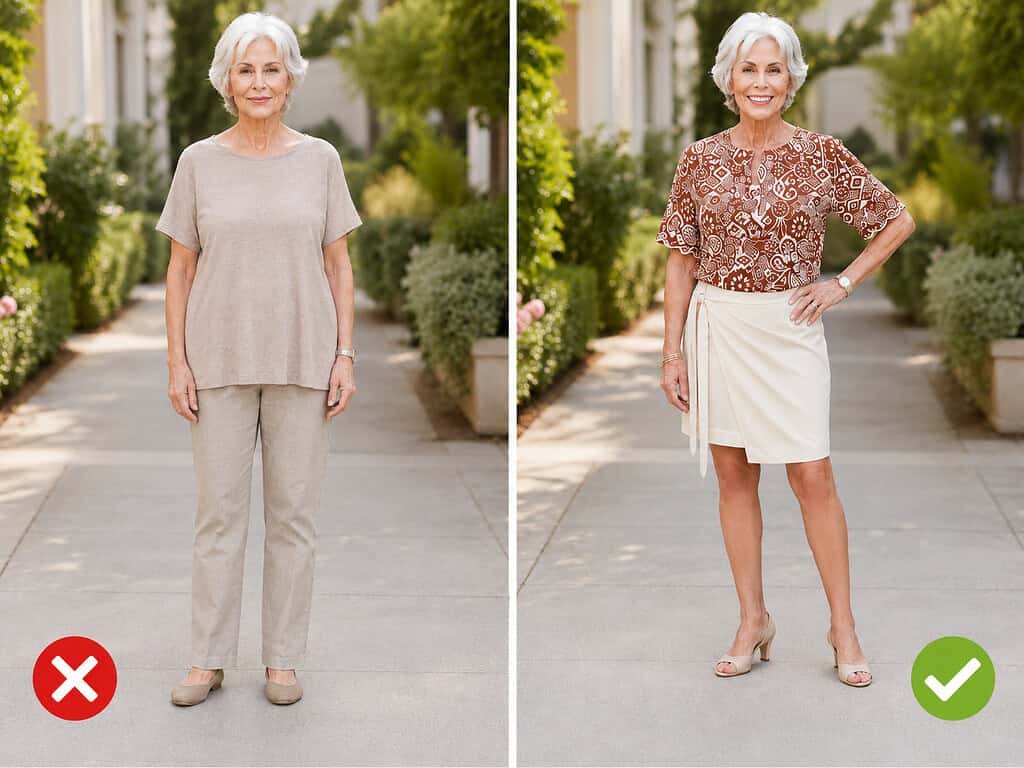
Somewhere along the way most of us decided we're a size. Then we shop for that size, and if it doesn't fit we assume we've failed.
After 70 that number gets less useful than ever. Muscle softens, weight moves toward the middle, and we lose height, which changes every proportion on the label.
Sizing shifts too, and not consistently. A 12 in one shop is a 16 in another. There is no fixed thing to be.
The cost of holding on to the number is real. We end up with clothes that pull, or clothes that hang, and either way we reach for them less.
Instead, shop by how it sits. It should skim. Not cling, not hang like a curtain. Structured cotton, a firm knit, or a bit of weight in the fabric will hold its shape across the middle, which is usually where it shows first. Soft jersey follows every line underneath it.
If something fits everywhere but one place, a tailor can fix that for less than a new pair of trousers costs.
One small rule: cut the label out when you get home. Nobody sees it but you, and it isn't helping.
Shop Your Capsule
6. Wearing A Bra That Was Fitted To A Different Body
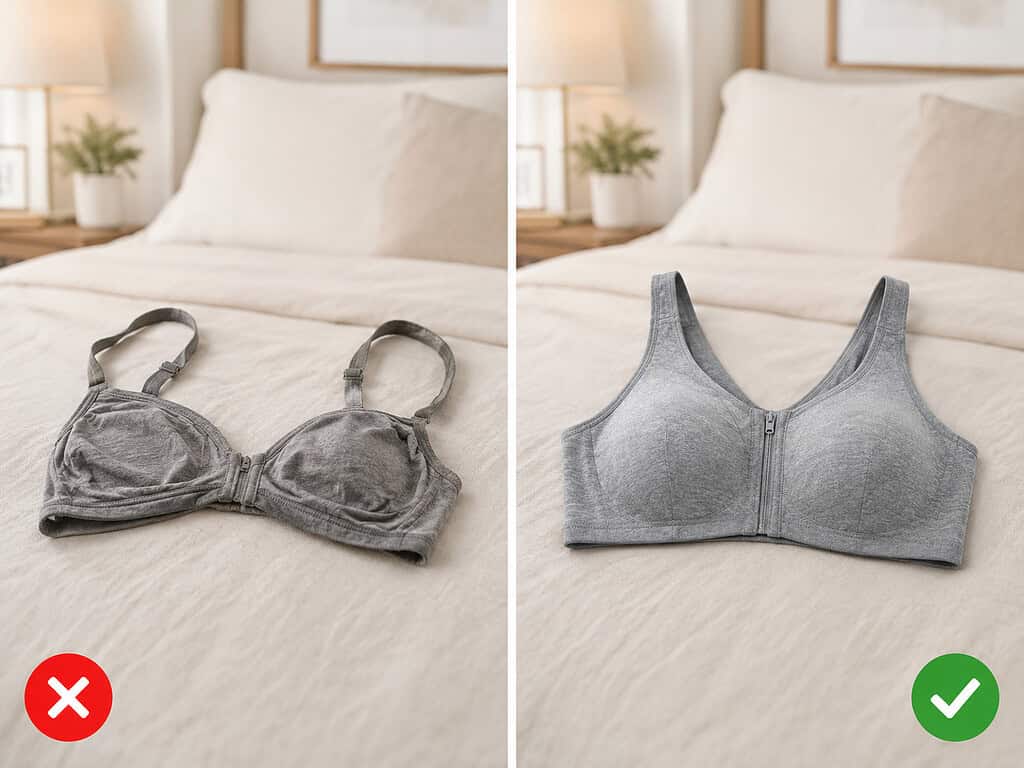
This is the piece we think about least and it changes the most.
After menopause the bust sits lower, softer, and wider-set than it used to. That's ordinary, and it happens to everybody.
The bra in the drawer was fitted to the body from before. So the band creeps up the back, the straps dig in and carry weight they were never meant to, and everything worn on top sits about an inch off.
It shows through every blouse and jacket we own, which is what makes it worth fixing first.
Instead, remember the band does the work. Firm, level, and low across the back, straps just along for the ride. If the band rides up, it's too big, and going down a band size while going up a cup usually solves it.
If your upper back has rounded at all, a wireless or soft-cup style is often far more comfortable. Wires are built for a flat ribcage and can press where you don't want pressing.
One small check: put a bra on and reach both arms straight up. If the band lifts off your ribs, it isn't holding you.
Shop Your Capsule
7. Judging Shoes By How They Look On The Shelf
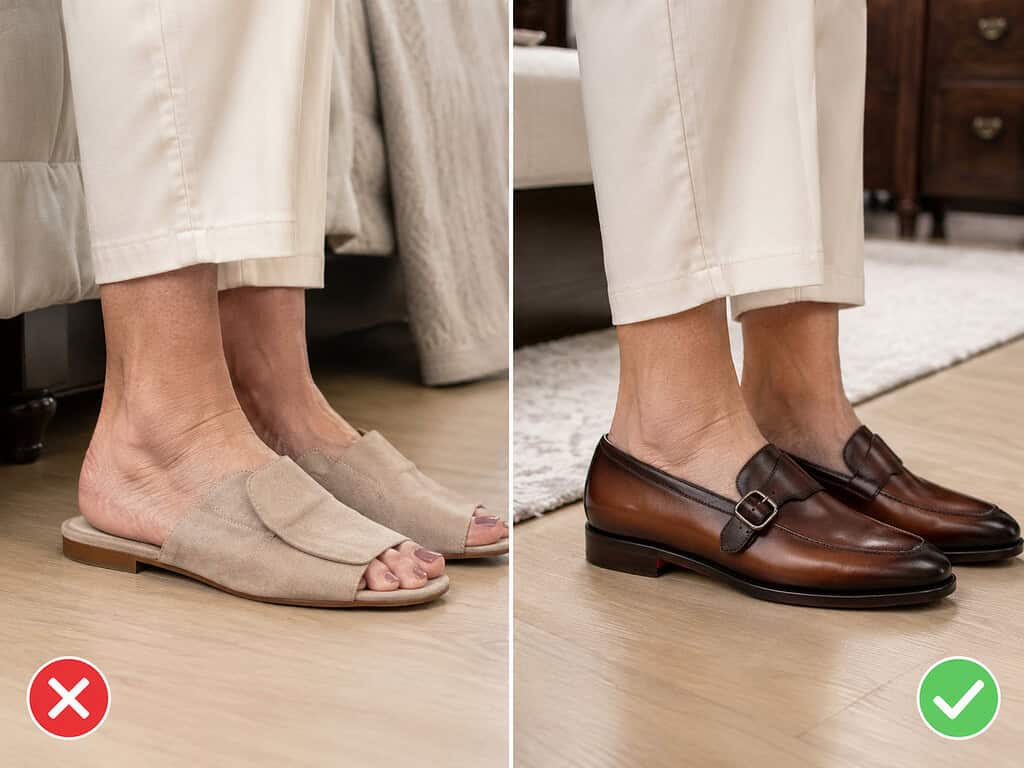
Feet keep changing our whole lives, and they change quite a bit after 70. They spread, they get a little longer, and they swell through the day.
Which means the size we've bought for thirty years may not be our size anymore. It's worth being measured again. It's free, and it surprises most people.
Then there's what the shoe does once it's on. A backless slide or a slipper doesn't hold the foot, so the toes grip to keep it there, and the whole foot works harder than it needs to. That's usually why the feet ache by evening, not the walking.
Instead, look for a low broad heel, a sole with some grip and some firmness, and something that fastens. A loafer, a lace-up, a strap, a good sneaker.
The same goes indoors, where most of us spend most of our time and wear the least supportive thing we own.
Building a small set of shoes that give you real support beats a cupboard full of pairs you don't wear.
One small rule: shop for shoes in the afternoon, when your feet are at their largest. Morning feet will lie to you.
Shop Your Capsule
8. Keeping Clothes That Fight Your Hands
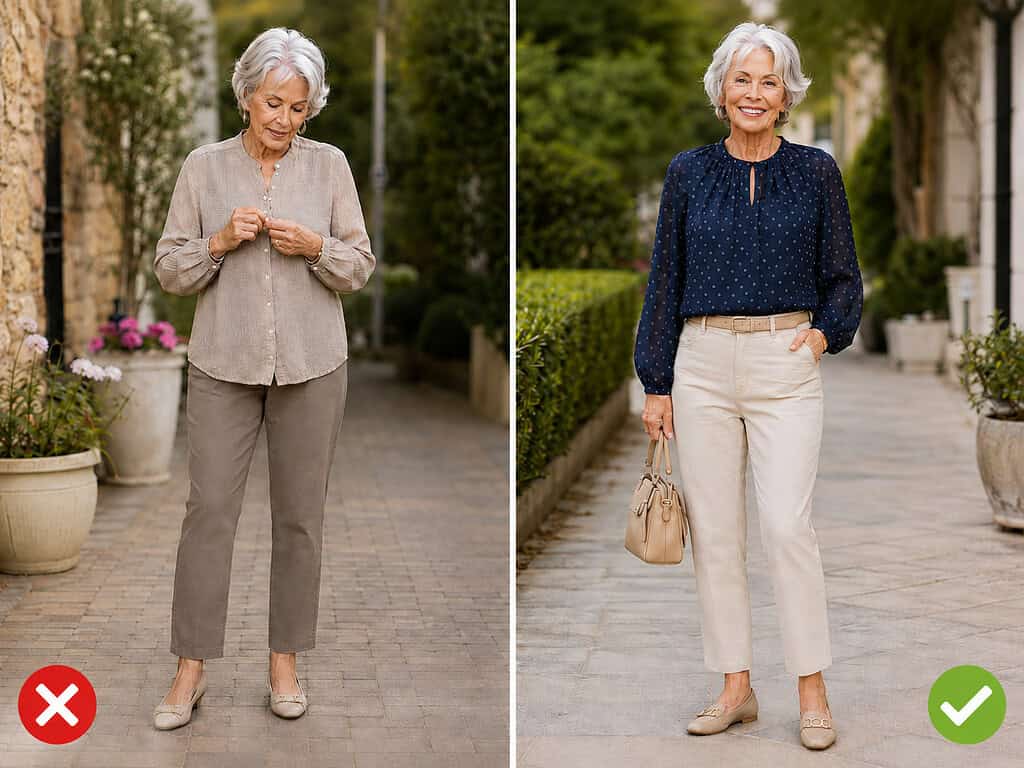
Hands stiffen up, especially first thing in the morning. Fingers get less patient with small fiddly things.
And a surprising amount of clothing is built entirely out of small fiddly things. Zips at the back. Buttons the size of a pea. Bra hooks. That necklace clasp needing a pinch grip and steady fingers at the exact moment neither is available.
What tends to happen is quiet. We don't declare that a dress is too hard. We just stop choosing it. Six months later it's still in the closet and we've forgotten why we never wear it.
Instead, look at what opens at the front or the side. Bigger buttons. A larger zip pull, or a loop of ribbon threaded through a small one, which takes a minute and costs nothing.
Magnetic clasp converters clip onto necklaces you already own and turn a two-minute struggle into one second. They're a few dollars and they're invisible once on.
Elastic waists have a reputation they no longer deserve. A flat-front pull-on trouser in a proper fabric looks like a trouser, because it is one.
One small rule: if getting dressed takes two hands, a mirror, and a bad word, that's the garment's fault.
Shop Your Capsule
9. Dressing For One Temperature
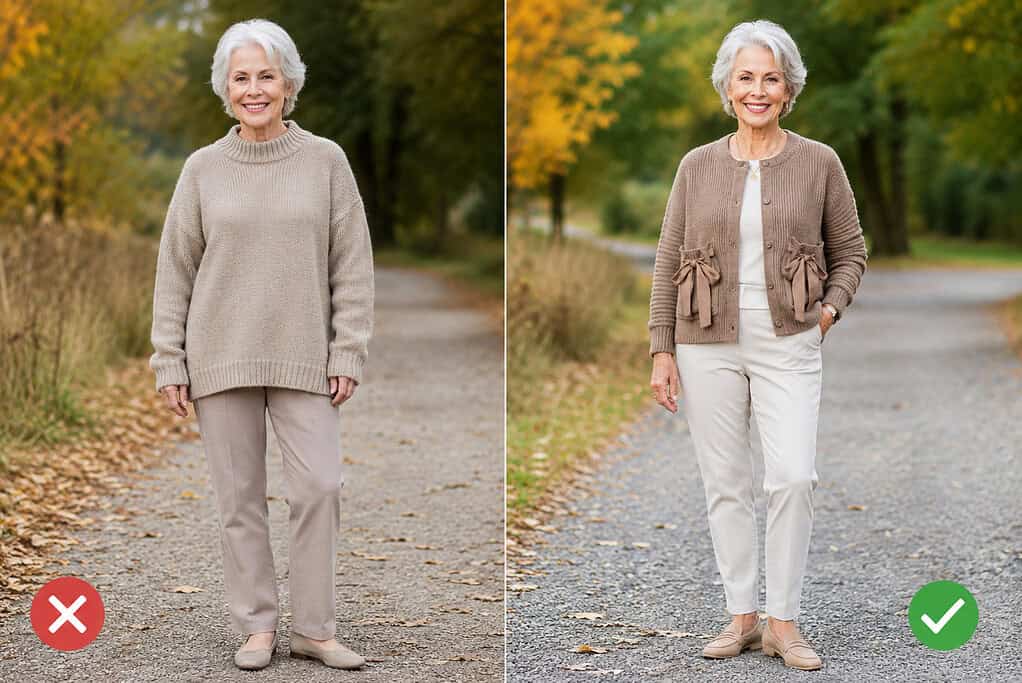
Our thermostats get unreliable in both directions.
Some days the cold goes right through us and the heating doesn't touch it. Other days a hot flash arrives at eleven in the morning and the blouse we put on at eight is no longer survivable.
Sometimes both, in the same day.
One heavy sweater can't solve either. Put it on and you're stuck with all that warmth whether you want it or not, and taking it off leaves you in whatever was underneath, which usually wasn't meant to be seen.
Instead, build the outfit in thin layers that each look finished on their own. A shell that's a proper top. A fine cardigan. A jacket you can carry. Adding and shedding one at a time is control that a single thick layer can't give you.
Natural fibers help more than they get credit for. Cotton, linen, silk, and fine wool move air. Polyester holds heat against you and then holds onto the damp too.
A scarf or a light cardigan left on the back of a chair is the cheapest fix in this whole post.
One small rule: three thin layers is warmth you control. One thick one is warmth you're stuck with.
Shop Your Capsule
10. Saving Your Good Clothes For A Someday That Hasn't Come Yet
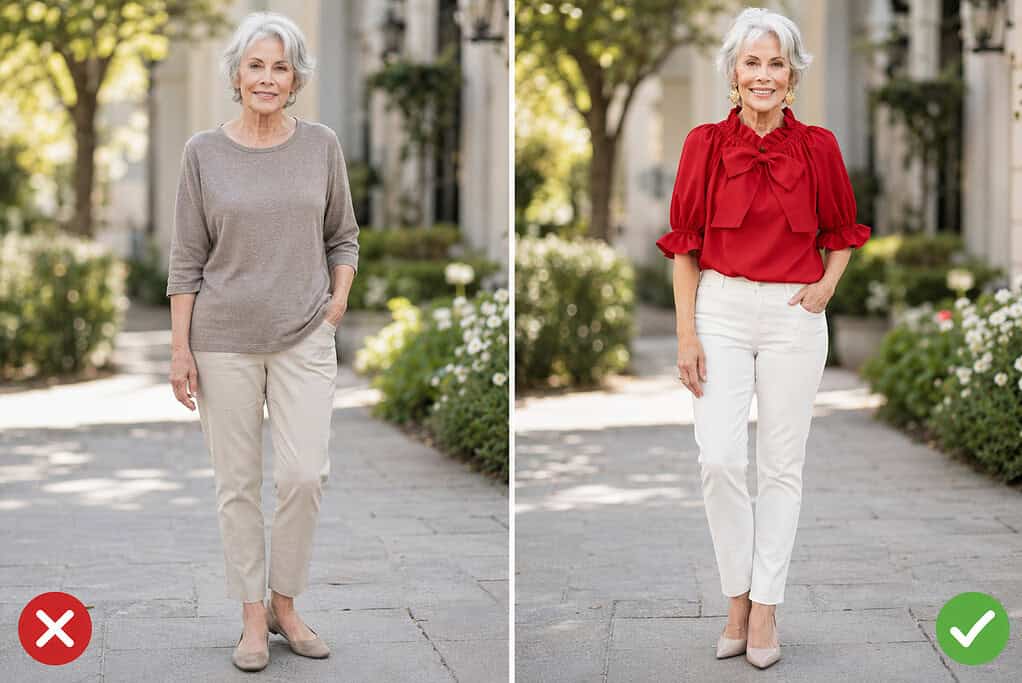
Almost every woman has a version of this. The nice blouse waiting for a nicer occasion. The trousers that will fit again after a few more pounds. The good earrings kept for somewhere worth wearing them.
It makes complete sense. You paid for those things, and you want them to have their moment.
But here's what it quietly costs. While the good things wait, you get dressed every morning in whatever's left over. And whatever's left over is usually the stuff you like the least.
Instead, let the good things out. Wear the blouse to the grocery store. Put the earrings on for a Tuesday afternoon.
If the weight comes off, wonderful. You'll enjoy those trousers all the more when it does. But you still have to get dressed tomorrow morning. And tomorrow deserves something you feel good in too.
Remember, if you're saving a specific dress or cardigan (whatever it is) for a special occasion, this week counts as one.
Shop Your Capsule
Three Outfits That Fix Most Of This
None of this has to be worked out garment by garment. Most of it collapses into a few combinations you can wear on repeat.
Here are three, built from things you probably already own.
White Blouse + Straight Trousers + Loafers + A Scarf You Already Own

An untucked blouse that skims past the hip. Trousers with a flat front and a straight leg. Loafers that fasten. Then the scarf, which is doing the real work by bringing color up to your face.
When to wear it: Church, lunch out, family gatherings, anywhere you want to look considered without thinking about it.
Why it works: The blouse skims instead of tucking, so it doesn't fight a rounded back. The loafers hold your feet. The scarf keeps the white off your neckline.
Reassurance: Every piece here is something you own or can find easily. Nothing about it will look dated in three years.
Shop Your Capsule
Jewel-Tone Long-Sleeve Tee + Straight-Leg Jeans + Enclosed Sneakers

A soft long-sleeve tee in teal, plum, or rust. Dark straight-leg jeans. Sneakers that lace.
When to wear it: Errands, appointments, the school run, an ordinary Tuesday.
Why it works: Soft sleeves that feel good against your skin, in a color that lifts your face. Jeans that skim rather than cling. Shoes that hold your feet through a full day of walking.
Reassurance: Yes, jeans. Yes, sneakers. Both are fine at 70 and always were.
Shop Your Capsule
Fine Cardigan + Shell + Pull-On Trousers + One Good Brooch
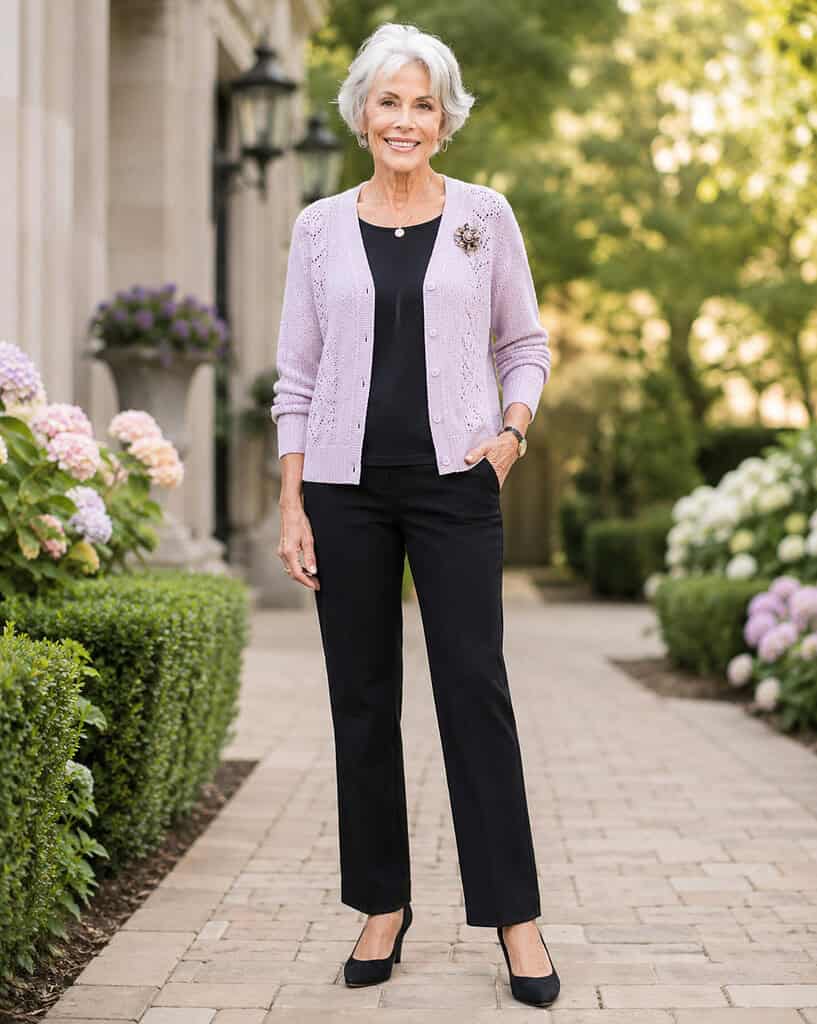
A shell top that stands on its own. A fine cardigan over it. Flat-front pull-on trousers. One brooch or a pair of earrings.
When to wear it: A day your hands ache, a room you can't predict the temperature of, an evening out that starts warm and ends cold.
Why it works: Nothing to fasten. Layers you can shed one at a time. Two pieces instead of a dress, so nothing rides up.
Reassurance: This is the outfit for a bad morning that still ends up looking like a good decision.
These aren't rules. They're starting points, and you can break every one of them.
Shop Your Capsule
How To Update Your Style Without Replacing Everything
Almost nothing in this post needs a shopping trip.
Start in your own closet. Pull out everything you haven't worn in a year and ask why, honestly. Half of it will turn out to be a fastening you can't manage or a fabric that itches, and that's useful to know.
Move your best scarf to the front where you'll see it. That single move fixes the color problem for free.
Try untucking three tops you've always tucked. Costs nothing, takes four minutes, and tells you immediately whether proportion is your issue.
Get measured, both bra and feet. Both are free, both take twenty minutes, and both change more than a new outfit would.
When you do buy, buy one thing. The bra, or the shoes. Not the wardrobe. One good piece that solves a real problem beats five that were on sale.
Then choose fabric over quantity. Fewer things in cotton, linen, or wool will feel better and last longer than a drawer full of polyester.
This is really the same idea behind building a wardrobe that works with less. Fewer decisions, better ones.
Looking Pulled Together After 70
Here's what I love about this list…
Not one of these ten things is about your body being wrong.
Every single one is about clothes catching up to a body that's still going. The blouse rides up, so we untuck it. The shoes stopped fitting, so we get measured. The bra was for a different decade, so we replace it.
That's maintenance. That's all it ever was.
And that's the whole trick to looking pulled together at 70. Not younger. Not smaller. Not quieter, either.
Just clothes that fit, in colors that light up your face, on a body you've had for seventy-odd years and can be rather proud of.
Wear the belt. Wear the earrings. Be the woman who walks into the room looking exactly like herself.
Take The Guesswork Out Of Getting Dressed

If you're reading this thinking, yes, but where do I actually start, I've got you covered.
My free capsule wardrobe guide walks you through a simple four-step process to work out what you have, what suits you now, and what's actually missing.
It's built for real closets and real budgets. There's no shopping list, and nothing in it assumes you're starting over.
Just a clear way to look pulled together using what's already hanging in front of you.
It's free, it takes about ten minutes to read, and over 9,000 women have used it already.
Frequently Asked Questions
1. What should a 70-year-old woman not wear?
There isn't really a list, and anyone who gives you one is guessing.
The things worth avoiding are the same at any age. Clothes that don't fit. Fabrics that itch. Shoes that don't hold your feet.
Age doesn't rule anything out. Fit and comfort rule plenty out, and they're the only two tests you need.
2. How can a 70-year-old woman look stylish?
Start with fit, then color, then comfort. In that order.
Clothes that skim rather than cling or hang. A color near your face that lifts it. Shoes and fastenings that don't fight you.
Get those three right and almost anything works. Get them wrong and nothing does, no matter how nice the garment.
3. Should a 70-year-old woman wear jeans?
Yes.
Straight-leg or slim in a dark wash looks polished with almost anything, and they're comfortable enough for a full day out.
Skip heavy distressing if it isn't you, and check the rise. Mid-rise is often more comfortable than high if your waist has shortened.
4. What colors should a 70-year-old woman wear?
Whichever ones light up your face, and silver hair widens that list rather than narrowing it.
Navy, camel, cream, and charcoal are easy near the face. Teal, plum, moss, and rust work beautifully against grey and white hair.
Black isn't off limits. Just break it up at the neckline with a scarf or a lighter collar.
5. Can a 70-year-old woman wear sleeveless tops?
Yes.
Choose sleeves for the weather and for how the fabric feels, not for how you think your arms are being judged.
If you want a layer because a room is cold or the sun is strong, that's a good reason. That's the only kind you need.
6. What length skirt is most flattering after 70?
Knee-length or just below suits most people, and a midi works well with the right shoes.
Length matters less than what it's doing. A skirt that skims and moves will look good at almost any length.
Check it sitting down as well as standing. That's where most skirts tell you the truth.
Follow me elsewhere!

