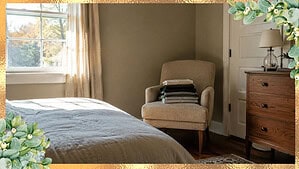
There's a chair in my bedroom that hasn't held a single person in months.
It holds laundry. Clean laundry, mostly, the kind I washed and folded with good intentions and then never put away. Some days I look at that chair and feel my whole body get heavy.
I know I should deal with it. I just can't seem to make myself do it.
And the longer it sits, the worse I feel. The worse I feel, the less I want to touch it. So it grows. A sweater here, a pair of jeans there, until the chair disappears completely and I'm getting dressed out of a laundry basket on the floor.
If you've ever stood in a room that made your heart sink, you already know this feeling. The mess makes you sad. And somehow the sadness makes even more mess.
For a long time I thought something was wrong with me.
I thought I was lazy, or that I'd let myself go. (I wasn't either of those things, and chances are you aren't either.) What I finally understood is that a messy home and a low mood feed each other.
They go around and around until you feel stuck in the middle of it.
I'm not a doctor, and decluttering for mental health isn't a cure for anything. But I've found that clearing even a little space can loosen that heavy feeling just enough to let you breathe.
So if the mess feels like too much right now, stay with me. I'll walk you through the small things that helped me start on the days I didn't think I could.
A quick, honest note before we start. I'm writing as a friend who has lived this, not as a professional. If the heaviness you're feeling goes deeper than a cluttered house, or it's been with you for a while, please talk to your doctor or a counselor. There's no shame in it, and you deserve real support. This post is about gently making room, not about replacing the care a trained person can give you.
Why the Mess and the Sadness Keep Feeding Each Other

For years I blamed myself. I figured if I just tried harder, or cared a little more, the house wouldn't get so cluttered the way it did.
That wasn't the problem.
The problem was that a messy room and a low mood pull on each other. When my home felt heavy, I felt heavy. And when I felt heavy, I didn't have it in me to deal with the home. So the dishes sat. The mail piled up. The chair filled with laundry.
Then I'd walk past all of it and feel worse, which left me with even less energy than I started with.
Maybe you know the feeling.
That feeling when you finally sit down to rest, but your eyes always land on the dining table buried under stuff.
And just like that, resting doesn't feel like resting anymore.
It feels like one more thing you're behind on. (I spent more evenings like that than I'd like to admit.)
I wish someone had told me sooner that none of this means you're lazy or broken. A tired mind and a cluttered room are simply hard on each other. There's a real connection between clutter and how we feel, and once I understood that, I stopped taking it out on myself. When you're already running low, every pile in the house asks for energy you personally didn't have.
So if you've been carrying that blame, I'd like you to set it down for a minute. You're not weak. You're worn out. And being worn out is not a character flaw.
What helped me most was learning that this works both ways. The mess can pull your mood down, that part is real. But clearing even one small corner can lift it back up a little. Not all at once, and not perfectly. Just enough to make the next small thing feel possible.
That's where we'll start.
The Small Things That Helped Me Start Again
None of what helped me looked like the advice I used to read.
There were no before-and-after photos. No big productive weekend where I fixed everything at once. What worked was so small it almost felt silly. But small was the only thing I could manage, and it turned out small was enough.
Here's what I mean.
Start With the First Thing You See in the Morning

When the whole house feels like too much, picking a place to start can stop you before you even begin. So I stopped trying to choose the right spot. If you've ever wondered how to start decluttering when you're overwhelmed, this was my answer. I just went with the first thing my eyes landed on when I woke up.
For me, that was the chair with the laundry.
I didn't empty it. I just hung up two things. Then I left the rest and went to make my coffee.
That was it. That was the whole task.
But here's what surprised me. Walking back into that room later and seeing two fewer sweaters on the chair gave me the smallest lift. Not a fireworks kind of feeling. Just a quiet little “oh, that's a bit better.” (Some mornings that tiny bit of better was all I had, and it still counted.)
When the first thing you see every morning is a little less heavy, your whole day starts on slightly steadier ground. You don't have to fix the room. You just have to make the first thing your eyes meet a little kinder to wake up to.
Pick One Small Thing and Stop There

The old me would have ridden that little bit of momentum straight into a four-hour cleaning marathon.
Then I'd burn out halfway, leave a bigger mess than I started with, and swear off decluttering for another month.
So I made a new rule. One small thing, and then I stop. On purpose.
Not stop because I ran out of steam. Stop because I decided to, while I still had a little left in the tank.
Maybe it's clearing the spot on the counter where the mail lands. Maybe it's the inside of one drawer. Whatever it is, you do that one thing and you let yourself be done, even if you feel like you could do more.
Stopping while it still feels okay is what makes you willing to come back tomorrow. (The marathons are what taught me to dread the whole thing.)
Clear a Path, Not a Whole Room

On the hard days, a whole room is out of the question. I learned to aim lower than that. Instead of the room, I'd clear the path through it.
The walkway from the bedroom door to the bed. The floor space in front of the closet. The strip of counter right next to the stove where I actually cook.
These are the spots you move through every single day. When they're clear, the house feels more livable even when the rest of it isn't done yet. You can walk to your own bed without stepping over a basket.
A clear path won't pass a white-glove inspection. But it gives you back the parts of the room you use the most, and that matters more than it sounds.
Let It Be Messy While You Work

This one took me the longest to make peace with. When you pull everything out of a drawer or a closet, the room gets worse before it gets better. For a while there's stuff everywhere, and if you're already feeling low, that in-between mess can send you right back to the couch.
So I stopped treating the mess as a sign I was failing. It's not. It's just the middle.
Every job has an ugly middle, and learning to sit with that was one of the habits that slowly reshaped how I keep my home. The pile on the bed before the clothes get sorted. The papers spread across the table before they get filed. That chaos isn't you doing it wrong. It's you doing it.
When you can let the middle be messy without turning it into proof that you're hopeless, you can keep going long enough to reach the better part on the other side.
Let “Done” Beat “Perfect”

I used to think if I couldn't organize a space properly, with matching bins and neat labels, there was no point starting. That kind of perfectionism is one of the quiet reasons self-care feels so hard. So I didn't start at all.
That kind of thinking kept my house cluttered for years.
Done is the clothes off the chair, even if they're not folded the way a magazine would fold them. Done is the dishes washed and stacked in the rack, even if they're not put away yet. Done is good enough, and good enough is a thousand times better than the perfect version that never happens.
Let the bar be low. A low bar you actually clear beats a high one you keep walking away from. (I have walked away from a lot of high bars in my life.)
Do a Little, Then Rest Without Guilt

For most of my life, sitting down felt like something I had to earn. If the house wasn't done, I had no business resting. So even when I did sit, I didn't really rest. I just sat there feeling guilty about everything I wasn't doing.
That has to stop, because rest isn't the reward for finishing. It's the thing that gives you enough back to keep going. Resting isn't the opposite of taking care of your home. It's part of taking care of yourself.
So now I do a little, and then I rest, and I let the resting be okay. I cleared the path. I hung up two shirts. I wiped down one counter. That's a real thing I did, and I'm allowed to sit down afterward without a running list of everything still left.
You don't have to finish the whole house to deserve a quiet cup of coffee in a chair that, for once, doesn't have laundry on it.
Go Easy on Yourself

If you take nothing else from all this, take this part.
It took a long time for your home to get to where it is. Months, maybe years, of life happening, of hard seasons, of days when surviving was about all you could do. So it isn't fair to expect yourself to undo it in a weekend, or to feel ashamed that you can't.
You're not behind. You're human.
There were stretches where I did one small thing a day, and stretches where I did nothing at all for a week. The nothing weeks used to fill me with guilt. Now I see them differently.
Sometimes resting was the work.
Sometimes I needed to refill before I could pick anything back up.
The chair still collects laundry now and then. The counter still gets away from me.
The difference is that I don't spiral over it the way I used to. I know how to start small again, and I know that one quiet corner can lift my mood just enough to reach for the next one.
That's not failing.
That's living, and then gently coming back.
So be patient with the woman doing the work. Talk to her the way you'd talk to a dear friend who's tired and trying.
She's doing better than she thinks.
If You Want a Soft Place to Start

If reading this stirred something in you, that quiet feeling of “I want things to be different, I just don't know where to begin,” I made something for you.
It's my free Declutter for Self Care Checklist. I built it for the exact days I've been describing here, the ones where the mess feels heavy and your energy is thin. It doesn't ask you to overhaul your home or fix everything at once.
It meets you where you are, gently, and helps you find one small place to begin.
FAQ's
Why does clutter make me feel so anxious and down?
A cluttered space gives your mind more than it can comfortably hold. Every pile is a small unfinished task your brain keeps track of, even when you're trying to rest. That low hum of “I should deal with that” adds up over a day, and it can leave you feeling anxious, heavy, or just worn out. You're not imagining it, and you're not being dramatic. Your surroundings really do affect how you feel inside.
Where do I start decluttering when I feel too overwhelmed to begin?
Start smaller than feels reasonable. Not a room, not even a whole drawer. Pick the first thing your eyes land on in the morning, or one single surface, and deal with just that. The goal isn't to make a dent in the whole house. It's to give yourself one small win that makes the next small thing feel possible. Overwhelm shrinks when the task shrinks.
Is it normal to feel sad or emotional while decluttering?
Yes, and it's more common than people let on. Our belongings hold memories, plans we never got to, and pieces of who we used to be. Letting go can stir up real feelings, even over small things. Give yourself room to feel it. If a particular item brings up too much, set it aside and come back another day. There's no rule that says you have to sort through everything at once.
How can decluttering actually help my mood?
When you clear even a little space, you often feel a small lift along with it. Part of that is having one less thing weighing on you. Part of it is the quiet proof that you can affect your own surroundings, which feels good when so much else is hard. It won't fix everything, and it isn't meant to. But a calmer space can take a bit of pressure off a tired mind.
What if I clean up and the mess just comes back?
It will, at least some of it, and that's normal. Keeping a home isn't a thing you finish once. It's something you tend to, a little at a time, for as long as you live there. When the chair fills up again or the counter gets away from you, you haven't failed. You just start small again, the same way you did before. Coming back is the whole practice.
Follow me elsewhere!