
Getting rid of clutter is one thing. But keeping it from coming back is a whole different story.
I used to have those days where I'd declutter an entire room, feel really good about it, and then watch it slowly fill back up over the next few weeks.
Over time, I realized that the clutter wasn't really the problem.
But my daily habits were.
What I needed wasn't another big decluttering session. I needed small, simple habits that fit into the life I was already living — ones I could actually stick to without carving out a whole huge chunk of my time for it.
And that's what this post is about.
These seven habits didn't overhaul my life overnight. But one by one, they changed how I move through my home every single day. Some took a little getting used to. Others clicked almost immediately. And a few of them are so simple I almost didn't take them seriously at first.
If you've ever decluttered a space only to find it messy again two weeks later, I think at least one of these will change things for you.
7 Habits That Make a Big Difference In My Life
Some of these I picked up from other people. Others I figured out on my own after a lot of failed attempts.
What they all have in common is that they're small enough to start today and practical enough to actually keep doing.
1. The 10-10 Rule

The idea is simple. Set a timer for 10 minutes, grab a bag, and find 10 items to get rid of.
That's it.
But there's one part of this rule that makes all the difference — the items have to actually leave your home.
Not move to the garage. Not sit in a pile by the door.
They go in the donation bag, the trash, or the sell pile. And that bag leaves the house.
I started doing this on Sunday mornings while my coffee was brewing. Ten minutes, ten things, done before I even sat down for breakfast. It felt almost too easy at first. But after a few weeks, I noticed the surfaces in my kitchen staying clearer.
The junk drawer is getting lighter.
The closet gets easier to close.
The 10-10 rule works because it's short enough that you never talk yourself out of it. You're not committing to a big project. You're just finding 10 things in 10 minutes.
Most days, you'll find more than 10 before the timer even goes off.
2. Habit Stacking
Habit stacking means attaching a small decluttering action to something you already do every day.
The idea is that instead of trying to find extra time to declutter, you borrow a few minutes from a routine that's already happening.
For me, it looked like this.
Every morning while I waited for my toast, I'd go through the pile of mail sitting on the counter and toss anything I didn't need to keep.
It took maybe four minutes.
But that counter went from a daily dumping ground to one of the clearest spots in my kitchen.
You can stack it onto almost anything.
While the coffee brews, you clear the kitchen counter. While you wait for the shower to warm up, you check the medicine cabinet. While the TV show loads, you go through the mail pile on the side table.
The key is keeping it small enough that it doesn't feel like a separate task. You're not stopping what you're doing. You're just adding one tiny action to something that's already part of your day.
It sounds almost too simple. But that's exactly why it works. You never have to find the time because the time is already there.
3. The One-Minute Rule
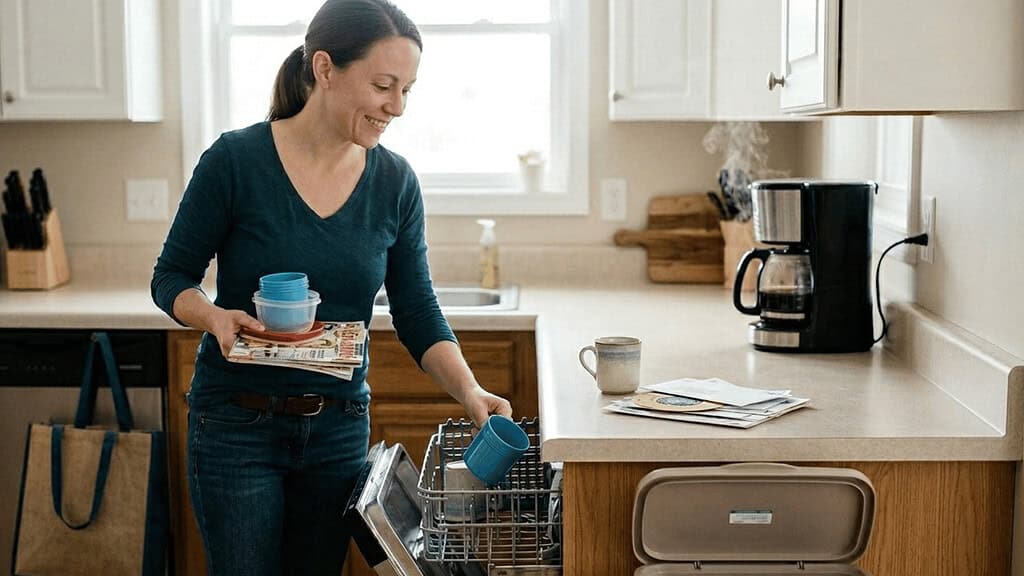
If something takes less than a minute to put away, do it now.
That's the whole rule.
It sounds obvious. But I can't tell you how many times I'd walk past my coat draped over the kitchen chair (the same chair it had been on for three days) and tell myself I'd hang it up later.
Or how I'd leave a stack of magazines on the coffee table because dealing with them felt like a task I needed to prepare for.
It wasn't a task. It was 45 seconds.
But the one-minute rule changed that for me.
The coat gets hung up the moment I walk in the door. The junk mail goes straight into the recycling bin before I even set my purse down. The empty coffee cup goes directly into the dishwasher instead of sitting on the counter until the end of the day.
None of those things feel like decluttering when you're doing them. But when you stop letting small things pile up, the whole house stays calmer without any extra effort.
The clutter that builds up in most homes isn't from big complicated problems. It's from a hundred small things that each took less than a minute to deal with — and didn't get dealt with.
4. The Four Corner Rule
This one saved me from my biggest decluttering problem — getting distracted.
I'd start in the bedroom, notice something that belonged in the bathroom, walk it over there, spot the cabinet that needed sorting, and before I knew it I'd been “decluttering” for an hour and nothing was actually done.
The four corner rule fixed that.
The idea is simple. You start in one corner of a room (any corner) and you work your way around the room, corner by corner, until you end up back at the door.
You don't skip ahead. You don't follow items to other rooms.
If something belongs somewhere else, it goes in a pile by the door and you deal with it after.
I tried this first in my bedroom on a Tuesday afternoon. I started in the far left corner by the window, worked my way around, and finished in about 40 minutes.
The pile by the door had maybe 15 items in it — things that belonged in the kitchen, the bathroom, the hallway closet.
I dropped them off on my way out.
What I liked most about this method is that it keeps your brain in one place. You're not making decisions about the whole room at once. You're just handling what's directly in front of you, moving to the next corner when you're done.
It's a small shift in how you move through a space.
But it keeps you from that scattered, running-in-circles feeling that makes decluttering feel exhausting before you've even really started.
5. The One Sock Rule
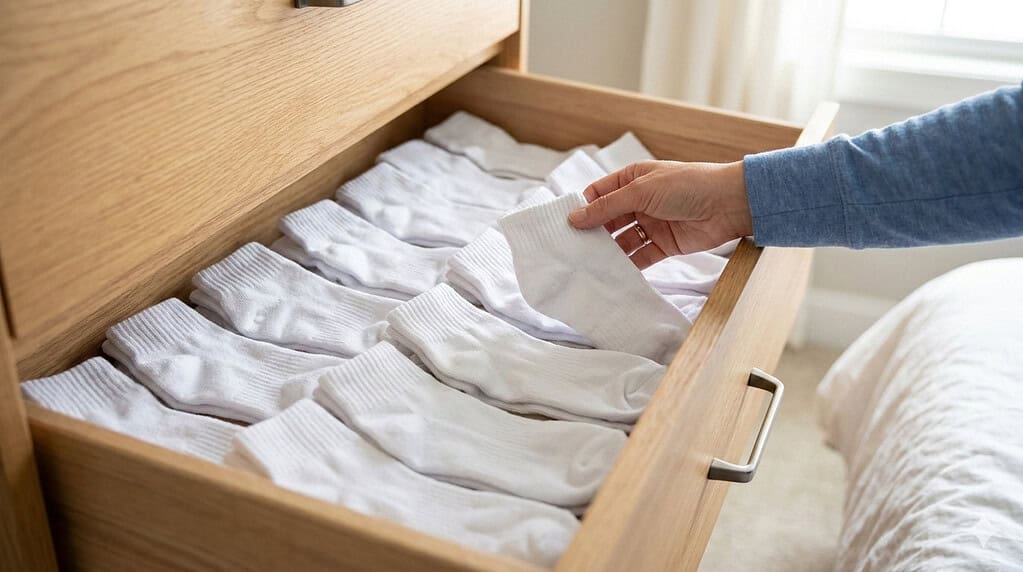
This one sounds too simple to make a real difference. I almost didn't try it.
The idea is that you buy the same socks (same color, same length, same brand) so that every single sock in your drawer matches every other sock.
I used to spend a good two minutes every morning just trying to find a matching pair.
Some days I'd give up and wear two socks that were close enough. For some it wasn’t a big deal, but if it happens to you every single day then it turns annoying
That’s why I decided to switch to one style of white ankle sock for everyday wear, and guess what? It changed my laundry routine more than I expected.
Every sock out of the dryer matches automatically. The drawer stays neat without any effort. And that one small frustration I dealt with every single morning just disappeared.
Now, I do keep one or two specialty pairs separate (my walking socks for when my feet need extra support) because those serve a specific purpose. But everything else is the same.
It sounds like such a minor thing. But clutter isn't always about big piles of stuff. Sometimes it's about the little daily irritations that quietly wear you down.
And the sock drawer was one of mine.
If you have a drawer that always seems to end up messy no matter how many times you sort it, look closely at what's in there. Sometimes the problem isn't the drawer. It's the mismatch.
6. Keep a Permanent Donation Spot
This habit is probably the simplest one on this list. And it's the one I wish I had started years earlier.
The idea is that you keep one spot in your home (a box, a bag, a bin) that is always there and always open for donations. No sorting, no scheduling, no waiting for a “big declutter day.”
When you come across something you no longer need, it goes straight in.
I keep mine in the corner of my laundry room (a plain canvas tote that hangs on a hook by the door). It's not pretty, but it's always there.
What changed for me was having a place for things the moment I decided to let them go.
Before, I'd set something aside with good intentions and then find it back on a shelf two weeks later because it had no clear destination.
The donation box gave it one.
The rule I set for myself is simple — when the bag is full, it leaves.
I don't wait for a convenient time or a special trip. I put it in the trunk of my car the same day and drop it off the next time I'm already out running errands.
That last part matters more than it seems. The stuff that sits by the door in a bag for three weeks has a way of finding its way back inside.
Out of the house is the only finish line that counts.
2:47 AM
7. “Cute Doesn't Mean I Need It”

This last habit is less of a system and more of a mindset shift. But it might be the one that prevents the most clutter from coming in the first place.
I used to walk into a store for one thing and come home with four. A cute little basket on clearance. A candle in a pretty jar. A set of hand towels in a color I loved.
None of it was expensive. None of it felt like a big decision at the time.
But it added up fast.
The problem wasn't that I was buying things I didn't like. The problem was that I was buying things just because I liked the look of them in the store (not because I had a real place for them or a real need for them at home).
So I started asking myself one question before putting anything in the cart…
Do I actually need this, or do I just like it right now?
That changed a lot for me.
Most of the time, I'd put it back. And nine times out of ten, I'd forget about it completely by the time I got to the parking lot.
I also started keeping a small wishlist on my phone. If I see something I like, I add it to the list instead of buying it on the spot. If I still want it two weeks later, I'll consider it.
(Most things I forget about within a few days)
Cute things will always catch your eye. That part doesn't change.
But so does the clutter that comes in when you bring home things that have no real place waiting for them.
Consistency Beats A Big Clean Sweep Every Time
A clutter-free home isn't the result of one big decluttering.
It's the result of small decisions made over and over again — the mail that gets tossed right away, the donation bag that leaves before it gets unpacked, the item you put back on the shelf at the store because you know you don't really need it.
None of the habits on this list are complicated.
But done regularly, they add up to something that one big decluttering session never could…
A home that stays manageable without you having to constantly start over.
Pick one from this list and start there. Just one. Give it a week and see what happens.
Ready to Take the First Step?

My free Declutter for Self Care Checklist walks you through the process one step at a time — so you always know exactly what to do next and nothing feels too big to tackle.
It's straightforward, easy to follow, and designed to help you actually finish what you start.
Frequently Asked Questions
What are the best decluttering habits to do daily?
The ones that take the least amount of time are usually the easiest to stick to. The one-minute rule, habit stacking, and keeping a permanent donation spot are all good places to start. They don't require a block of free time — just a small, consistent action worked into what you're already doing each day.
How do I declutter when I'm overwhelmed?
Start smaller than you think you need to. Not a whole room — one drawer, one shelf, one corner. Set a timer for 10 minutes and stop when it goes off. The goal isn't to finish everything in one sitting. It's just to make a little progress without burning out.
How do I stop clutter from coming back?
Clutter comes back when there's no habit in place to catch it. The one-minute rule handles the small stuff before it piles up. The one-in, one-out rule keeps new things from quietly taking over. And a permanent donation spot gives things a place to go the moment you decide to let them go.
Where do I start if I've never had a decluttering routine?
Pick one habit from this list — just one — and try it for a week. The 10-10 rule is a good first choice because it's short, simple, and you'll see results quickly. Once that feels normal, add another habit. Building slowly is what makes it last.
Can decluttering really help with stress?
It can. A cluttered space has a way of keeping your brain on low-level alert — there's always something unfinished in your line of sight. When your home feels more manageable, that background noise quiets down. Many people notice they sleep better, feel calmer at home, and spend less time looking for things they've misplaced.
Follow me elsewhere!

