The 7 Uncomfortable Reasons You Can’t Let Go of Clutter (And What to Do About Each One)

There's something in your home right now that you've been meaning to deal with for years.

You can probably picture it without trying. The thing on a shelf. The box you've moved twice without opening. The drawer that catches when you try to open it because something inside is jammed against the side.

You know you don't really need it.

You know it's taking up space.

You know your life would be a tiny bit lighter without it.

And yet.

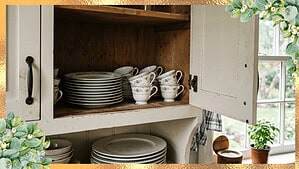
For me, it's a set of my grandmother's china in the cabinet above my stove. Twelve dinner plates. Eight cups and saucers. A platter I haven't used in fifteen years.

I don't host the kind of dinners that need fine china anymore. My grandmother has been gone for over three decades. The dishes will not be used by anyone in my house in this lifetime.

And I cannot give them away.

I've tried. I've taken the platter down, set it on the counter, and put it back.

More than once.

What stops me isn't the value of the china. Or the memory of her. Or even the hope that someday my daughter will want them.

What stops me is something else. Something I don't quite have a word for.

That something is why you keep clutter, and it's what this post is about.

It's also the seven uncomfortable reasons it lives inside almost all of us.

Why Letting Go of Clutter Is Harder Than It Looks

Wooden kitchen table holding four small empty cardboard boxes lined up beside a folded paper checklist

Most decluttering advice acts like the problem is your stuff.

If only you had the right system. The right four boxes. The right Saturday morning. You'd handle it.

But you've tried.

You've watched the shows. You've folded socks the Marie Kondo way. You've bought the bins.

And six months later, the cabinet, the drawer, the box are full again.

The problem isn't your stuff. The problem is what your stuff means.

What you're really facing when you stand in front of an object you can't let go of isn't a logistics question. It's a question about your money. Your past. Your fear. Your identity. Sometimes your family of origin.

Those are not problems a Saturday afternoon and four boxes can solve.

What helps is naming what's actually happening.

Because once you can say “this isn't about the platter, it's about my grandmother and my mother and the woman I thought I'd be by now,” the platter loses some of its grip.

Decluttering doesn't get easier when you find the right system.

It gets easier when you understand why letting go has been so hard in the first place.

The seven reasons below are the most common ones I've run into in my own home, in my mother's, in women in my book club, in stories readers have shared with me.

If you recognize yourself in even one of them, the work of letting go just got a little more possible.

The 7 Uncomfortable Reasons You're Still Holding On

What follows isn't a list of personality flaws.

These reasons aren't about you doing something wrong. They're about being human in a world that filled our homes faster than anyone taught us how to manage what arrived.

Read related post:   How to Organize a Small Wardrobe So You Can Easily Find and Wear What You Need

1. You Don't Know Where to Put It If You Let It Go

Broken table lamp on a hallway floor beside an empty cardboard box and a closed donation bag

The donation bin? The trash? Facebook Marketplace?

That hand-me-down from your sister, the broken lamp from your aunt's house, the half-used craft supplies in the basement.

You'd let them go if you knew where they should go.

So they sit. Because deciding what happens to a thing feels like a bigger decision than deciding whether to keep it.

This is one of the most common reasons people stall. It looks like indecision about the item, but it's actually paralysis about the next step.

What to do about it: Pick a single drop-off location and use it for everything for one month. The thrift store down the street. The Buy Nothing group on Facebook. Whichever one is closest to your real life.

Don't try to find the perfect destination for each item. Most things just need somewhere to go.

If you want a more thoughtful approach, there are meaningful places to send your things where they'll actually be used. But the first job isn't perfection. It's motion.

2. You Can't Decide, So You Don't

Wooden dining table covered with small piles of mixed household items books and greeting cards

Decision fatigue is real, and decluttering is one of the most decision-heavy activities you can do.

For every single object, your brain has to ask: keep, donate, trash, sell, give to a specific person? Five possible answers, multiplied by hundreds of items.

Your brain runs out of fuel and just stops choosing.

So everything stays.

This isn't laziness. It's mental exhaustion masquerading as preference.

What to do about it: Make decisions in batches, not item by item. Of all these greeting cards, which three matter most? Of all these mugs, which two do I drink from every week?

You aren't deciding yes on every keeper. You're deciding which few to keep, then letting everything else go as a group.

Decisions in batches are about ten times faster than decisions one at a time. Honest questions like this become the engine that actually moves things out.

3. You Live With Someone Whose Stuff Is in the Way

Garage workbench covered with tools an old fishing reel a half-built model and a stack of project boxes

You can declutter your closet. You cannot declutter your husband's workshop.

You can decide what stays on your nightstand. You cannot decide what your adult son keeps in the basement when he visits.

For a lot of women, the most discouraging part of trying to declutter isn't their own things. It's the things they have no authority over and have to live around.

This is a real, uncomfortable reason your home doesn't look the way you want it to.

What to do about it: Two things, and only two.

First, work only on what's yours. Your closet, your dresser, your half of the kitchen. The temptation to “just deal with his side too” almost always backfires.

Second, have one honest conversation with the people you live with about what bothers you most. Not a lecture. A real conversation.

You might be surprised. The pile that's been driving you crazy may be something your husband forgot was even there.

4. You Tell Yourself You Don't Have Time

Couch with a folded throw blanket a remote control and a smartphone face-down beside a cooled cup of tea

This one's hard to say out loud, but it has to be said.

Most of us have more time than we admit. We have time to scroll. To rewatch a show we've seen four times. To browse a store we don't need to buy anything from.

What we don't have is motivation. The clutter feels heavy. Scrolling feels light.

So we say we don't have time. When what we mean is we don't have the energy to face it today.

What to do about it: Stop trying to find a free Saturday. Find fifteen minutes.

You can declutter one shelf in fifteen minutes. You can empty one drawer. You can sort through one stack of mail.

Fifteen minutes adds up faster than people think. Two fifteen-minute sessions a week is twenty-six hours of decluttering a year.

Read related post:   "Just in Case" Clutter: The Painful Cost of Saving Things for Someday

If you've been waiting for the right block of time, you'll wait forever. The right block is the next fifteen minutes you have.

5. You Know What It's Like to Live Without

Basement shelf holding a row of empty glass jars beside a small folded stack of fabric scraps

This is the one most decluttering blogs skip.

A lot of us grew up in homes where things were tight. Maybe our parents lived through the Depression. Maybe our grandparents did, and the lessons rolled forward another generation.

Maybe you lived through a time when you didn't have much, and you remember it in your bones.

That kind of scarcity changes how you hold on to things. Not because you're hoarding. Because somewhere deep in your brain, throwing away something usable feels reckless.

It isn't a habit you can talk yourself out of. It's a teaching you inherited.

What to do about it: Honor the teaching first, then update it.

The instinct to save came from a real place. It served your family well. You don't have to feel guilty about having it.

But the world you live in now isn't the world that built that instinct. The empty jars don't need to be saved. The thirty-year-old fabric scraps aren't insurance against anything that's coming.

The just-in-case clutter in your home is often this exact pattern, expressed in objects. Naming the inheritance is the first step to deciding what stays and what doesn't.

6. You Grew Up in a Home Full of Stuff

Open bedroom doorway showing stacked boxes piles of folded clothes on a dresser and a small chair with a stuffed animal

This one is harder than the last, and it deserves to be treated gently.

Some of us grew up in homes that weren't just full. They were too full.

Maybe a parent was a hoarder. Maybe an aunt's home felt like walking through a museum. Maybe you never had a clean surface in your childhood bedroom because every flat space had something on it.

The way our parents managed their stuff becomes the way we learn to manage ours. Even when we hated it growing up. Even when we swore we'd never do it.

That kind of childhood doesn't just teach you what clutter looks like. It teaches you what normal feels like.

What to do about it: Be patient with yourself.

You aren't going to undo thirty or sixty years of learned behavior in a weekend. The goal isn't perfection. The goal is a home that feels like yours, not a continuation of someone else's.

If this reason is close to home for you, please know it's worth talking to someone you trust. A close friend. A therapist if you have access to one. A sister or daughter who knew the home you came from.

You aren't broken. You learned something difficult, very young. Unlearning it takes the kind of time and care you weren't given the first time around.

7. You're Afraid of Who You'll Be Without It

Wooden bedroom dresser holding a folded work blazer vintage running shoes and a small framed photograph turned face-down

This is the deepest reason, and probably the one you didn't expect to find here.

Some objects aren't just objects to us. They're identity holders. They're one of the trickier ways the endowment effect attaches us to our belongings.

The good china that says you're the kind of woman who hosts. The work blazers that say you're the kind of woman who has a career. The exercise equipment that says you're the kind of woman who's going to start running again. The baby clothes that say you're a mother who's still in that season.

Letting these things go means letting go of who you've been telling yourself you are.

And that's terrifying.

If the china leaves, are you still your grandmother's granddaughter? If the blazers leave, are you still someone who matters professionally? If the running shoes leave, what does that say about your future?

What to do about it: Notice when you're keeping an object for its identity work rather than its actual use.

The question isn't whether you ever used the item. The question is what story the item is telling about you.

If the story is one that's true and current, the object can stay. If the story is about a person you used to be, or hoped you'd become, you have permission to let both go.

Read related post:   What to Do with Precious Moments Figurines (When You’re Not Sure What to Do With Them)

You aren't the china. You aren't the blazers. You aren't the running shoes.

You're the woman doing the slow, brave work of figuring out who you actually are right now.

That woman doesn't need props.

The Reason Behind the Clutter Is Almost Always Bigger Than the Clutter

Look back at the seven reasons.

Not one of them is about your stuff.

They're about money. Decisions. Other people. Time. Your family of origin. Your childhood. Your sense of who you are.

The clutter is just where those things are parked.

This is why systems alone don't work. Why you keep clutter is a question those systems were never designed to answer.

The four-box method, the 30-day game, the seasonal purge. They can move objects out the door for a few weeks. But until the reason behind the keeping changes, the objects come back.

The work isn't really about your home.

It's about you.

Which is why the post you're reading right now is more useful than another list of decluttering tips.

Once you know which of the seven reasons applies to you (and for most of us, it's two or three of them), the question stops being “how do I get rid of this?”

The question becomes “what is this object actually doing for me, and what would I lose if it left?”

That's a question you can sit with over a cup of coffee.

And when you can answer it honestly, the letting go often takes care of itself.

The lasting decluttering habits that actually change things almost always begin here, with this kind of naming. Not with a label maker or a bin.

The clutter is downstream of the reason.

When you fix the reason, the clutter follows.

Ready to Try a Different Approach?

Free Declutter for Self Care Checklist printable guide

If reading through the seven reasons made one or two feel uncomfortably familiar, you already know which work is yours.

The next step isn't another decluttering system.

It's a way to slowly walk through your home with the reason in mind, so you can do the actual work without overwhelming yourself.

That's what my free Declutter for Self Care Checklist is for.

It's not a checklist of every cabinet in your house. It's a gentle, room-by-room guide that lets you move at your own pace, ask the right questions in each space, and stop whenever you've done enough for the day.

Made for women who are ready to do the deeper work without making a project out of it.

Frequently Asked Questions

Why do I keep clutter even when I want to get rid of it?

Because the reasons you keep things are almost never about the things themselves.

They're about money you spent. Decisions that feel overwhelming. People who live with you. Inheritances from your family of origin. The version of yourself the object represents.

Until those underlying reasons are named, the clutter stays. It's not a willpower problem. It's a naming problem.

How do I know which of the 7 reasons applies to me?

Most people have two or three from the list, not just one.

A useful exercise: pick a single object in your home you've been struggling to let go of. Walk through the seven reasons one by one and ask, “Is this what's holding me here?”

The reasons that make you flinch a little are usually the ones doing the work.

What's the difference between holding onto clutter and just being sentimental?

Sentimentality is one flavor of why we keep things, but it's not the whole story.

Plenty of clutter has no sentimental weight at all. The expired medications, the broken lamp, the cords in the drawer. Those items stay because of decision fatigue, indecision, or scarcity thinking, not sentimentality.

Sentimentality usually shows up most in reasons #5 (scarcity), #6 (childhood) and #7 (identity).

How long does it take to overcome these reasons?

There's no fixed timeline.

Naming the reason is fast. Working through it is slow. For most people, the first uncomfortable reason takes the longest because it's the first one they've ever consciously faced. The next reasons go faster.

This isn't a project with an end date. It's a slow shift in how you relate to your belongings, and it tends to last the rest of your life once it begins.

Do I need a therapist to work through these reasons?

For most of them, no.

Reasons 1-5 and 7 are mostly self-work. You can read about them, name them, and start adjusting your habits without professional help.

Reason 6 (growing up in a home full of stuff) is the one most likely to benefit from a counselor or therapist, especially if the home you grew up in was traumatic. There's no shame in asking for support with that one. You weren't given the tools as a child. It's reasonable to need help building them now.

Follow us on PinterestFollow
Follow me elsewhere!

Leave a Comment