My granddaughter sent me a video a few weeks ago.
It was a young woman, maybe thirty, standing in front of a closet. She opened the doors, and then, with both arms, she swept every single thing inside it onto the floor. Sweaters, shoes, boxes, a tangle of belts. All of it, in one big heap on the carpet.
The caption said something like “the chaos method changed my life.”
I'll be honest. My first reaction was to laugh.
Because I have spent a good part of my sixties learning how to make less mess, not more. The idea that the path to a tidy home runs straight through a giant pile on the floor sounded like something invented by a person who has never been too tired to finish what she started.
But then I kept seeing it.
It was in an article I read the next week. A friend at church mentioned it. There was a whole piece about it in a magazine at the dentist's office. The chaos method, the chaos method, the chaos method. Everywhere I looked.
So I decided to stop having opinions about something I'd never tried.
At 64, I have learned that I am allowed to be wrong about things. I have also learned that the only honest way to tell you whether something works is to actually do it myself, in my own house, with my own knees and my own energy and my own pantry.
So that's what I did.
What follows is the honest account. What the chaos method is, what happened when I tried it, what it got right, and the moment it almost went very wrong. And then, at the end, my real thoughts on who I think it will genuinely help, and who I think should skip it entirely.
Because here's what I've already decided after trying it.
The chaos method is not for everyone. And the people telling you it is have probably never run out of energy halfway through a job.
Let me tell you what happened.
But First, What Even Is the Chaos Method?

If you haven't seen it yet, you will soon.
The chaos method (some people call it “chaos decluttering” or the “chaos zone” method) is exactly what my granddaughter's video showed. You take one space in your home, and you empty it. Completely. Every item out, all at once, into one big pile on the floor.
Not one shelf. Not one drawer at a time. The whole thing.
Your pantry. Your closet. The cabinet under the bathroom sink. Whatever space you've chosen, you pull every single thing out of it and pile it up where you cannot ignore it.
The idea is that the mess forces your hand.
You can't walk away from a mountain of belongings in the middle of your kitchen floor. You can't tell yourself you'll get to it later, because “later” means stepping over a pile of canned goods every time you want a cup of coffee. The chaos creates urgency. And that urgency, in theory, carries you all the way through to a finished, sorted, decluttered space.
The method was made popular by a professional organizer named Kim Jones, and over the last year it has spread across social media and into just about every home magazine I can think of. It has been written up everywhere from morning shows to Time.
Supporters say it is fast. They say it stops you from overthinking. They say that seeing everything you own in one giant heap is a kind of reckoning that a tidy little drawer-by-drawer approach can never give you.
And I will tell you, after trying it, that some of that is true.
But “fast” and “good for everyone” are not the same thing. And that is the part nobody seemed to be saying out loud.
So I tried it.
Why a Skeptic Like Me Gave It a Shot

I have tried a lot of decluttering methods over the years.
I've done the slow, gentle reverse decluttering approach, where you build up your tidy space a little at a time. I've done the move-out method, where you pretend you're packing to leave. Most of them have worked, at least in part.
So why try one more?
Two reasons.
The first was simple curiosity. When something is everywhere, I want to understand it. I don't like dismissing things I haven't seen for myself.
The second reason is more honest. There is one space in my house that has defeated every gentle method I've ever used. My pantry.
It is not a disaster. But it is the place where good intentions go to hide. The half-used bags of flour. The three open boxes of the same crackers. The canned soup from a sale I no longer remember. Every time I've tried to tidy it shelf by shelf, I run out of steam before I reach the back.
The chaos method promised something my gentle methods hadn't delivered. It promised that I would have to finish, because the mess would leave me no choice.
That promise is what got me. So I picked a Tuesday morning, when I had energy and nowhere to be, and I decided my pantry was going to be the test.
What Happened When I Dumped My Whole Pantry on the Floor

I want to describe this honestly, because the honest version is the useful one.
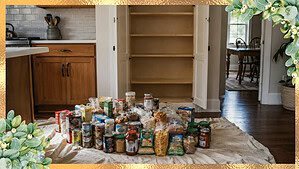
I started at nine in the morning with a cup of coffee and a clear kitchen floor. I had laid down an old bedsheet to keep things clean. Then, shelf by shelf, I took everything out of my pantry and put it on the sheet.
It took about twenty minutes just to empty it.
And when I was done, I stood back and felt my stomach drop.
Because the pile was enormous. I have a small pantry. I would have told you, before that morning, that it didn't hold very much. I was wrong. The pile on my kitchen floor looked like the after-photo of a small grocery store falling over. Cans, boxes, bags, jars, things I did not recognize and could not explain.
For about five minutes, I genuinely regretted the whole thing.
That was the low point. I sat down in a kitchen chair and looked at the mountain and thought, you have made your kitchen unusable and you did it to yourself on purpose.
But then something shifted.
Because I could see it all. Every single thing I owned, out in the open, nowhere to hide. And once I started sorting, the decisions came faster than they ever had shelf by shelf. Three open boxes of crackers became one. The mystery cans, the ones with no clear future, went into a donate box without much agonizing. The expired things, and there were many, went straight into the trash.
I worked for about two hours. I had to take two breaks to sit down. And a little after noon, I put the last jar back onto a clean, wiped-down shelf.
The pantry looked better than it had in years.
I had also, by then, formed some very strong opinions.
What the Chaos Method Got Right

I will give the method its due, because it earned it.
The biggest thing it got right is visibility. When everything you own is in one pile, you cannot lie to yourself anymore. Shelf by shelf, I had never once noticed that I owned three boxes of the same crackers. They lived on different shelves, and so in my mind they were different crackers. The pile told the truth.
The second thing it got right is speed of decision. There is something about seeing the whole mountain that makes you less precious about each item. When a can of soup is one of a hundred things on the floor, you don't hold it and reminisce. You decide, and you move on.
And the third thing, the one I didn't expect, is that it gave me a real ending.
My gentle methods never had a finish line. I would tidy part of a space, feel fine about it, and drift away. The pantry would be half-better for a month. The chaos method does not allow that. The mess made me finish, exactly as promised, because a person cannot live with a grocery store on her kitchen floor.
For the right person, in the right space, those three things are genuinely valuable. I want to be fair about that before I tell you the rest.
The Moment It Almost Went Wrong

Here is the part the videos do not show you.
About halfway through, around the ninety-minute mark, I felt my energy drop. Not a little. A lot. The kind of drop where your back stiffens and your hands slow down and you realize, with some alarm, that you are not as far along as you thought.
And there was a pile of my belongings covering my entire kitchen floor.
I want you to sit with that picture for a moment, because it is the whole point. If that energy drop had come an hour earlier, or if it had not lifted, I would have been in real trouble. I would have had a kitchen I could not cook in, a mess I could not finish, and no good way to put it all back quickly.
A younger person might shrug that off. They can come back to it after dinner. They can leave the pile overnight and finish Saturday.
I could not have done that. My husband and I needed the kitchen. My knees were already telling me the day had limits. The chaos method had handed me a deadline I had not fully agreed to, and for about fifteen minutes, it frightened me.
It worked out. My energy came back after a sit-down and a glass of water, and I finished. But I finished thinking about all the women my age who would not have, and who would have been left with a mess and a sinking feeling and a lesson nobody warned them about.
That moment is the reason for everything I'm about to say next. Because the reason we keep clutter is rarely a lack of urgency. Adding more pressure is not always the kindness it pretends to be.
Who I Think the Chaos Method Will Work For

After trying it, here is who I think will genuinely do well with the chaos method.
You will likely do well if you are a person who is motivated by mess. Some people see a pile and feel a strong, almost itchy need to make it right. If you are that kind of person, the chaos method turns your own wiring into a tool. The mess will drive you, and you will enjoy the drive.
You will likely do well if you have the energy and the time to finish in one sitting. This is not a method you can safely pause. If you can reliably give a job two or three unbroken hours, and your body will let you, you are a good candidate.
And you will likely do well if you are working in a small, contained space. A single pantry. One dresser. The bathroom cabinet. A space whose entire contents will fit into a pile you can actually finish.
If those three things describe you, the chaos method may be the most satisfying decluttering you have ever done. I mean that.
But please notice how specific that list is. Motivated by mess. Energy to finish. A small space. The method works beautifully inside those lines, and it gets risky outside them.
And Who I Think Should Skip It Entirely

Now the honest part.
I think you should skip the chaos method, or at least change it, if you are a person who feels panicked by mess rather than motivated by it. For some of us, a giant pile is not a helpful push. It is a wave of overwhelm that makes us freeze, or shut the door and walk away. If that is you, the method works against your wiring instead of with it. You know which kind of person you are.
I think you should skip it if your energy or your mobility is not something you can count on for a full job. If there is any real chance you will need to stop partway, you should not begin by putting everything you own on the floor. The pile does not care that your back went out. It just sits there and waits.
And I think you should be especially careful with this method if you struggle with strong attachment to your belongings, or if decluttering has ever felt genuinely painful rather than just hard. The chaos method speeds everything up, and speed is the last thing a tender heart needs. If letting go is already difficult for you, a slower and gentler path will treat you better than a mountain on the floor and a ticking clock.
None of that is a personal failing. It is just self-knowledge. The smartest thing you can do with any decluttering method is to be honest about whether it fits the person you actually are, not the person a video says you should be.
One Drawer, Not One Room: My Compromise

So here is where I landed.
I did not throw the chaos method out. I shrank it.
The next time I used it, I did not empty a whole pantry. I emptied one drawer. The next week, one shelf. The week after that, the cabinet under the bathroom sink, which is small enough that the pile was never frightening.
This is the version I would actually recommend to most women my age.
You keep everything that makes the chaos method good. You still empty the whole space. You still see all of it at once. You still get the honesty of the pile and the speed of the decisions and the real, satisfying ending. But the space is small enough that you can always, always finish, even if your energy drops, even if your back complains, even if the phone rings.
One drawer, not one room. That is the whole rule.
It is not as dramatic as the videos. There is no giant heap, no swelling music, no caption about your life changing. There is just a woman, an emptied drawer, twenty honest minutes, and a small space that works again. If you want a gentle on-ramp, the five-minute approach pairs well with this, and it has never once frightened me.
That is the chaos method I can recommend without worrying about you.
Where to Start (When You're Ready)

If reading this has made you want to try the gentler version, the hardest part is usually just choosing the first drawer.
That is where a little structure helps.
My free Declutter for Self Care Checklist walks you through your home one small space at a time. It does not ask you to dump your house on the floor. It asks gentler questions, in a gentler order, at a pace your body and your heart can actually keep.
It was made for women in their 60s and 70s who don't need more urgency. They just need a kind, clear next step.
Whenever you're ready. The checklist will be here.
Frequently Asked Questions
Is the chaos method good for beginners?
Not usually, at least not the full version.
If you are new to decluttering, starting by emptying an entire room or pantry onto the floor is a lot of pressure to put on yourself. A better beginning is the shrunken version: empty one drawer, sort it, finish it. You will learn the same lessons the chaos method teaches, the visibility and the quick decisions, without the risk of a mess you can't complete.
What's the difference between the chaos method and just making a mess?
The difference is that the chaos method is contained and intentional.
You choose one specific space. You empty only that space. And you do it when you have the time and energy to sort the pile all the way down to a finished, put-away result in one sitting. A mess is what happens by accident. The chaos method, done properly, is a mess you create on purpose, in one defined spot, with a clear plan to resolve it the same day.
How long does the chaos method take?
Less time than gentle methods, but more than the videos suggest.
My pantry took about three hours from the first item out to the last item back, including two breaks to sit down. A single drawer takes me about twenty minutes. The honest rule is this: never start a chaos-method job unless you are confident you have enough unbroken time, and enough energy, to finish it that day.
Is the chaos method safe if I have a lot of clutter?
This is where I would be most careful.
If you have a lot of clutter, emptying a whole space can produce a pile so large it becomes genuinely overwhelming, both to your body and to your spirit. For a heavily cluttered home, I would not use the full chaos method at all. I would use the one-drawer version, work in very small spaces, and give yourself the grace of a slow pace. A method should make your life feel more possible, not less.
Follow me elsewhere!