Black Friday Deal
My Declutter Binder 50% OFF

How Reverse Decluttering Helped Me Clear My Home Without the Guilt

I used to stand in my kitchen staring at the junk drawer, pull out three things, put two back, and close it again.

Every decluttering article I read said the same thing. Take everything out. Make piles. Decide what to toss. Be ruthless.

But every time I tried, I got stuck on a takeout menu from a restaurant I liked (we might go back), a rubber band ball my daughter made in third grade (she's 32 now), and a packet of soy sauce from 2019.

The method wasn't the problem. I was doing exactly what I was supposed to do. I just couldn't get myself to let go of anything.

Then I tried something different. Instead of asking what I needed to get rid of, I asked what I wanted to keep.

That one shift changed everything.

It's called reverse decluttering, and it's the only method that ever worked for me.

Not because it's some brilliant new system. It works because it stops making me feel like I'm doing something wrong every time I can't throw something away.

Traditional decluttering puts you on trial for everything you own. You have to defend each item, explain why you're keeping it, justify the space it takes up.

Reverse decluttering does the opposite. It starts with what you already know you love and actually use. 

Then it deals with the rest.

I'm not talking about a massive overhaul where you empty your entire house into the driveway. I'm talking about one drawer. One shelf. One category at a time.

And for the first time in years, I actually made progress.

What Reverse Decluttering Actually Is

A woman decluttering her clothes on top of her bed

Here's what reverse decluttering is in the simplest terms I can give you.

Most decluttering methods ask you to look at everything you own and decide what to get rid of. You stand there holding a sweater you haven't worn in two years, and you have to make a case for why it needs to leave.

Reverse decluttering flips that completely. You start by pulling out only the things you know you use and love. The stuff you reach for all the time. The items that actually make your life easier or better.

Once you've set those aside, you look at what's left. And suddenly, it's so much easier to see what doesn't belong.

The whole process shifts from loss to clarity. You're not mourning what you're giving up. You're protecting what you want to keep.

It sounds like a small difference, but it changes how the whole thing feels. Instead of defending every item in your house, you're just identifying your favorites. That's it.

You're not trying to become a minimalist or live out of a suitcase. You're just figuring out what actually serves your life right now (not the life you had five years ago or the one you think you should be living).

And you're doing it in a way that doesn't make you feel terrible about yourself every step of the way.

You're absolutely right. Let me add that:

What Makes Reverse Decluttering Different

Here's what I figured out after years of trying every decluttering method I could find and failing at all of them.

Reverse decluttering works because it changes the entire emotional setup. It's not about what you're doing wrong or what you need to fix. It's about recognizing what's already working and building from there.

1. It cuts through decision fatigue before it even starts

Traditional decluttering makes you decide about every single thing you own. Should I keep this? Do I need it? When did I last use it? What if I need it later?

By the time you get through one drawer, your brain is exhausted.

Reverse decluttering lets you skip most of those decisions. You only make choices about the things you already know you want. The coffee mug you use every morning. The spatula that fits your hand perfectly. The sweater you grab every time the temperature drops below 60.

Read related post:   What to Do with Old Photos and Portraits

You're not deliberating. You're just recognizing what's already true.

The rest of it? You deal with that later, and by then it's so much easier because you're not starting from scratch every time.

2. It avoids the guilt that usually stops you cold

I spent $80 on a waffle maker six years ago. Used it twice. Every time I opened that cabinet, I saw it sitting there, and I felt like a failure.

I couldn't get rid of it because that would mean admitting I wasted the money. So it stayed. Taking up space. Making me feel bad every single time I reached past it for something I actually used.

Reverse decluttering doesn't make you confront the waffle maker first. It lets you pull out the things that work. The skillet you use three times a week. The mixing bowls that actually fit in your cabinet.

By the time you circle back to the waffle maker, you've already built momentum. And it's easier to let go because you're not leading with guilt.

3. It helps you see what actually serves your life right now

A woman holding a cup while sitting on the floor

I used to keep clothes that fit me 20 pounds ago. Craft supplies for hobbies I hadn't touched in five years. Books I thought I should read but never opened.

I was decluttering for the person I used to be or the person I thought I should become. Not the person I actually am.

Reverse decluttering makes you focus on your real life. The one you're living today (not the one you're planning to start next month).

When you pull out only the things you genuinely use, you stop pretending. You stop keeping the bread machine because someday you might bake. You keep the toaster because you use it every morning.

It's honest in a way that feels like relief.

4. It puts you in control instead of making you feel attacked

Traditional decluttering feels like an audit. Someone's going through your stuff, pointing at things, asking why you still have them.

Even when that someone is you.

Reverse decluttering feels different. You get to choose what stays. You're not defending yourself. You're curating.

That shift matters more than it sounds like it should. When you feel in control, you make better decisions. When you feel judged, you shut down and keep everything just to prove you're not the problem.

I kept a set of placemats for 12 years because someone gave them to me and I felt bad donating a gift. The guilt kept them in my linen closet long after I stopped using them.

Reverse decluttering let me keep the cloth napkins I actually loved and quietly let go of the placemats without making it a whole thing.

5. It's faster because you're not agonizing over every item

A woman putting her things in a basket

When you have to decide about everything, you get stuck. You pick up a vase, put it down, pick it up again, and 20 minutes later it's still sitting on the counter and you haven't made any progress.

Reverse decluttering moves faster because you start with the easy stuff. You know what you use. You know what you love. You pull those things out and you're already halfway done.

The hard decisions come later, but by then you've got momentum. And most of the time, the things you thought would be hard to let go of turn out to be easier than you expected.

Because once you see what you actually kept, the rest of it doesn't feel as important anymore.

How to Use Reverse Decluttering in Your Own Home

I'm going to walk you through exactly how I do this. It's not complicated, but there are a few things that make it work better.

1. Start small (and I mean really small)

Do not empty your entire closet onto your bed. Do not pull everything out of your kitchen cabinets. Do not decide you're going to tackle the whole garage in one afternoon.

Start with one drawer. One shelf. One category like coffee mugs or winter scarves.

The first time I tried this method, I picked the messiest drawer in my kitchen because I figured if it worked there, it would work anywhere. I started with the drawer next to my stove. The one with all the spatulas and wooden spoons and that weird garlic press I got as a wedding gift.

It took me 15 minutes. And when I was done, I felt like I'd actually accomplished something instead of just making a bigger mess.

Small wins build momentum. And momentum is what keeps you going when the process starts to feel hard.

2. Pull out only what you know you use and love

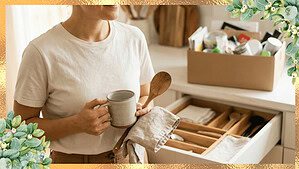
A lady decluttering her kitchen drawer

This is the part that feels backwards at first, but it's the whole point.

Don't touch anything you're not sure about. Don't pick up the serving platter you inherited from your grandmother and try to decide if you should keep it. Leave it right where it is.

Read related post:   My Guide To Decluttering (Room-To-Room Cleaning Strategies)

Only take out the things you reach for all the time. The ones you don't have to think about.

When I did my utensil drawer, I pulled out two wooden spoons, one silicone spatula, a pair of tongs, and the can opener. That's it.

Everything else stayed in the drawer.

It felt weird leaving so much behind. But that's the point. You'll deal with it in the next step.

3. Look at what's left with fresh eyes

Now you take a real look at everything that's still sitting there.

This is where reverse decluttering gets interesting. Because once you've removed the things you actually use, what's left is so much easier to see clearly.

When I looked back at that drawer after pulling out my everyday items, it was like seeing it for the first time. I had three more spatulas I never touched. A pizza cutter I used maybe twice a year. Four measuring spoons (I only kept one set). A meat thermometer that didn't work anymore.

None of it was terrible. None of it was broken (except the thermometer). But none of it was earning its place in my drawer either.

And suddenly, it was obvious what needed to go.

4. Make decisions about the remainder

A woman sorting her kitchen stuff

Go through what's left and sort it into three groups.

Things you actually do use, just not as often. Those go back in the drawer (or wherever they live).

Things you don't use but have a legitimate reason to keep. Maybe it's a special occasion item or something expensive that would be hard to replace. Find a different spot for it. Somewhere out of your daily space.

Everything else goes. Donate it, toss it, give it to someone who'll actually use it.

This part went faster than I expected because I wasn't fighting with myself over every item. I kept the pizza cutter because we do use it a few times a year and I didn't want to buy another one. I moved it to a different drawer with other occasional-use items.

The three extra spatulas went to Goodwill. The broken thermometer went in the trash.

5. Put your keepers back with intention

This is the part most people skip, and it's a mistake.

Don't just toss everything back in the drawer the way it was before. Put it back neatly. Give each item a spot.

It doesn't have to be perfect. You don't need fancy drawer organizers or a label maker. Just put things where they make sense.

Once I'd cleared out what I didn't need, I had so much more room to actually organize what was left. I put my two wooden spoons in the front left corner. Spatula next to them. Tongs in the back. Can opener in the front right.

Now when I open that drawer, I can see everything. I can find what I need in two seconds. And I'm not digging past a bunch of junk I never use.

That's the whole method. Start small. Pull out the keepers. Look at what's left. Decide about the rest. Put things back with intention.

Do it one drawer at a time, one shelf at a time, and eventually you'll get through the whole house without ever feeling like you're drowning in your own stuff.

Where Reverse Decluttering Works Best

Reverse decluttering works just about anywhere, but there are a few spots where it makes the biggest difference.

These are the places where you tend to accumulate duplicates, guilt purchases, and things you thought you needed but never actually use.

Kitchen (multiples, duplicates, gadgets you thought you needed)

Kitchen utensils drawer organizer

This is where I saw the most dramatic change.

I had six wooden spoons. Three spatulas. Two sets of measuring cups. A drawer full of gadgets I bought because a recipe called for them once.

Most kitchens are like this.

You end up with multiples because you can't find the one you know you have, so you buy another. Or someone gives you a set of something and you keep it even though you already had one that worked fine.

Reverse decluttering cuts through all of that fast.

Pull out the skillet you actually use. The one good knife. The mixing bowl that's the right size for everything. Your favorite coffee mug (not all 12 of them).

Once you've set those aside, look at what's left. How many serving platters do you really need when you only host Thanksgiving once a year? How many coffee mugs can you actually use when there are only two people in your house?

I kept one wooden spoon. One spatula. One set of measuring cups. And my kitchen instantly felt easier to work in.

Closet (clothes you actually wear vs. aspirational purchases)

This is the hardest area for most people, but reverse decluttering makes it bearable.

I used to keep clothes I hadn't worn in three years because I thought I might fit into them again someday. Or because I spent good money on them. Or because I liked the idea of being the kind of person who wore that style.

But when I pulled out only the clothes I actually reached for, the truth was impossible to ignore.

I had about 15 items I wore on repeat. Everything else was just taking up space and making me feel bad every time I opened the closet.

Read related post:   How to Minimize Clutter In Your Home

You don't have to get rid of everything. Just pull out what you actually wear. The jeans that fit. The sweater you grab every week. The dress you feel good in.

Then look at what's left and decide if any of it is worth keeping.

Most of the time, it's not.

Bathroom (products you reach for vs. bottles you walk past)

Cluttered bathroom drawer

I had 11 half-empty bottles of lotion under my bathroom sink.

Eleven.

Some of them were gifts. Some of them smelled nice but felt too greasy. Some of them I bought on sale and never opened.

When I did reverse decluttering in my bathroom, I pulled out the face wash I use every night, the lotion I actually like, the one lipstick I wear, and my mascara.

Everything else stayed on the shelf.

And when I looked at what was left, I realized I'd been holding onto products I didn't even like. Shampoo that made my hair frizzy. Moisturizer that broke me out. Lipstick colors that didn't look good on me but seemed too expensive to throw away.

I got rid of all of it. And now when I open my bathroom cabinet, I can actually see what I have.

Sentimental items (identifying what truly matters vs. guilt-keeping)

This is where reverse decluttering saved me the most emotional energy.

I had a box of stuff from my kids' childhood. Art projects. Report cards. Every single birthday card they'd ever received.

I couldn't even look at it without feeling overwhelmed.

But when I asked myself what I'd actually want to keep if I could only choose a few things, the answer was clear.

The handprint art from preschool. The Mother's Day card my daughter made in second grade. The photo of my son on his first day of kindergarten.

Those were the things that mattered. The rest was just paper taking up space in my closet.

I kept what I loved. I took pictures of a few other things. And I let the rest go without feeling like a terrible mother.

Reverse decluttering lets you honor what‘s truly important without drowning in guilt over everything else.

The Real Point Isn't Getting Rid of More Stuff

I used to think the goal of decluttering was to own as little as possible. To get my house down to some perfect minimalist standard where everything had a place and nothing was unnecessary.

That's not what this is about.

Reverse decluttering isn't about forcing yourself to live with less. It's about making room for what actually works in your life right now.

It's about opening a drawer and being able to find what you need without digging through five things you never use. It's about looking in your closet and seeing clothes you actually want to wear instead of feeling guilty about everything hanging there.

It's about clearing out the mental clutter that comes from being surrounded by stuff that doesn't serve you anymore.

You don't have to do your whole house in one weekend. You don't have to get rid of half of what you own. You don't have to become a different person.

You just have to start with one small space and ask yourself what you actually want to keep.

The rest will take care of itself.

And when you're done, your home won't feel empty. It'll just feel easier. Like you can finally breathe without tripping over your own stuff.

That's what reverse decluttering did for me. And that's all it needs to do for you.

Ready to Figure Out What Actually Deserves Space in Your Home?

If reverse decluttering showed you anything, it's that you don't need a massive overhaul to make real progress. You just need to know where to start and what to focus on.

That's exactly what my free Declutter for Self Care Checklist does. It walks you through the spaces that make the biggest difference in how your home feels, so you're not wasting time on areas that don't matter or second-guessing every decision you make.

Grab your free checklist here and start with the one area that'll give you the most relief.

FAQ

What's the difference between reverse decluttering and regular decluttering?

Regular decluttering asks you to look at everything you own and decide what to get rid of. Reverse decluttering flips that. You start by pulling out only the things you know you use and love, then you deal with what's left. It's faster, less overwhelming, and sidesteps a lot of the guilt and decision fatigue that usually stops people from making progress.

How long does reverse decluttering take?

It depends on the space, but most drawers or shelves take 15 to 20 minutes. A closet might take an hour. The key is to work in small chunks instead of trying to tackle your whole house at once. One drawer today, another shelf tomorrow. You'll make more progress that way than if you set aside a whole weekend and burn out halfway through.

What should I do with the items I don't keep?

Donate what's still in good condition. Toss what's broken or worn out. If something has value but you don't use it, consider selling it or giving it to someone who will actually appreciate it. Don't let the leftovers sit in a box by the door for six months. Get them out of your house as soon as you can so you don't start second-guessing your decisions.

Does reverse decluttering work for sentimental items?

Yes, and it's actually one of the best methods for sentimental clutter. Instead of trying to decide what to get rid of, you ask yourself what you'd truly want to keep if you could only choose a few things. That makes it so much easier to see what really matters. You can let go of the guilt-keeps without feeling like you're erasing memories.

Where should I start with reverse decluttering?

Start with the space that bothers you most or the one that's easiest to finish quickly. A junk drawer, a bathroom cabinet, or a single shelf in your closet. Pick something small enough that you can complete it in one sitting. That first win will give you the momentum to keep going.

Follow us on PinterestFollow
Follow me elsewhere!

Leave a Comment